

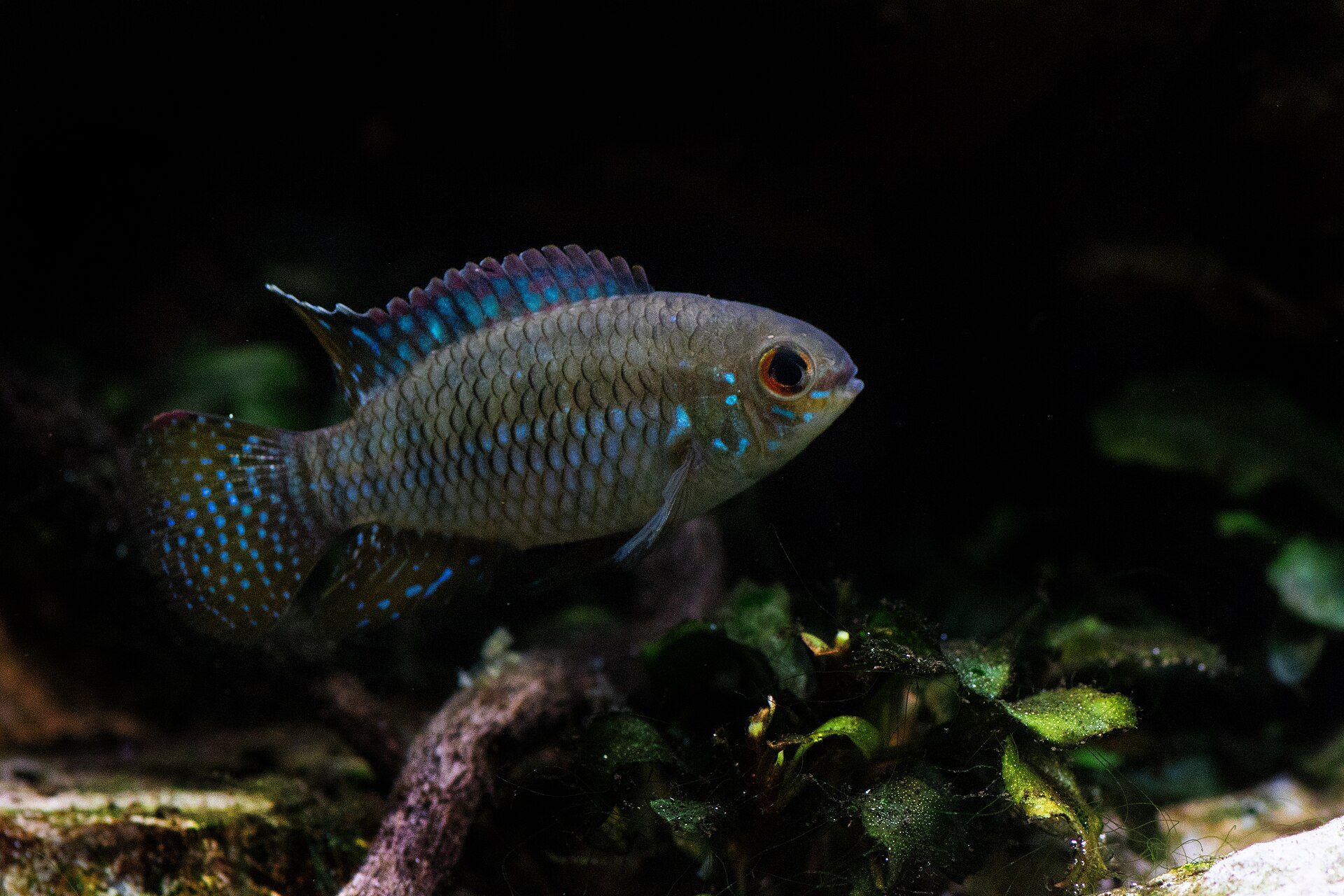
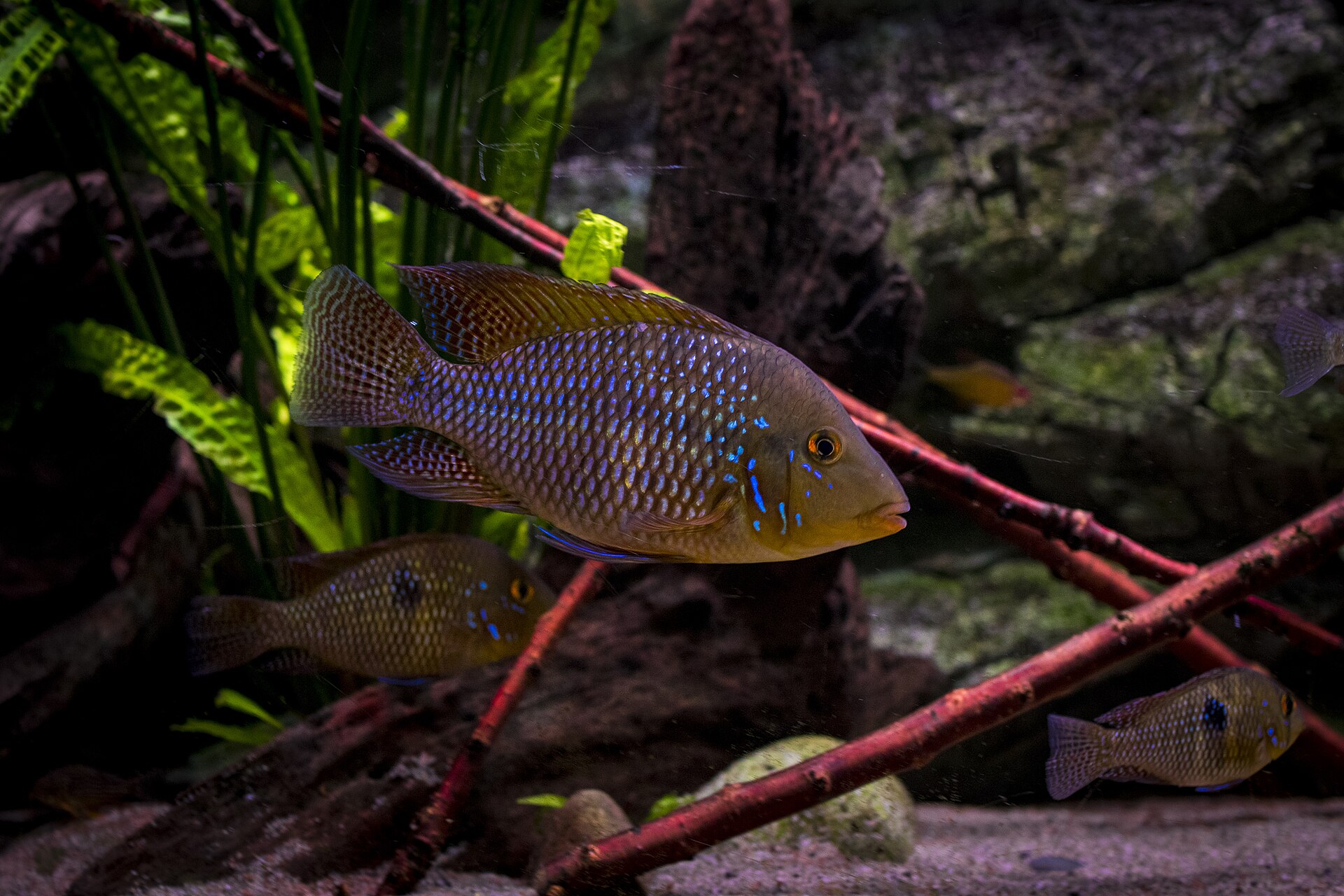
The flag acara is the dwarf people recommend when someone wanted a cichlid that would not eat the community and would not demand Rio Negro laboratory water. Laetacara curviceps is a 6–8 cm Amazon fish, rounder than a Dicrossus, milder than a steindachneri male, planted-tank native in habit. A pair holds a small territory, flashes colour in the dorsal (the “flag”), and tends eggs on a leaf or stone. It is a Laetacara, not an Apistogramma, not an Anomalochromis, not a ram — though the tank you build looks more like a ram tank than like a Julie tank or a Geophagus river.
They are still cichlids. When they spawn, the flag goes up and the tetras get herded. That is not the same as a pearl cichlid owning a third of 300 litres. It is also not a fish you throw in with mbuna because it is “African-looking.” It is South American, soft-water, vegetated.
Vegetated Amazon, not blackwater at the edge of possibility
Amazon basin, in vegetated, typically soft water — plants, wood, leaf bits, sand, modest flow. pH 5.5–7.5, temperature 24–28°C. They do not require pH 4.5 like Dicrossus, which is why they are a better first dwarf for many people. They still dislike rift-lake salts and hard, alkaline boxes. They use plants as cover and as spawn sites more than they use a cave as an identity. Leaf litter is welcome; a 10 cm sand bed for sifting is unnecessary.
The habitat is a planted creek edge, not a sand beach of shells, not a rock wall of nigripinnis, not a coastal Brazilian lagoon of pearl cichlids.
A round dwarf with a dorsal flag
Body is compact, acara-shaped in miniature. Colour is a mix of beige, blue spangles, and red-gold in the fins when a pair is displaying; the dorsal can show a banner of colour that explains the common name. They do not wear a checkerboard grid. They do not wear a panda mask. They do not grow a Uaru ocellus. Males may be slightly larger; pairs are the unit, not a harem of four females in coconut shells (they may use a cave, they do not require the apisto harem model).
Compared with African butterfly cichlids, the continents differ and the look is more South American spangle than West African blotch, but the pair-on-plants behaviour is a cousin idea. Compared with rams, flag acaras are often a little more forgiving and a little less neon.
Eighty litres of plants they will not destroy
A pair is comfortable in 80 litres. Fine sand, real plants, wood, gentle filter, a few flat stones or broad leaves. They will not plough like altifrons. They will not graze the tank bare like Uaru. They may nibble and they will defend a nest, but a planted scape can survive. This is the anti-Geophagus dwarf tank. It is also the anti-Tanganyika tank: no shells required, no slate maze required.
A species pair in a planted community of appropriate tetras is the usual success. A male dumped into a 40 litre with no partner and no plants is the usual failure.
Soft to moderate, planted, stable
Temperature 24–28°C. pH 5.5–7.5. Soft to moderately soft. They are not a license to skip cycling. They appreciate botanicals but do not demand Dicrossus extremes. Chemistry, cycling, and a planted tank primer are the three supporting documents. Rift salts are still wrong.

Nitrate in a planted 80 litres is easier than in a 350 litre sifter tank, which does not mean you never change water.
Omnivore of the planty middle-bottom
Flakes, micro pellets, frozen brine and daphnia, some vegetable matter in foods. They will take food from the sand and midwater. They will not need a zucchini regimen. They will not need powdered Boraras dust as a staple (though fry will). Feed the pair; when they spawn, feed more small foods for fry if you are leaving them in.
Community until the eggs appear
Good: small to medium tetras that like similar water, Corydoras on sand, maybe a peaceful gourami in a larger tank. Possible: shrimp until spawning. Bad: other cichlids that want the same leaf, large sifters, Tanganyika fish, greater scissortails. Tiny Boraras may be eaten or at least harassed when the pair has fry.
They are among the better “community cichlids” in this batch. That sentence would be a lie about compressiceps, pearls, and moorii.
Eggs on a leaf, two small flags on duty
Open spawners on a leaf, stone, or wood. Both parents tend, more like a ram or Anomalochromis than like a female-only apisto cave. Fry school in the plants. You can raise them in the display if tankmates are gentle and you feed baby food. You will not get mouthbrooding. You will not get a shell full of faces. If the pair eats the spawn, they may be young, underfed, or interrupted.
Let a pair form from juveniles rather than forcing two random adults if you can. Rehome extra fish. Two males is torn fins; a pair is the flag display you wanted.
Faded flags and mystery hiding
Faded colour: water, diet, or no pair bond. Hiding: spawning, or a bully you thought was peaceful. Ich on new fish: quarantine in planted soft water. They are small enough to lose to a parameter swing that a pearl would ignore.
If you wanted a harder blackwater grid, Dicrossus. If you wanted caves and a harem, an apisto. If you wanted West African plants and a pair, Anomalochromis. If you wanted sand giants, you wanted Geophagus, and you wanted a different room in the house. The flag acara is the planted Amazon pair that actually fits the word gentle — until the eggs stick to the leaf.
The flag as a mood ring you can actually use
When the dorsal colour comes up and the pair stands over a leaf, you are seeing spawning, not a new disease. Reduce traffic. Feed baby food if you want survivors. When the flag is down and the fish hide, test water before you add a cave you copied from an apisto article. They may use a cave; they do not need you to rebuild the tank into a harem system. The planted pair is the design. Let the plants be the architecture, and let the flag tell you whether the architecture is working.
Explore other topics
Dive into more aquarium guides across the site.