

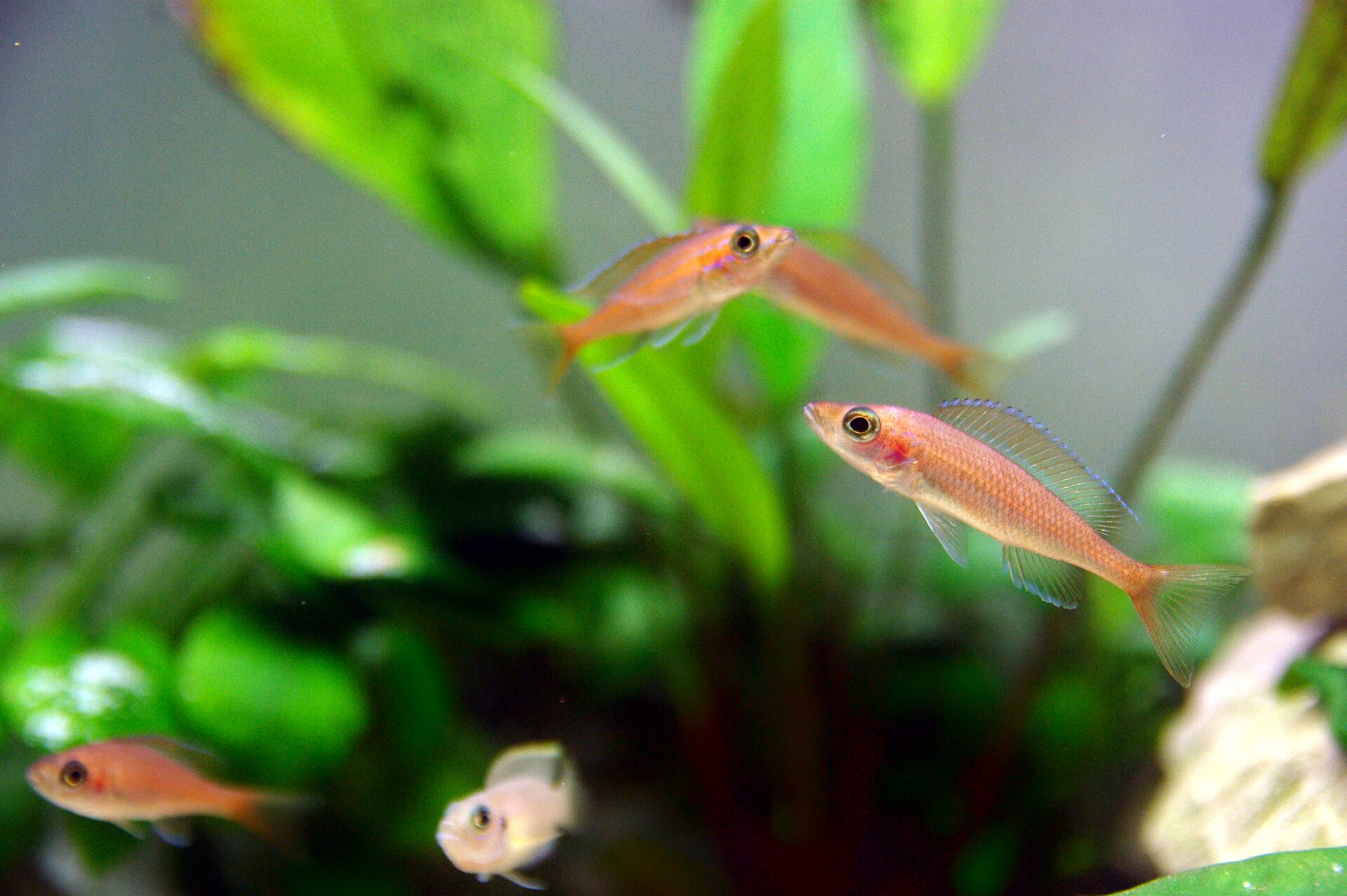
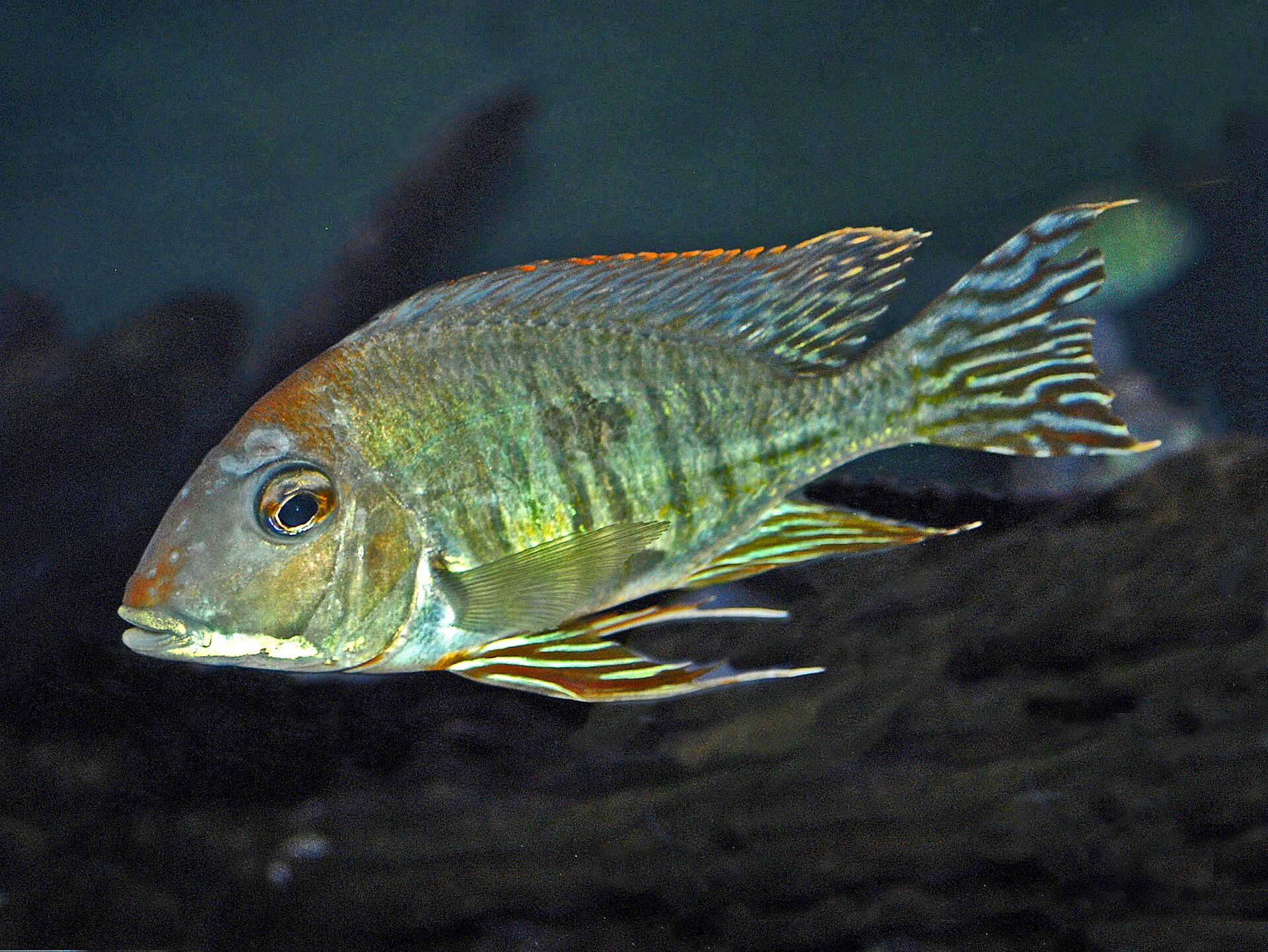
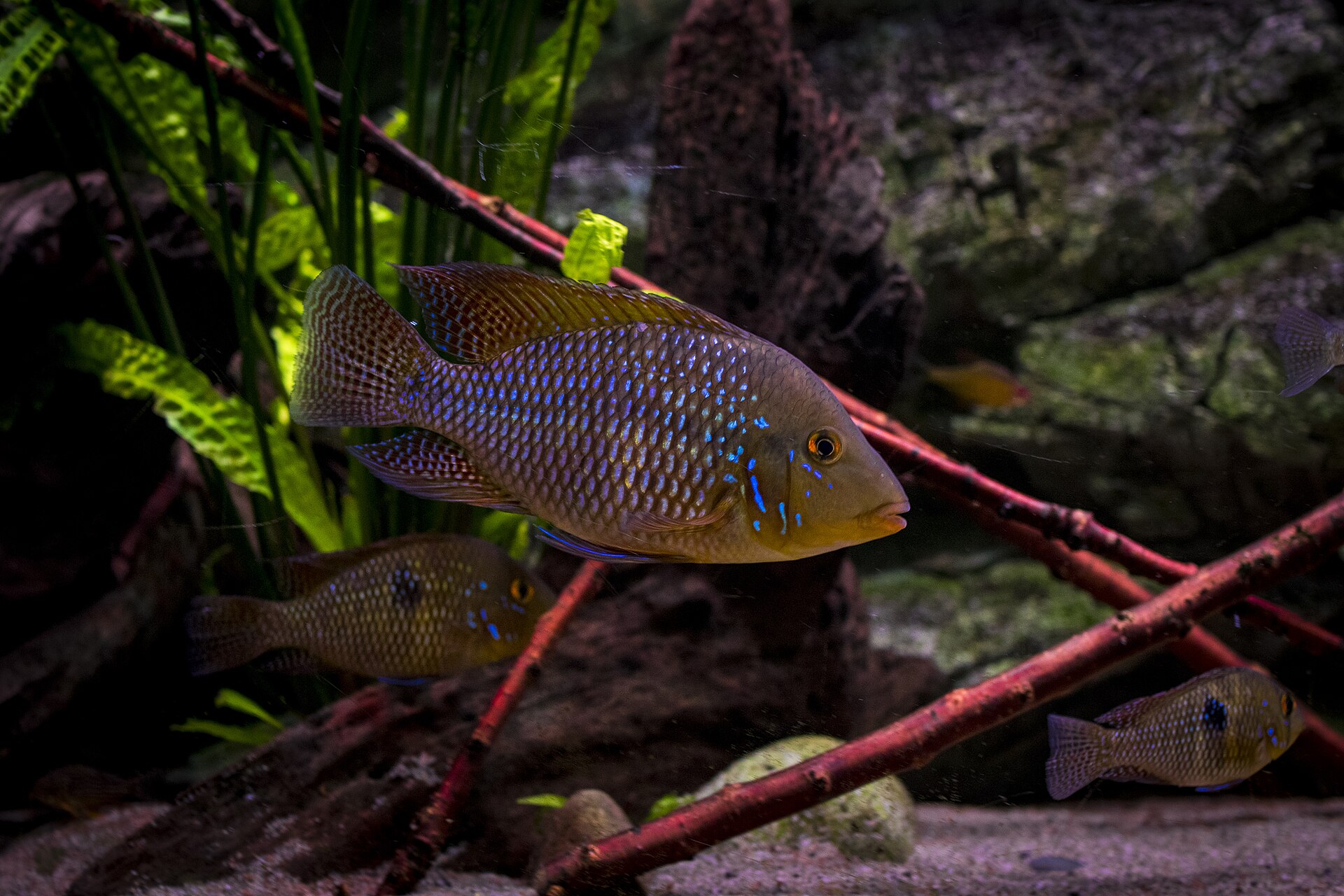
Blue neon is a trade nickname for Paracyprichromis nigripinnis, a slender Tanganyika cichlid that lives in the water column along steep rock walls. Males in a proper group show a blue that looks almost lit from inside; females and subordinate males stay plainer. Adults 8–10 cm. They are maternal mouthbrooders (the female carries), they school or shoal in three dimensions, and they need height plus length. They do not occupy shells. They do not wedge into Julie slits as a lifestyle. They do not want a 60 litre planted cube with harlequins.
True Cyprichromis leptosoma is a related open-water idea with its own shape and breeding quirks. Nigripinnis is the “blue neon” Paracyprichromis: darker fins, a habit of hugging the wall more than some Cyprichromis, still a midwater fish.
The cliff face, not the beach, not the swamp
Native to rocky walls in Lake Tanganyika. The fish hang in open water next to structure, moving up and down more than a river rasbora moves along a horizontal commute. Depth in the tank (height) is useful. The water is hard, alkaline, oxygenated, 24–27°C. There is no leaf litter. There is no peat. Shells on the sand below are irrelevant to them except as something other species might own.
If you build only a low cave pile and no swimming volume, they look like stressed sardines. If you build a planted Amazon, they look like dying sardines in the wrong pH.
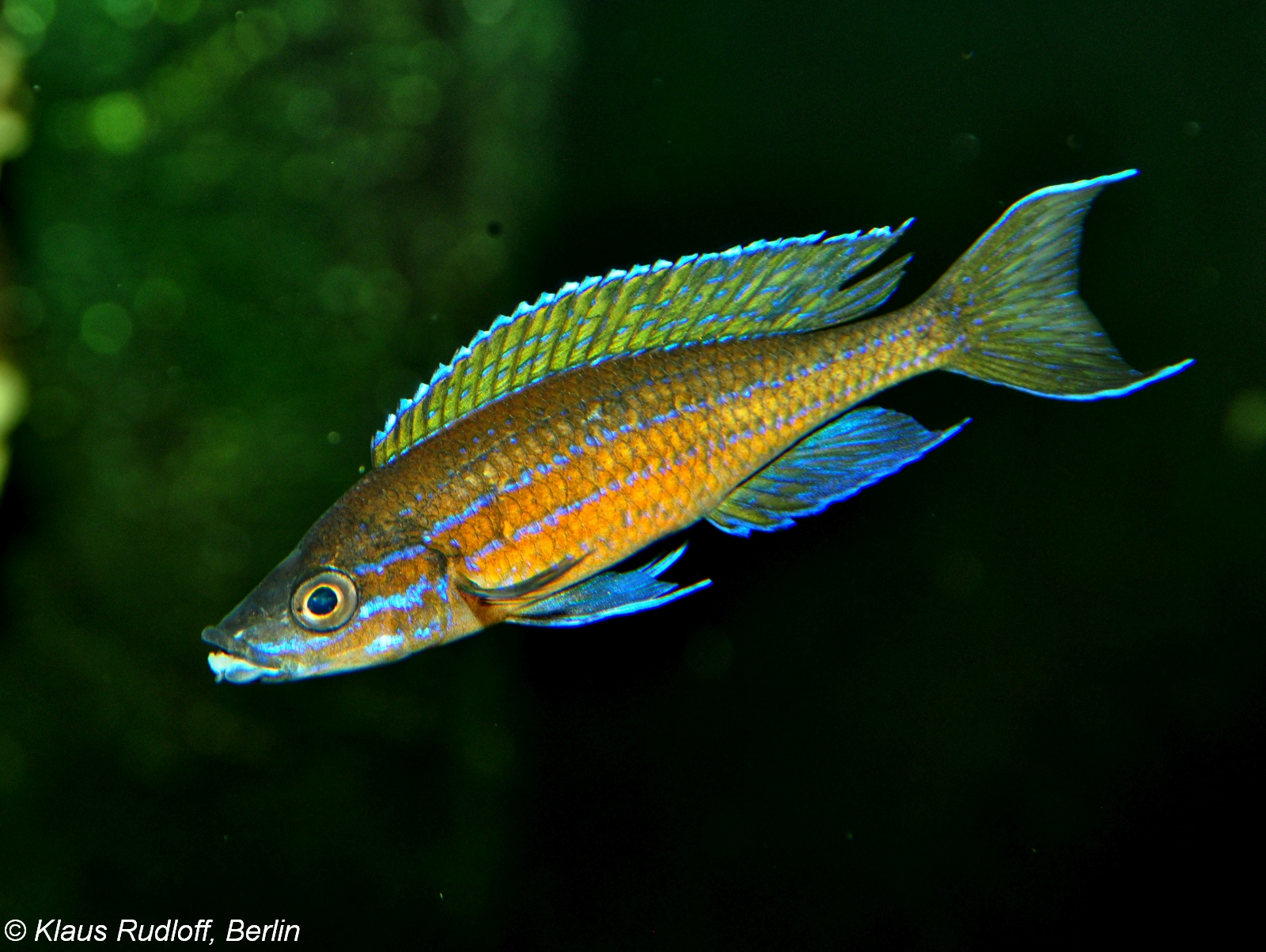
Neon that only exists in a crowd
A single male in a shop tank is a rumour of the colour. A group of ten or more, with several males, is the display: blue on the body, dark on the fins, a hovering, slightly head-down or wall-parallel posture that is not a disease. Females are silvery to brownish and should outnumber or at least match males if you want less harassment. This is not a pair-in-a-cave species. Removing the school “to reduce bioload” removes the behaviour you bought.
Do not confuse the blue with a neon tetra. Neon tetras are tiny Amazon characins in soft water. The shared word “neon” is marketing. Chemistry and ecology are opposites.
Two hundred litres, long and tall
Hang them in 200 litres with both length and height. A long low tank is better than a cube, a tall tank with a rock wall and open water is the dream. Rock along the back as a visual reef; open water in front for the school. Sand on the bottom. No need for a shell surplus. Plants are generally skipped; if you try hard-water plants, keep them out of the swimming lane.
Filtration and surface movement for oxygen: these fish are pelagic in habit and will show distress in warm, still water. Lid is wise; they can jump when panicked, though they are not greater scissortails. Do not use a nano sponge filter as the only life support for a 200 litre school.
Alkaline water with oxygen as a parameter
Temperature 24–27°C. pH 7.8–9.0. High hardness. They are as serious about minerals as a shell-dweller and as serious about swimming volume as a large rasbora — a combination that fools people into using the wrong article. Cycle fully. A school of 10 cm cichlids is not a nano bioload. Chemistry, cycling.
Never mix into a Dicrossus blackwater tank. Never mix into a clown rasbora swamp.

Tiny foods in open water
They pick plankton-like foods in the column. Micro pellets, frozen cyclops, daphnia, baby brine, finely crushed flakes. Heavy sinking wafers for plecos will sit on the sand while the school starves in midwater. Feed small amounts several times if you can; they have a small stomach and a high activity level. Males colour up when well fed and unrivalled by a single despot in too small a group.
They are not sand-sifters. They are not algae-grazing moorii (though they may pick at particles). They are not snail-crushing compressiceps.
Who can live under the school
Best companions are other Tanganyika fish that use the bottom and rock without eating the nigripinnis: some shell-dwellers in a large tank, some rock dwellers that stay low. Risky: anything that hunts midwater, including compressiceps. Wrong: tetras, rasboras, apistos, Corydoras, discus, Uaru.
A species-only school in a tall tank is the cleanest husbandry. If you add shell-dwellers, you are building a lake cross-section, not a community list from a shop poster.
She carries the brood
Mouthbrooding: the female holds eggs and fry in her mouth. You may see a distended buccal cavity and a female that eats less. Do not chase her with a net unless you intend to strip (advanced, stressful). Provide calm, the school as cover, and rock. Males display in the column; they do not decorate a shell. This is the opposite of ocellatus breeding and the opposite of a Julie cave spawn.
Raising fry may mean isolating a holding female or letting some fry release into a densely structured tank. They are not egg-scatterers like rasboras. Do not add an egg-tumble filter and wait.
Faded blue, hanging at the surface, missing females
Faded blue: group too small, water too soft, or males too few/too many. Surface hanging: oxygen, temperature, or transport stress. Missing females: male harassment in a short tank. Quarantine a group together if possible; a single fish in a box does not behave enough to judge health. Watch them eat in midwater. Ich on imports is common; treat in mineral water, not in a peat hospital.
Sister open-water article on this site: Cyprichromis leptosoma. Bottom-dwelling contrast: L. ocellatus. Rock-slit contrast: J. ornatus. That is the Tanganyika set: wall water, sand shells, and rock slits — three habitats, none of them a planted tetra community.
Males, ratios, and the blue that dies in a short tank
A 4-male, 2-female group in a short tank is a harassment machine. Aim for more females than males, or a large enough volume that beaten males can hold a different height along the wall. The blue neon look is a social colour. It is not a paint you buy in a single show male. If one male owns the entire column, the others look like dull sardines and the females look tired. Add height. Add numbers. Then the blue comes back without a new bottle of colour food.
Explore other topics
Dive into more aquarium guides across the site.