

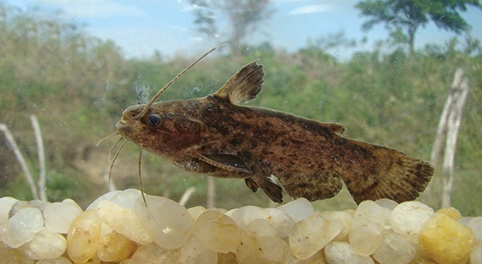
The driftwood catfish Trachelyopterus galeatus looks like a piece of wet bark that decided to swim at night. It is an auchenipterid, a driftwood catfish in the true family sense: a compressed, mottled, nocturnal fish that hides in hollow logs, fertilises internally, and comes out after dark to take insects and small prey. Adults commonly reach about 18–22 cm. That is a medium wood-cavity specialist, not a 4 cm oto, not a xylophagous panaque (it hides in wood; it does not eat the log as cellulose), and not a metre-class shovelnose. The hobby error is to see “catfish” and “wood” and paste pleco advice. This fish does not rasp. It lurks.
Snags of the lowland Neotropics
T. galeatus is widespread in South American lowlands — Amazon, Orinoco, Paraná-Paraguay systems and more — wherever there are still waters and slow channels with submerged timber. By day it packs into cracks. By night it prowls the woodpile and the adjacent sand. The family Auchenipteridae is full of these internally fertilising, often nocturnal fishes; this species is one of the more regularly exported “woodcats.”
Habitat is tropical, structured, and dim. It is not a hillstream. It is not an estuary. It is not a Yangtze. Fallen trees are the architecture. An aquarium that is all open sand and bright light produces a permanently terrified, invisible animal.
Seasonal floods expand the woodpile. In the tank you must provide extra hollows so several fish are not jammed in one pipe injuring each other.
Bark camouflage and a unique family anatomy
Colour is brown, grey, and cream mottling that reads as rotting wood. The body is deeper and more compressed than a flat pleco. The dorsal fin is short and sharp. Eyes are small. The mouth is terminal to slightly inferior, for grabbing, not rasping. There are no sucker lips. There are no bee stripes of Microglanis, though both hide in the dark.
Auchenipterids are famous among catfish keepers for internal fertilisation: males have a modified anal fin, females can store sperm. That is nothing like a bristlenose cave clutch you watch on the ceiling, and nothing like a hoplo bubble raft. It is a reason not to copy-paste “breeding mode: cave spawner” from a template.
Healthy driftwood cats are solid, with intact fins and a habit of backing into a hole. Scraped sides mean they were packed or netted badly. They recover in a quiet wood maze with meaty food at night.
Hollow logs, not cobble riffles
A tank around 120 litres can hold a small group if you offer multiple true cavities — wide tubes, hollow wood, stacked slate with dark interiors. Soft sand. Dim lighting, floating plants, a moon-light if you want to watch them. Moderate filtration, no torrent. A lid, because night panic is a jumper story.
They will rest in contact with each other in a favourite log. That can be normal. Bleeding is not. Add more hollows before you add more fish.
Do not fill the tank with sharp plastic plants. They crash at night. Smooth wood is the scape.
Warm, still-ish, tannin-friendly
Temperature 24–28 °C, pH 6.0–7.5, softness welcome but not mandatory if stable. Botanicals that stain the water suit the mood of a snag. Ammonia must be zero; a fish that lives in a hole lives next to its waste if you overfeed in the log.
They are freshwater. No salt. No cool-water goldfish climate. Water changes at night-matched temperature keep a leafy tank honest.

Night prey, not wafers
Feed after lights-out: sinking carnivore pellets, frozen insects, chopped prawn, earthworm pieces. They are opportunistic carnivore-omnivores of the night shift. They may take a wafer if it falls in the hole; that is not a diet. They do not graze algae. They do not gouge lignin for calories.
If tetras eat everything at dusk, the driftwood cat starves in its log. Target-feed the cavity. Confirm with a dim torch.
Small tank mates of fry size will be eaten. That is the mouth, not malice.
A quiet woodpile community
Good neighbours are similar-sized, non-boisterous fish that share tropical, dim water and leave the logs alone by day. Large cichlids that redecorate will evict them. Giant pimelodids will eat them. Plecos may occupy the same hollow; pick who the log belongs to. Midwater characins that stay up top can work in a spacious tank.
They can be kept in a small group. They are not a pelagic school like Auchenipterus nuchalis; they are cavity packers. Different auchenipterid, different posture.
Quarantine with a tube and night feeding. A bright bare box is cruel for this species.
Internal fertilisation, external mystery
Males inseminate females; eggs may be laid later in vegetation or among wood, depending on the species and the account. Home breeding of T. galeatus is not a standard community event. Do not buy them as a bubble-nest project or a bristlenose project. Enjoy the nocturnal woodcat. If you get fry, you have beaten the odds and you will need to separate them from adult mouths.
Why internal fertilisation changes the breeding lecture
A male driftwood catfish does not need you to watch him fan a cave ceiling. He needs a female, cover, and the family’s odd reproductive anatomy. Eggs, if they appear, may be deposited later in plants or crevices without a public nest you can photograph for social media. That is why copying a bristlenose spawning guide onto this species is noise. If you want a nest you can see, keep a hoplo. If you want a bark-coloured night hunter in a hollow log, keep T. galeatus and stop expecting a show.
When you add new wood, make sure it is hollow or that you add a tube. Solid branches are scenery. This fish’s address is the cavity.
Wood as a house, not a meal
Trachelyopterus galeatus is a driftwood catfish in the family sense: a mottled, internally fertilising, hole-dwelling night hunter of South American snags. Give it hollow timber and meat after dark. Do not give it a pleco’s diet or a giant catfish’s tank. See Auchenipterus for a midwater cousin, chemistry, cycling.
Explore other topics
Dive into more aquarium guides across the site.