

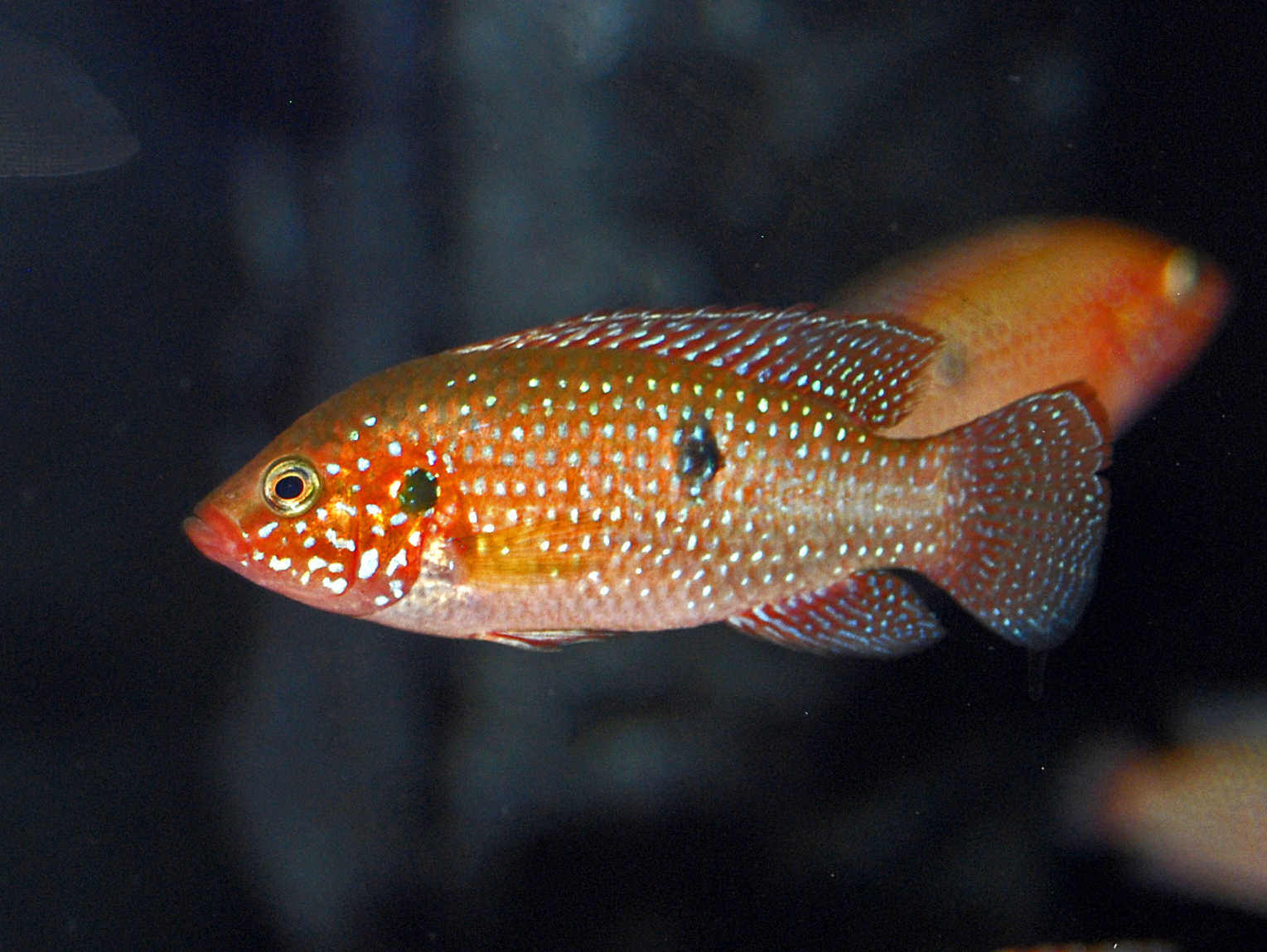
The red is not a warning colour in the advertising sense. It is a statement of ownership. A pair of jewel cichlids, Hemichromis lifalili, in spawning dress look like live coals with turquoise spangles, and they will treat a four-foot tank as a property line. This is a Congo-basin cichlid of modest size and immodest confidence. People buy it because it is beautiful. People rehome it because they put it in with angelfish and hoped the jewels would “stay small and peaceful.”
There is a naming mess in the trade. True H. lifalili is the five-spotted jewel from Congo waters, often confused with H. bimaculatus and with mixed aquarium strains. If your fish is a red jewel with metallic blue spots, the care below still applies: they are all pugnacious substrate spawners. If you care about the exact species, buy from a source that uses the Latin name and knows the spot pattern. Do not fight a forum for a year while the fish defends a flowerpot.
Congo colour in shallow water
Hemichromis lifalili comes from parts of the Congo system in vegetated, warm, relatively still to slow water — not the rapids of a blockhead, not a rift lake. They work the bottom and the lower third, among plants and wood, and they form pairs that guard a flattened site on stone, wood, or even glass. In the wild the red intensifies with breeding. In the aquarium it does the same, which is why a dull brown fish in the shop can become unrecognisable after a month of good food and a partner.
Spangles you earn
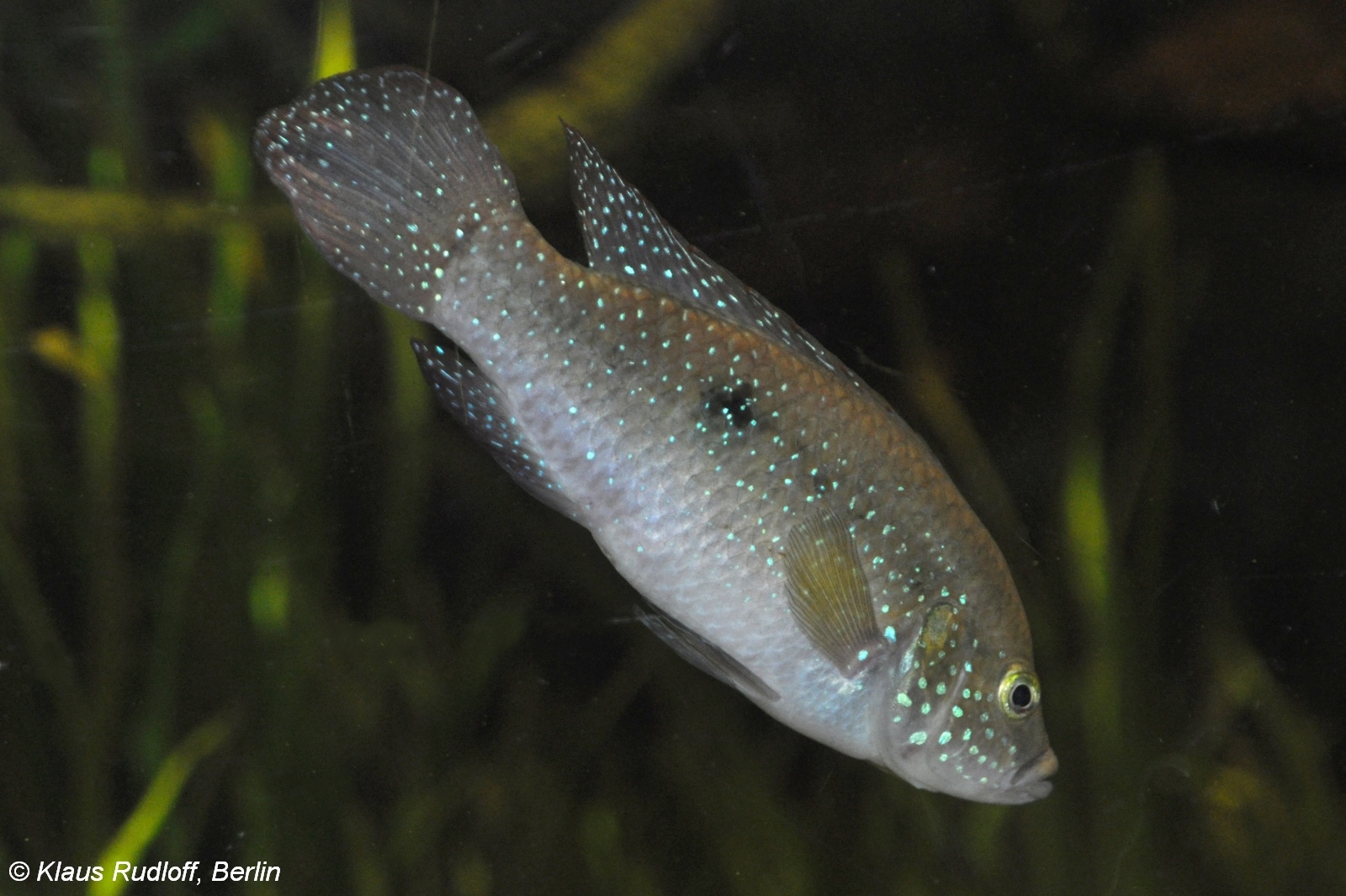
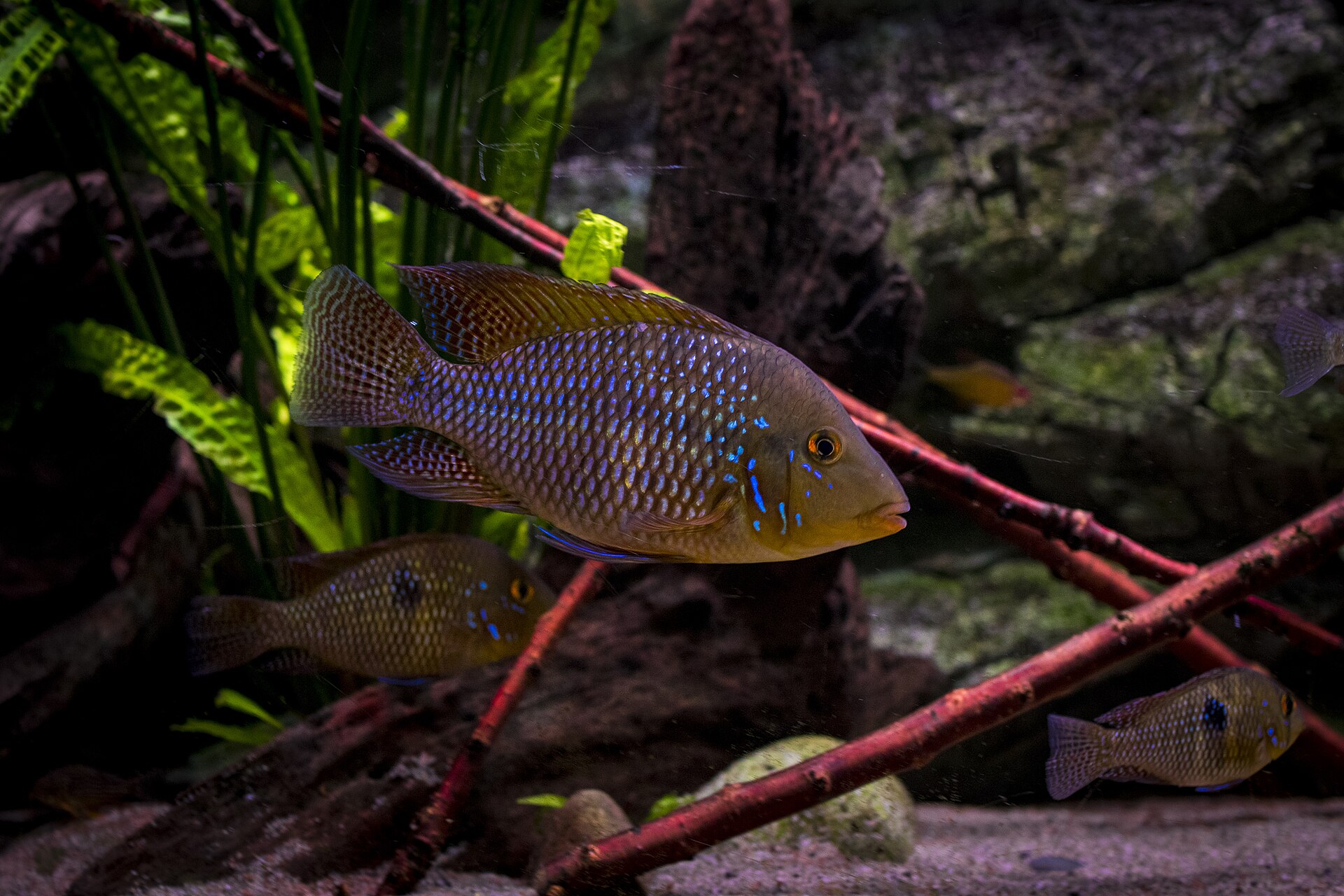
Adults typically reach 8–10 cm. The body is deep. The metallic blue spots are scattered, not a grid. A dark spot sits on the gill cover and another on the flank; lifalili is associated with additional spotting compared to bimaculatus, but aquarium fish muddy that textbook. Males and females look similar until they pair, when both colour up and the female may look even more intense. Sexing by eye alone is unreliable. Buy a group of juveniles and let a pair form, then remove the rest, or buy a known pair and believe the seller only after you have seen them spawn.
Dull fish are often just young, cold, or kept in hard, dirty water. They are not a different, “plain” species.
A tank that can survive a spawn
A hundred litres can hold a pair — and during breeding, only a pair. Community use of the same volume is how you get shredded tetras. If you insist on tank mates, think in terms of 200 litres and up, with robust fish that live in a different zone and can take a chase, and accept that spawning still means casualties. The honest layout is a species tank: sand or fine gravel, a few pieces of slate or wood as spawning sites, hardy plants they may uproot, and a cave they might ignore in favour of a flat rock.
They dig. They spit sand. They will move a plant you just planted. Decorate with that in mind. Filtration should handle the mess; they are not filthy like a big Central American cichlid, but a breeding pair kicks up a lot of substrate. A cover is wise. Heaters should not be exposed glass they can crack in a display fight.
Warm, not alkaline-on-purpose
Temperature 24–26°C is a comfortable band; they can go a little warmer. pH 6.0–7.5, soft to moderately hard water. They are West and Central African in chemistry, not Malawi. Dirty water and they lose colour and pick up infections. They are hardy in the sense that they survive mistakes that would kill a wild discus. They are not hardy in the sense that a neglected tank still shows a jewel. Nitrate control and regular changes keep the red. Stale water keeps the brown.

Do not add salt because an old book said African. Do not mix their water with a Tanganyika tank’s water on a whim.
Meat with some vegetable sense
They are predators of small invertebrates and fish fry, and they will take prepared food. Quality cichlid pellets, frozen mysis, brine shrimp, bloodworm, and chopped earthworm if you are old-school. Some vegetable matter in the diet does not hurt. Feed them well before you expect colour. Do not feed them like a jackal; obesity and dirty water follow. Two meals they finish are enough. Conditioning a pair means richer frozen foods for a week or two, then a slate, then standing back.
Beautiful, and not a community mascot
Outside of breeding they may ignore similarly sized, assertive fish in a large tank. Inside of breeding they will not. Dwarf shrimp are food. Small tetras are food or targets. Other cichlids of similar size will be rivals. A single jewel in a community is often a tyrant with no partner, which is not better. Keep a pair in their own aquarium if you want the colour show without a body count. If you mix, choose tank mates that are too large to eat, too fast to catch, and too stubborn to die of stress — and still have a backup plan.
They will eat snails. They will eat fry of anything. They will sometimes eat their own first spawn. That is inexperience or stress, not a unique defect.
Eggs on a stone, parents on a war footing
They are open or semi-open substrate spawners. The pair cleans a rock or a leaf, lays a patch of eggs, and both guard. Wrigglers are moved to pits. Fry are herded. The parents colour up to a level that photographs still undersell. This is the moment people fall in love with the species and the moment the rest of the tank files a complaint. You can raise fry in the display if it is a species tank and you feed baby brine and microworms. You can pull the slate to a breeder tank. You should not leave a breeding pair in a mixed community and hope the rasboras “learn.”
If they eat the eggs, improve diet, reduce disturbance, and check that they are actually a bonded pair rather than two fish you decided were married. If fungus takes the eggs, look at water quality and hardness.
Respect, then the red
Quarantine new jewels. They nip each other in bags and arrive with torn fins that need clean water, not a community full of extra bacteria. Ich follows chills. They usually eat in quarantine if you give them a rock and a little cover. Deworm only with evidence. Do not dump them into a planted show tank on day one; they will rearrange it and terrorise the existing stock before they have even coloured up.
A pair of Hemichromis lifalili can live many years and spawn repeatedly. The hobby does not lack jewels. It lacks people willing to give them a tank that is allowed to be theirs. Build that tank — warm, clean, a slate, no fragile roommates — and the spangles were never rare. They were waiting for the fight to have a purpose.
Explore other topics
Dive into more aquarium guides across the site.