

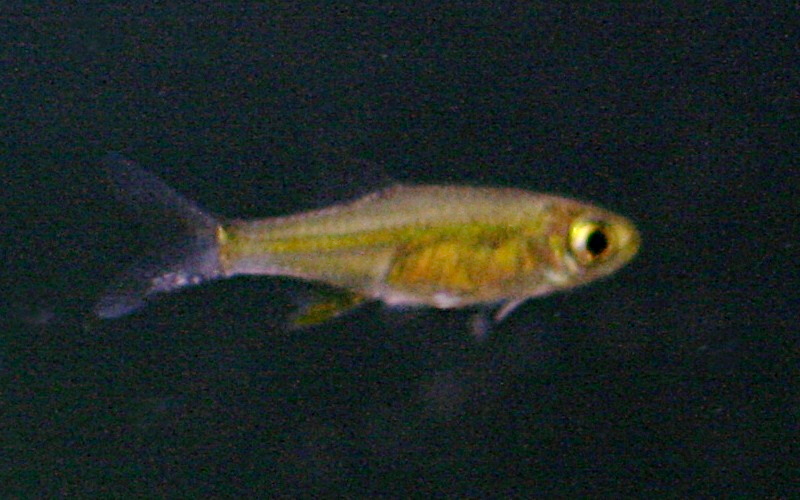
Microdevario kubotai is a 2–2.5 cm green spark from the Ataran drainage on the Myanmar–Thailand border. Sold as Kubota’s rasbora or neon green rasbora, it is a micro cyprinid that schools in planted water — but it is not a peat-swamp Boraras, and it is not a hill-stream Devario. Get the water slightly soft to neutral, the food microscopic, and the group huge, or you will own six grey-green splinters that hide in a corner.
Neon green at two centimetres
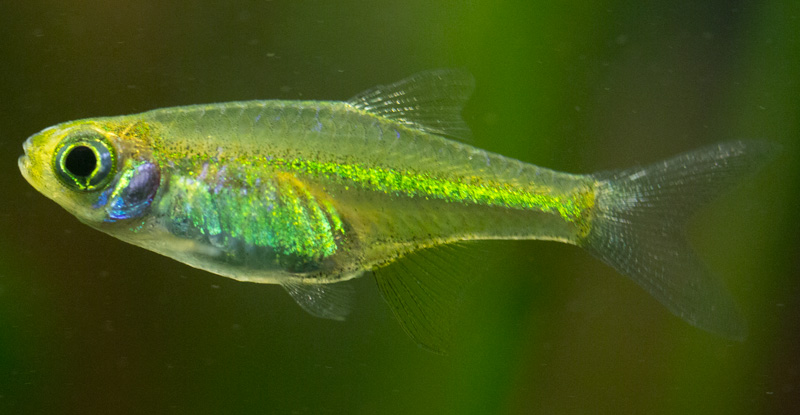
The colour is an electric yellow-green that looks radioactive in side light over a dark substrate. It is not dye if the fish can fade when stressed. Adults stay tiny. Males are slimmer and often greener; females are rounder. They show best in groups of fifteen or more. A “school” of six is a nervous huddle.
Wild fish come from streams and pools associated with the Ataran, not from the deep peat of Kalimantan and not from Inle Lake. Temperature 22–27°C, pH about 6.0–7.5, softness preferred but not the 4.5 pH of a true blackwater swamp. They are more chemically flexible than Phoenix rasboras and less flow-hungry than rose danios. A gentle filter is enough; a river pump is too much.
A planted nano that is still a school tank
Forty litres can work if it is planted, covered, and dedicated. Surface area and plant mass matter more than a tall silhouette. They use midwater, picking at tiny prey in the gaps. Floating plants dim the light so the green glows instead of washing out. They will jump through gaps; lids on nano tanks are often poorly fitted — fix that.
They are not hatchets. They do not need a sealed surface film diet. They are not Malabars. They do not need 120 cm. They need a crowd, fine food, and no roommates that consider 2 cm a serving.
Food that fits a pinhead mouth
Powdered foods, crushed flake, baby brine shrimp, cyclops, infusoria in a mature tank as a supplement. Large pellets are furniture. Feed several times a day in tiny amounts. In a mixed tank, assume shrimp and snails get the leftovers and the kubotai get nothing unless you watch.
Green intensity tracks condition and lighting. A white, bright, empty tank makes them look like unripe bananas. A dark, planted tank with live foods makes them look like they are under a blacklight.
Companions that cannot eat them
Other tiny peaceful fish: chili rasboras if the water is a compromise both can live with (kubotai slightly less acidic), ember tetras, small shrimp, small snails. Danios will outcompete and may eat them. Most tetras over 4 cm are a risk. Hatchets will take surface food and ignore them if well fed, but a hungry hatchet is a 4 cm mouth. Dwarf pencilfish can share a calm planted tank if feeding is careful.

Do not keep them with Mexican tetras. Do not keep them with Buenos Aires tetras. Those sentences should not need writing, yet mixed “community nano” advice still appears.
Eggs in fine plants
They scatter among moss and fine stems. Adults eat eggs. A species tank with heavy moss can produce accidental fry. Dedicated breeding is a mop or a grate and infusoria-scale first foods. Soft water helps. This is closer to a Boraras spawn than to a zebra danio spawn, even though the fish is a Microdevario, not a Boraras. Do not lower water for aerial eggs. Do not add shells.
Nano health, nano math
Ich on a 2 cm green fish is an emergency. Quarantine is hard because they stress alone — quarantine a group in a planted, covered box. Calculate medications for the real water volume. Skinny fish are usually hungry or parasitised. They are more forgiving of pH than Phoenix rasboras and less forgiving of roommates than zebra danios.
If you wanted ruby fish from Inle Lake, that is Microrasbora rubescens with a different chemistry. If you wanted peat-swamp red blotches, that is Boraras merah. If you wanted a neon green Ataran spark in a planted school, Microdevario kubotai is the one, and the group size is the difference between a glow and a rumour of a fish.
See chili rasbora for a red peat specialist of similar size, and do not copy its pH 4.5 recipe onto kubotai without cause.
Green that needs a crowd and a dark floor
Kubotai on white sand look like lost fry. Kubotai over brown soil or dark gravel, in a group of twenty, look like a neon sign. That is not a branding trick. Small green cyprinids use the school and the background to read as a single flashing object. Break either, and you have beige threads.
Ataran-associated water can be clear, not tea. You can add a leaf or two for aesthetics, but you do not need to chase pH 4. If your tap is already soft and near-neutral, you may be closer to kubotai than to merah. If your tap is hard, mix RO, but remineralise a little so pH does not crash in a tiny tank overnight — nano volume is chemically twitchy.
Feed on a schedule you can actually watch. A 2 cm fish that misses three meals in a community is already in trouble. Morning and evening pinches of powder, with a midday baby-brine treat, is closer to their metabolism than a once-daily flake blizzard meant for angelfish.
Green at two centimetres is a school effect. Twenty fish, dark substrate, powder-grade food, and a lid that actually fits will do more than any bottle of colour enhancer. Kubotai is an Ataran spark, not a peat-swamp Boraras and not a hill-stream Devario; keep the filter gentle and the crowd large.
If green intensity comes and goes with feeding days, you are seeing metabolism, not a failing LED. Keep the nano mature, resist the urge to bleach-clean every leaf, and let a little biofilm feed the mouths that powdered food only partly reaches. That is kubotai husbandry, not a swamp pH contest.
Explore other topics
Dive into more aquarium guides across the site.