

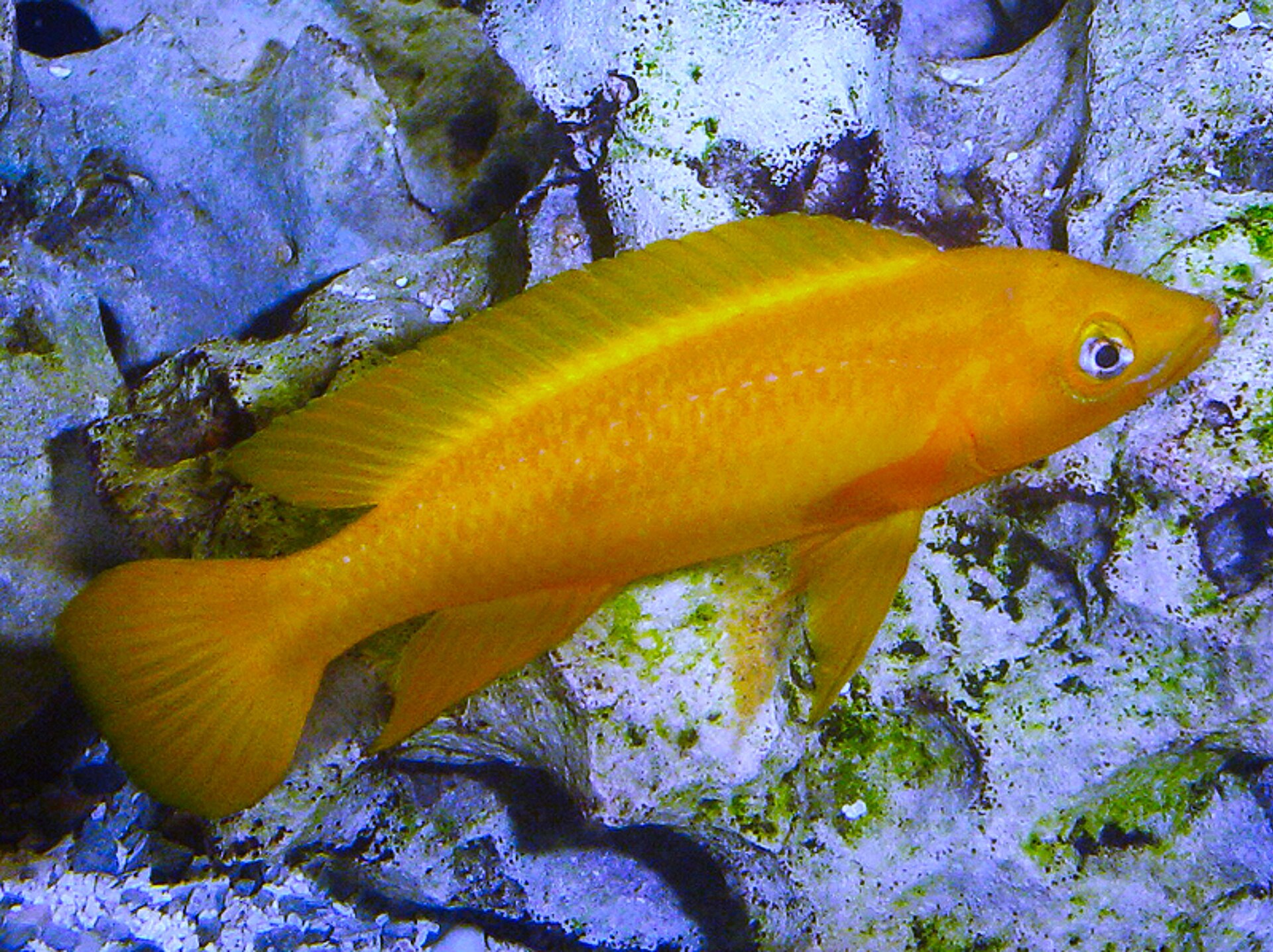
Yellow in Lake Tanganyika is not a cheap trick. Neolamprologus leleupi, the lemon cichlid, is a cave-dwelling predator-in-miniature from the eastern and related rocky coasts, and the colour is a carotenoid argument with diet, genetics, and mood. A well-kept adult is a living citrus wedge, 10 to 12 cm, with a long-finned, slightly compressed body and a face that looks too serious for the joke of the common name. A poorly kept adult is beige. People then blame the seller. The seller sold a yellow fish. The tank turned it into a potato.
It is sometimes confused with orange N. longior and with washed-out brichardi that someone hoped would stain yellow. True leleupi is a cave specialist, usually kept as a pair, not as a helper-clan palace fish. It does not want a Tropheus salad bar as its only food. It does not want a mbuna brawl. It wants a hole, a partner, mineral water, and enough animal food to stay lemon rather than straw.
The colour is a receipt for the last six weeks
Yellow and orange forms exist; locality and line matter. Colour fades with a diet short of carotenoids, with dim miserable conditions, with stress from a tank-mate that owns the cave, and with age in some individuals. Colour returns, at least in part, with crustacean-based foods, spirulina as a pigment helper rather than as a staple, and a fish that actually holds a territory. It will not return if the fish is hiding under a heater for three months. Sexing by colour is unreliable. Sexing by size and papilla at spawning is better. Females may be a little smaller. Pairs form and then defend a specific cave like it was a deed.
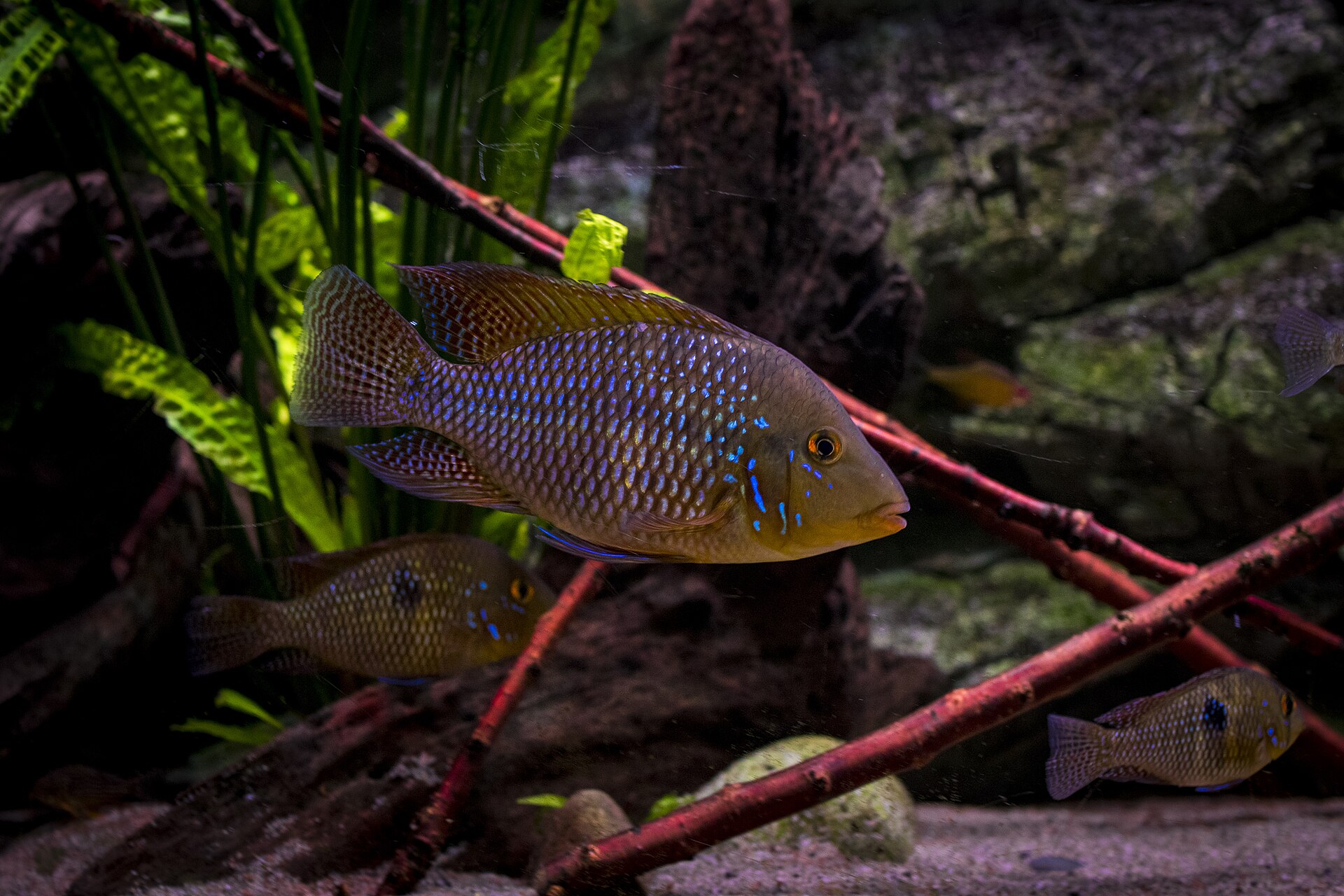
There is no second figure for this species in the files; the fish in the header is the one you get. Look at the body: elongate, lemon, Tanganyikan, not a Malawi peacock yellow and not a gold mbuna. Different lake, different mouth, different job.
A hole with a lease
A 100 to 150 litre tank can house a pair if the caves are real: rock overhangs, ceramic caves, stacked slate with a back door. Two caves can help a persecuted partner escape. One cave in a small tank is how the owner kills the tenant. Sand floor. Temperature 24 to 27°C. pH 7.8 to 9.0. High KH. Oxygen. They like a bit of current past the cave mouth, not a torrent inside it. Plants are optional and often ignored if they are tough; they are not the point.
A larger Tanganyikan community can include a lemon pair if — a serious if — no one else wants that exact cave, and if open-water fishes stay in open water. Shell dwellers may be harassed if the lemon pair decides shells are interesting. Brichardi colonies will annex. Julies may fight over the same real estate. Plan the neighbourhood on paper. Then watch it fail and move a cave.
Meat for a yellow hunter
Mysis, brine shrimp, cyclops, quality pellets, chopped prawn, insect foods. A little plant matter for gut motion. The pigment in krill and similar foods supports the lemon; a flake-only diet supports the beige. They hunt small invertebrates. They will eat fry. They will eat shrimp that share the cave block. Feed both pair members. The fish at the back of the cave is the one you check for a hollow belly.

They are not Tropheus. Do not copy the bloodworm ban so hard that you starve a micropredator. Do not copy a hap diet so hard that you ignore vegetables entirely. Sit in the middle, then bias toward the animals they would pick off a rock face.
Two is company; three is a casualty
A trio often becomes a pair and a corpse. Start with juveniles in a large tank and remove extras, or buy a known pair. Introducing a new adult to a housed pair is rarely a gift. They spawn in the cave: eggs on the wall or ceiling, both parents guard, fry stay nearby. It is julie-like in the family structure on a smaller, yellower scale, without the famous multi-generation maze of transcriptus necessarily developing in the same way. You can still see several sizes if you leave them. You can still lose the spawn if you have tank-mates that eat yellow specks.
A pair that is about to split will show torn fins and a fish that is not allowed in. Divider. Second tank. Same water. The lemon is not worth a slow death behind the filter.
Beige emergencies
Faded colour plus clamped fins plus flashing: parasites or chemistry. Faded colour plus eating well plus a dominant fish: maybe just a subordinate, move the caves. Faded colour plus a diet of pale flake: feed better for a month before you declare the line “not yellow.” Ich on a yellow fish is obvious. Treat in alkaline water. Quarantine in a cave-equipped tank or they will not settle enough to show you whether they eat.
Hole-in-the-head in dirty mineral water still happens to Tanganyikans. Changes. Not a peat extract from the wrong lake.
Lemon as a choice, not a decoration
If you want a single bright fish that occupies a doorway in a Tanganyikan rock tank, Neolamprologus leleupi is one of the best arguments for the colour yellow in freshwater. If you want a school of yellow, you wanted something else — maybe a group of labidochromis from the other lake, which is a different article and a different pH culture, or maybe a pack of lemon-coloured farmed anything. This one is a pair in a hole. Honour the hole. Feed the hunter. Keep the water on the Rift side of the test kit. The citrus is not a filter. It is a fish that will go straw-coloured the day you forget which lake it came from, and will go lemon again the day the cave and the mysis line up. That swing is the care guide. Everything else is interior design for a door they can own.
Do not buy one lemon “to add colour” to a mbuna tank. The mbuna will spend the colour. Buy a pair, or a group to split, and a wall with an address. Then the common name stops being a lie.
Explore other topics
Dive into more aquarium guides across the site.