

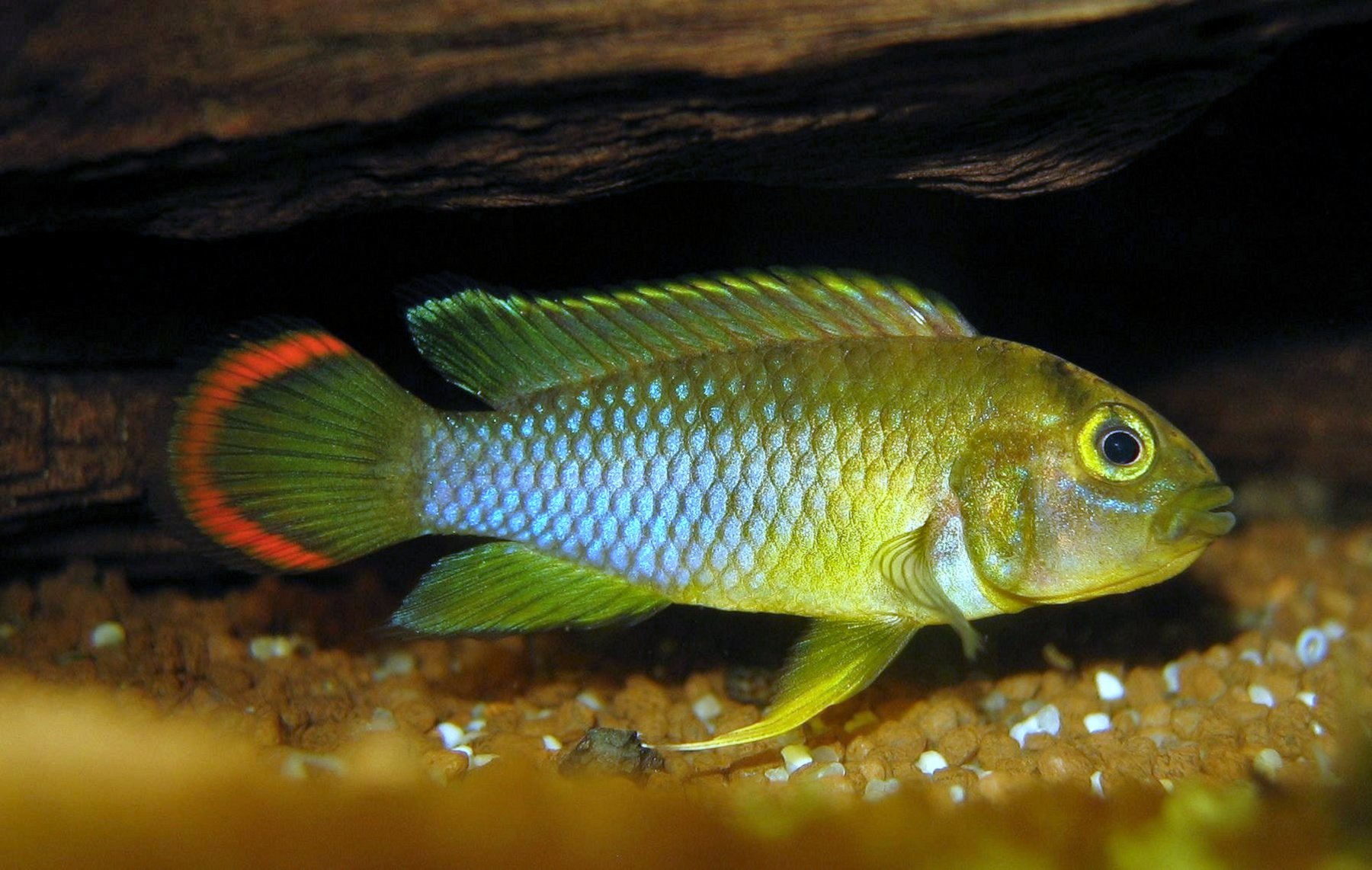
Nijssen’s apisto is the one with the panda face. Apistogramma nijsseni males show a pale, almost cream-grey head and a dark, often blue-black rear body and tail — a two-tone that looks like a mask and a cloak. Females are the usual apisto story: smaller, yellow when brooding, deadly serious about a cave. Five to six centimetres. Peru, blackwater. If you bought them because they looked like a tiny Uaru, you bought the wrong size class and the right continent’s water, at least: soft, warm, stained. You did not buy a Tanganyika fish.
The panda pattern only holds in good water. In hard, clear community tanks they look like dingy guppies with an attitude.
Peruvian blackwater, slower than a river, darker than a farm pond
Native to Peru, in blackwater habitats: low minerals, tannins, leaf beds, hidden cavities. pH commonly acidic. They forage in litter and hold caves. The biotope is closer to a Dicrossus creek than to a Geophagus sand river, and it is nothing like Tanganyika. Keep that map in your head when the shop tries to sell you “cichlid salts.”
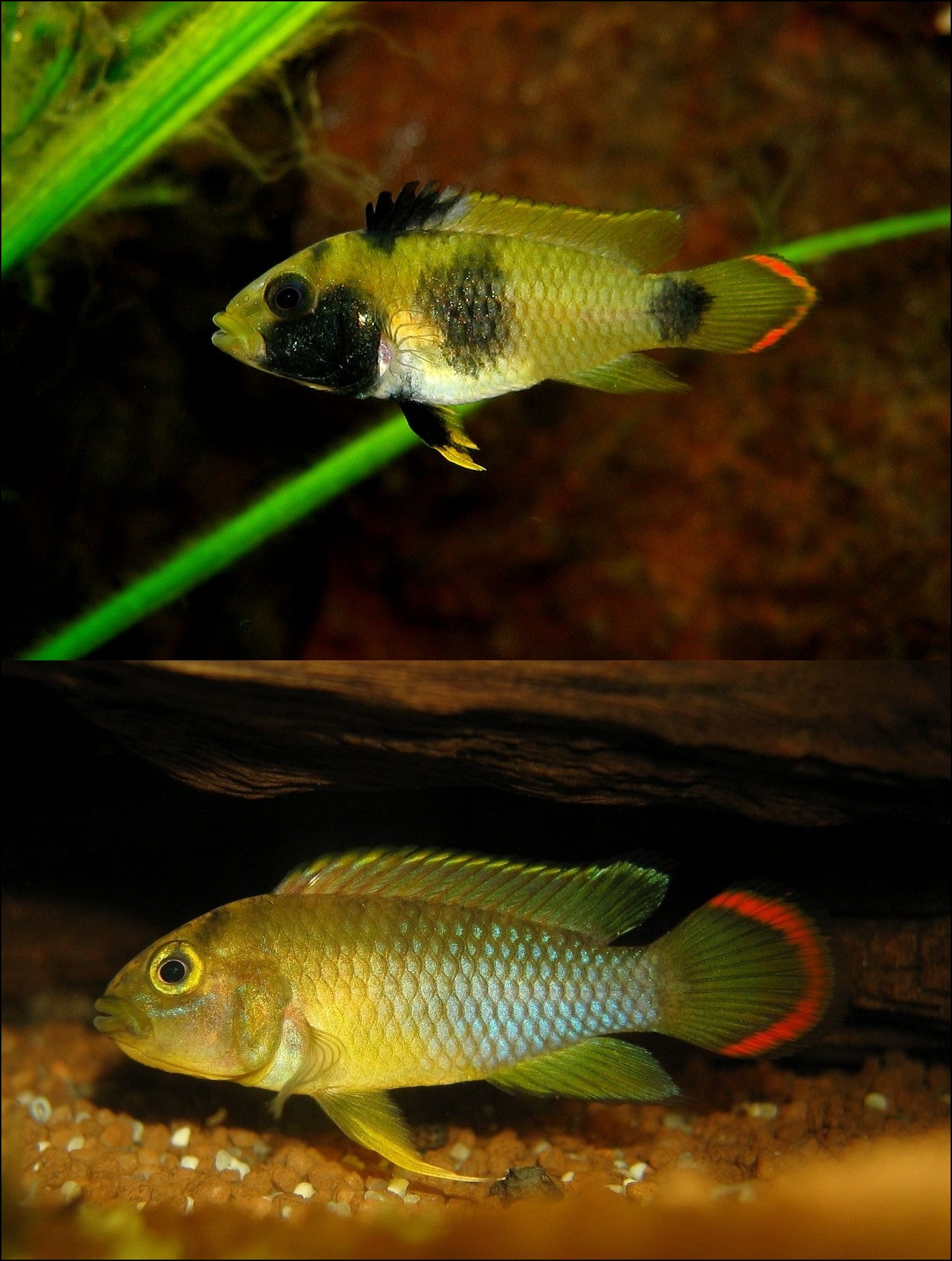
Mask and cloak, not a cockatoo crest
Males: the panda contrast, spade-shaped tail, modest D-shaped body rather than the extreme lyre of some A. cacatuoides lines. Females: shorter fins, brood yellow. There is no shell-spot ocellus like L. ocellatus. There is no Julie striping. There is no checkerboard like Dicrossus. If the male has a huge spiky dorsal like a show cockatoo, you may have the wrong apisto. Nijsseni is a face-and-body colour fish.
Panduro males are more uniformly steel-blue; nijsseni is the split paint job. Learn the difference before you mix Peruvian dwarfs.
A dim tank with more caves than females
Seventy litres as a starting harem tank. Fine sand. Leaves. At least one cave per female plus extras. Wood. Surface plants. Sponge filter. This is a blackwater room, not a 150 litre cylindricus cave wall in pH 8.5, and not a 25 litre strawberry rasbora swamp — though the chemistry overlaps more with the rasbora than with the Julie. Apistos still need caves and a slightly larger footprint for territories.
Light should be low enough that you use the tank’s reflection to find the fish at first. Then they colour and you will see the panda.
Very soft, very honest test kits
Temperature 24–28°C. pH 5.0–6.5. Soft. RO is normal. Botanicals help. Do not let pH crash unmeasured because you added a grocery bag of oak at once. Do not buffer with coral. Cycle first. Chemistry, cycling.
Nijsseni is often sold as more demanding than cacatuoides. Believe that. Farmed fish exist; they still look their best in blackwater, not in liquid rock.
Food that reaches the cloak
Frozen and live micro foods, then pellets that actually fit. Males display more when fat. Females need calories to hold a brood. They pick at the leaf layer; feed some sinking items. Skip the lettuce. Skip the large krill a compressiceps would want. This is a dwarf insectivore.

Tankmates: small, soft-water, not in the cave
Dithers: small tetras that match the water, pencilfish, maybe a group of Boraras in a larger tank if the apisto will not hunt them (risky with 2 cm fish). Shrimp: adult shrimp may survive; shrimplets and fry will not share a philosophy. Wrong: rift cichlids, large barbs, other male apistos in 70 litres, Uaru, eartheaters (wrong size, wrong digging).
A German ram is a different dwarf (Mikrogeophagus) with overlapping but not identical needs; mixing rams and nijsseni in a small tank is two harems in one box.
Panda fry in a dark doorway
Cave spawner. Female guards. Male patrols. Fry are tiny. Soft water helps egg development. This is not mouthbrooding. If eggs fungus, check pH swings, the male’s harassment, and whether the cave is in flow. Pulling the female and cave is a common breeding tactic. Leaving them is a behaviour exhibit with losses.
When the mask greys out
Hard water, nitrate, and bullying. Quarantine in the same chemistry with a cave. Do not put a panda apisto in a rift-lake hospital “because all cichlids.” They are not all cichlids in any way that matters to the kidneys.
Compare panduro for another Peruvian, cacatuoides for a hardier, spikier apisto, and Dicrossus if you wanted an even more extreme blackwater dwarf that is not an Apistogramma. Still no Tanganyika salts.
Why the panda is a water test, not a strain
There is no reliable “high contrast panda” strain that stays that way in GH 18 tap. The mask-and-cloak contrast is condition plus chemistry plus mood. If you want the photograph, you want the RO. If you want a colourful dwarf in mixed tap, you want a different apisto, probably a farmed cacatuoides, and you should not be angry at nijsseni for being itself.
Blackwater without a death crash
Add leaves slowly. Measure pH when you think you are done, then again the next morning. A bag of botanicals in a tiny tank can drop pH faster than a 5 cm cichlid can cope. Keep a little KH, even in a blackwater tank, so the pH does not free-fall. That sentence upsets purists; dead nijsseni upset the fish more. Stability at pH 5.8 beats a heroic pH 4.9 that swings.
When you acclimate, drip for a long time. Shop water is rarely true Negro tea. A panda that looks good in the bag can still osmotic-shock in your RO. Lights off. No audience. Food the next day, not the first hour.
Filaments, fungus, and the first spawn you should ignore
A first nijsseni spawn in new water often funguses. That is information: the pair is trying, the conductivity may still be high, or the cave is in the filter outflow. Move the cave. Soften further if tests say you are still in tap-land. Do not strip-spawn like a barb. Do not add methylene blue to a display full of leaves without a plan. The second spawn in a mature tea tank is the one that counts. Keep feeding the female through the failure; she spent calories.
Males with torn cloaks are usually males that share a tank with another male, or with a steindachneri, or with a hand that rearranges caves weekly. Leave the panda’s house alone. The contrast you want is a settled contrast.
Explore other topics
Dive into more aquarium guides across the site.