

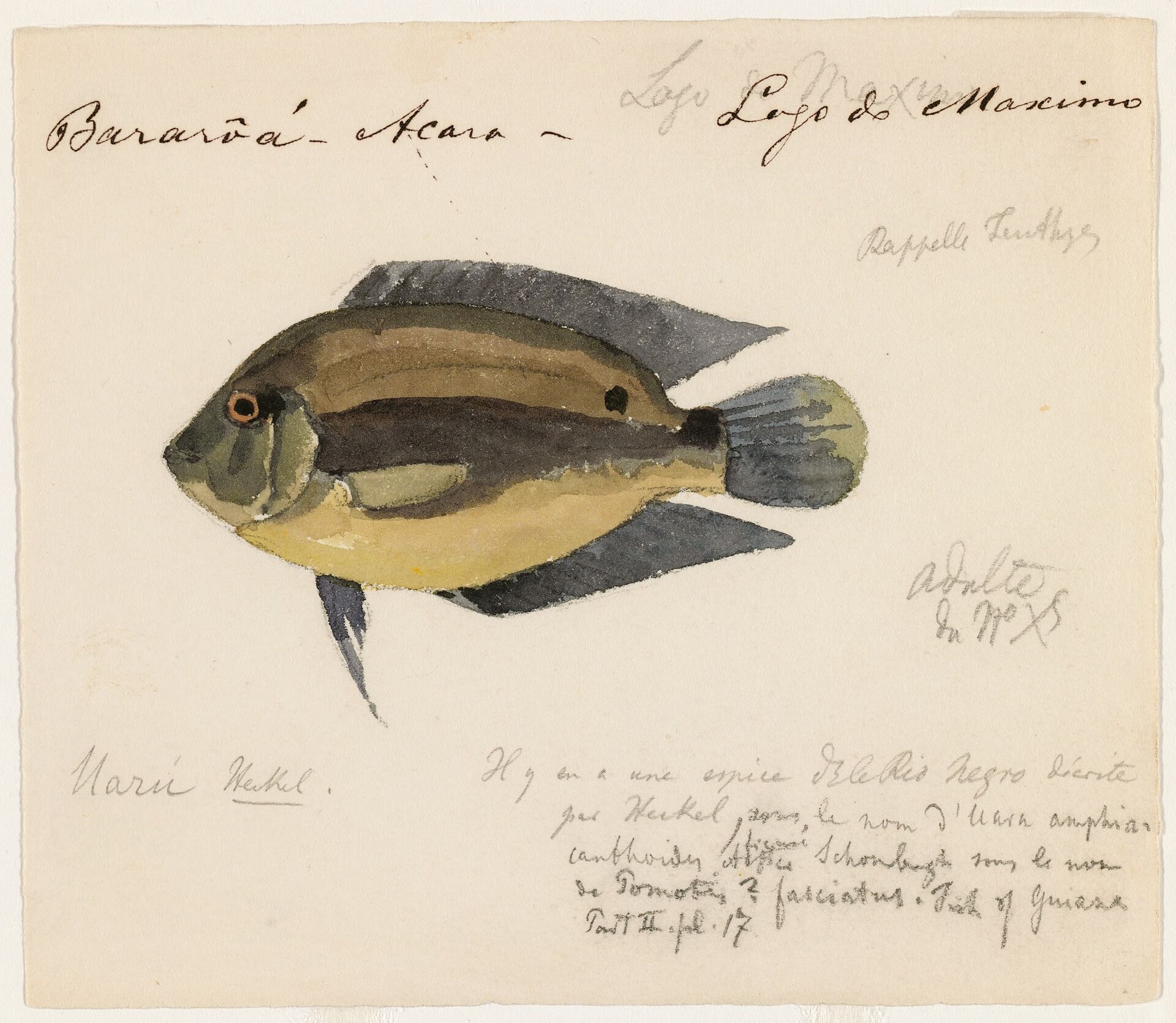
Uaru is the discus-adjacent cichlid that people buy because it looks like a brown triangle with a staring eye-spot, then discover it needs a tank the size of a discus project and a diet that is half garden. Uaru amphiacanthoides reaches 25–30 cm, comes from warm Amazon waters, and spends its time browsing aufwuchs, plants, and prepared greens more than ploughing sand like a dedicated eartheater. It is a large, social, somewhat shy South American cichlid. It is not a dwarf. It is not a shell-dweller. It is not a Julie. If your tank is 150 litres, you do not have a Uaru tank.
Juveniles are often sold at 8 cm looking like odd little angels. They grow. Record 30 cm before you pay.
Warm, soft Amazon, with wood and browsing surfaces
Native to the Amazon basin, in warm, typically soft water with wood, roots, and a lot of surface to graze. Temperature in nature can sit higher than a Tanganyika tank — Uaru are often kept 26–30°C, in the discus neighbourhood. pH 5.5–7.0. They are not sand-flat shell fish. They may pick at the substrate, but their reputation is plant and biofilm browsing, not the continuous Geophagus sift. Leaf litter can exist; a deep sift bed is not the defining furniture.
Copy warmth, softness, cleanliness, and space. Do not copy a Malawi rock pile. Do not copy an ocellatus beach.
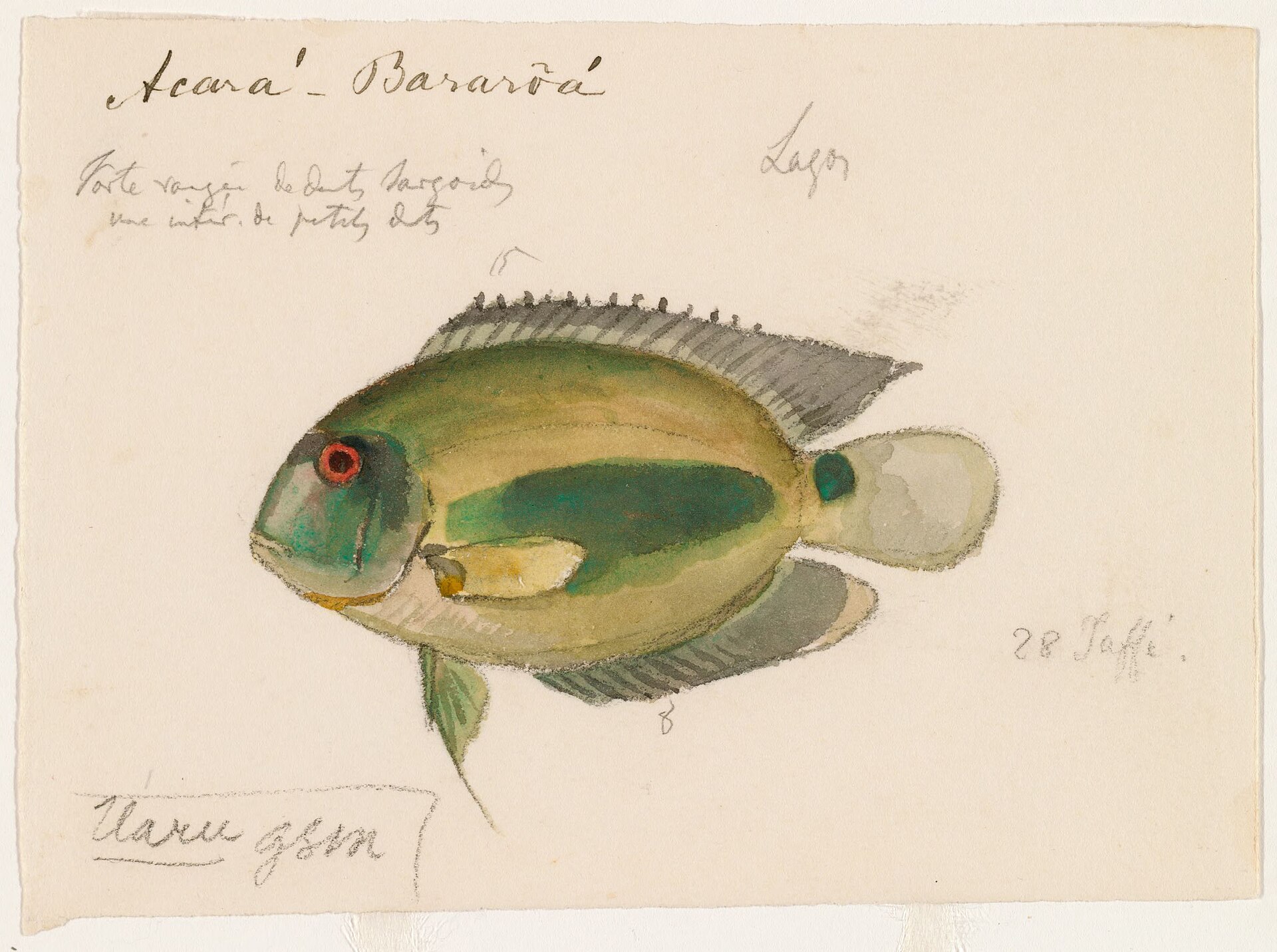
The triangle, the ocellus, the juvenile lie
Adults are deep-bodied, laterally compressed like a discus that went brown-olive, with a prominent dark spot on the flank that can look like a huge eye. Fins are broad. Colour is mood: they can flush gold-brown or go dark when unhappy. Juveniles show a different, often more barred or spotted pattern — keepers are regularly shocked at the adult silhouette. Sexing is difficult; they are best kept in a group of five or more so a pair can form without you guessing from a bag of two.
They are not Satanoperca (longer, sand-sifting, different face). They are not Geophagus altifrons (high forehead, sift, usually less ‘discus-shaped’). They are Uaru: the plant-heavy large cichlid.
Four hundred litres is a conversation starter, not a boast
A group starts at 400 litres or more. Footprint for a group. Wood to graze and hide. Soft lighting. Strong filtration because large cichlids in warm water produce waste and eat a lot of greens that rot if uneaten. Sand is fine; they will not need 15 cm of it the way a dedicated eartheater will, but sharp gravel is still rude. Plants will be eaten. That is not a failure of the fish. Stock cheap, fast plants as food, or skip the aquascape fantasy.
Heater capacity for 26–30°C. Oxygen at those temperatures is a real parameter. This is closer to discus husbandry than to pearl cichlid husbandry (the pearl often takes cooler, harder coastal water).
Warm, clean, and actually soft
Temperature 26–30°C. pH 5.5–7.0. Soft. Zero ammonia, low nitrate. Warm water plus a vegetable diet plus a large body is a recipe for dirty tanks if you are lazy. Large weekly water changes of matched, warm, soft water are normal. RO is common. Chemistry, cycling — cycle a tank this size properly; you cannot hide a cycle behind a 30 cm cichlid.

Do not add rift salts. Do not keep them with compressiceps. Do not keep them with greater scissortails in a 200 litre river tank and call it Amazon because there is a piece of bogwood.
Vegetables are not a garnish
Staple: quality cichlid foods plus spirulina, blanched courgette, spinach, peas, and similar, plus some frozen protein. A Uaru kept on bloodworm-only becomes a medical case. A Uaru kept without greens looks wrong and behaves hungry. They will eat aquarium plants. They will eat lettuce. They are not a Julie picking cyclops off a slit. They are not an apisto taking baby brine in a cave.
Feed a group so subordinates get greens, not only the pair. Uneaten zucchini in 28°C water is ammonia. Remove leftovers.
A group of large, mild, still territorial fish
Keep a group if you can; pairs in small tanks wreck each other. Tankmates: other large, peaceful Amazonians in a huge tank — some Geophagus, Severums, peaceful catfish that can take the warmth. Risky: discus (similar water, Uaru may be boisterous). Wrong: dwarfs that will be steamrolled, Tanganyika fish, mbuna, tiny rasboras, shrimp.
They are generally less murderous than a pearl cichlid of similar size, and less sand-obsessed than altifrons. Do not use that as an excuse to undersize the tank.
Pairs in a group, eggs on wood or stone
They pair within a group, clean a surface, spawn, and guard. Warmth and softness help. This is open substrate spawning of large cichlids, not mouthbrooding like some Satanoperca, not a shell spawn, not an apisto cave. Fry need fine foods and a plan; the parents may eat them in a crowded tank. Breeding Uaru is a project for people who already keep them well as adults.
Dark fish, clamped fins, holes in the head
Dark, clamped Uaru in cool, hard, dirty water are a diagnosis. Hexamita-type issues and hole-in-the-head track organics, temperature, and diet — especially lack of greens and poor water. Quarantine in warm, soft, clean water with wood, not in a cold community hospital. They should browse. If they do not eat zucchini, something is wrong with the fish or the water, not with the vegetable.
Related large Amazonians: G. altifrons if you wanted a sifter, S. jurupari if you wanted a sand-sifting mouthbrooder, discus articles if you wanted the more compressed, pickier cousin. Not a fairy cichlid — different lake, different salts, different size class in practice.
Greens on a schedule, not a guilt pile
Blanch, clip, and clip again. A Uaru group will ignore a whole courgette until it fouls, then eat a ribbon you clip to a rock. Weight the vegetable. Remove it after a few hours. Alternate greens so they do not bore on one item. Mix in prepared spirulina foods on the days you cannot cook for fish. The diet is work. The work is the species. If that sounds worse than feeding a Julie cyclops, keep the Julie.
Explore other topics
Dive into more aquarium guides across the site.