

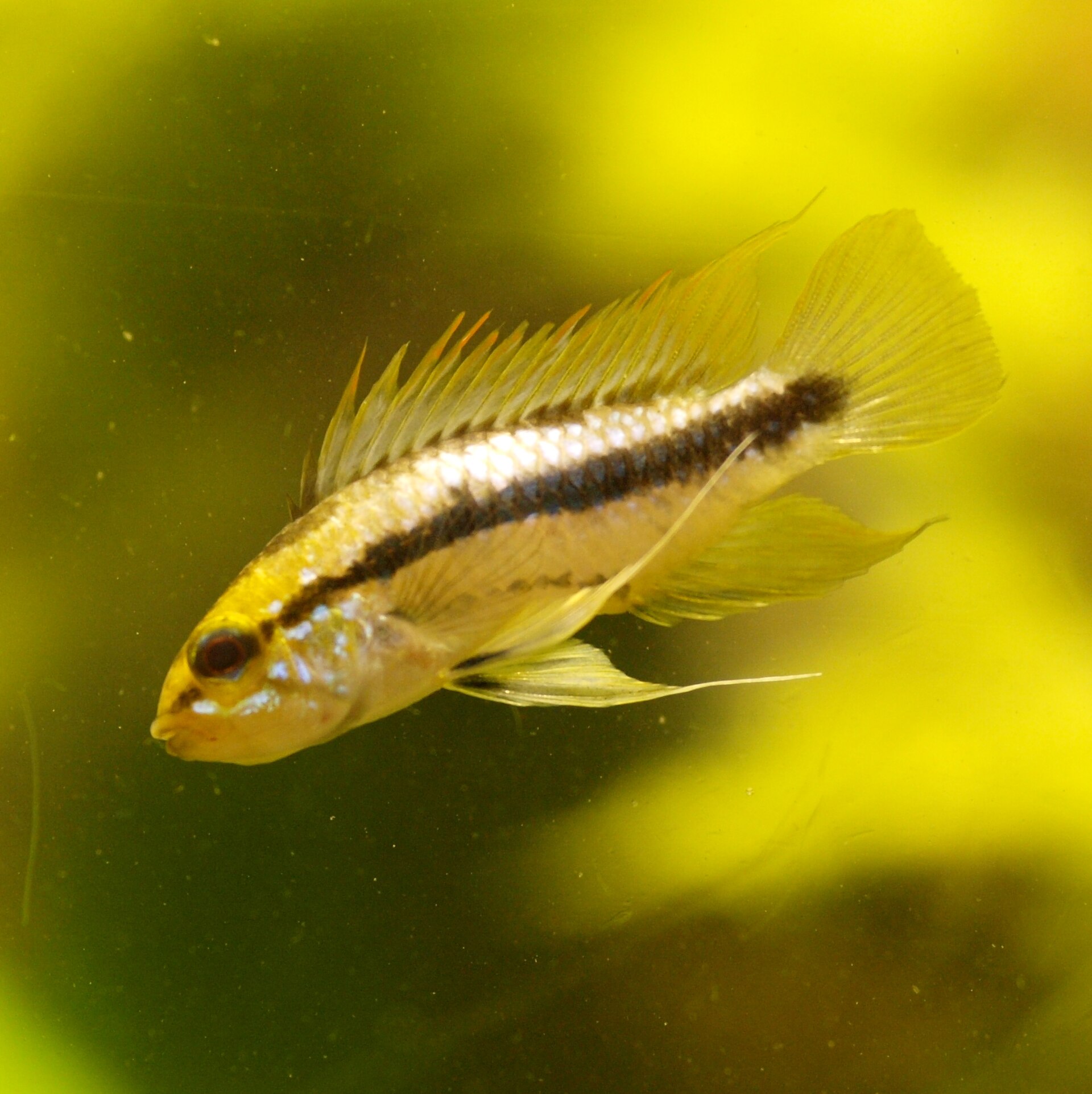
Three dark lines run the length of a healthy Apistogramma trifasciata. That is the field mark, and it is also a warning: when those lines fade to grey smudges, the fish is not “settling in.” It is telling you the water, the company, or the cover is wrong. The three-stripe apisto is a small Paraguay-basin dwarf cichlid, shyer than the yellow borellii, and it rewards a tank that feels like a vegetated ditch rather than a community showpiece.
Males carry the stripes on a body that can flush gold, blue, and rust depending on mood. The dorsal fin is taller than a female’s and often edged in colour that photographs never quite catch. Females are smaller, rounder, and can look almost plain until they own a cave, when the stripes sharpen and the belly takes on a warm tone. People who buy four “males” from a tank of juveniles are usually looking at unsexed fish. Wait for the dorsal and the attitude.
Stripes from a shallow country
Apistogramma trifasciata comes from tributaries and backwaters in Paraguay, adjacent Brazil, and northern Argentina — the same broad Paraná–Paraguay world as a few other dwarf cichlids, but not the same microhabitat as a forest blackwater specialist from the Rio Negro. Water can be clear or lightly stained, often shallow, with plants, grasses, and banks of leaf. Seasonal flooding rearranges the furniture. The fish are used to change, which is not the same as being used to ammonia or to a 10°C overnight drop from an unheated tank in a cold room.
They stay close to structure. In an aquarium that means they will use the back and the corners until they decide the front is safe. If you want to see them, you build safety first: wood, plants, caves, a broken sightline. Then they come out. The opposite order — a bare tank “so I can watch them” — produces fish you never watch, because they are behind the heater.
Size, shape, and the third stripe
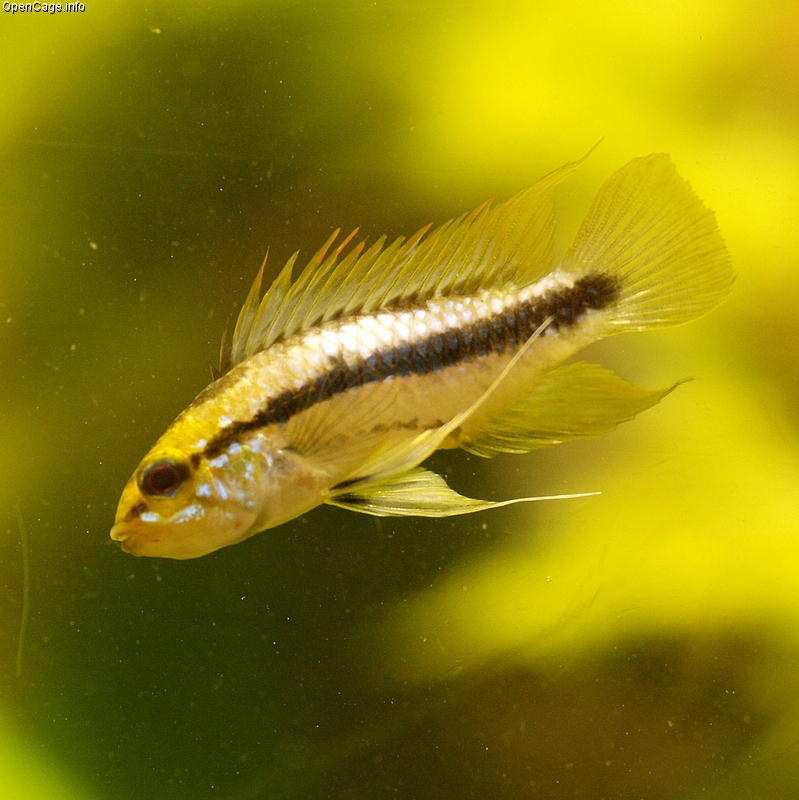
Adult males typically reach about 6 cm, females less. The three longitudinal stripes are the identification: a mid-lateral line, a lower line, and a dorsal-adjacent line that together give the fish its name. Stress compresses the pattern into a muddy blur. Disease and poor water do the same. Do not diagnose a “new colour form” when the fish is simply unhappy.
Fins on a mature male are longer; the caudal can show colour that females lack. There is some locality and strain variation in how much red or blue appears in the unpaired fins. None of that variation turns them into a different species. If a seller cannot tell trifasciata from a similarly striped apisto, buy elsewhere. Hybrid swarms in the hobby start with “close enough.”
Cover they will actually enter
A pair can live in 60 litres if that 60 litres is all theirs. A male with two females needs more floor and more caves — think 80 litres and up, longer rather than taller. Place at least one more cave than you have females. Coconut shells, clay pipes, and small rock caves all work if the opening is low and the interior is dark. I like one cave half-buried in sand so the entrance is a slit. Females of this species often prefer a tighter hole than the open “flowerpot showcase” people put in for photographs.
Sand is the right substrate. They dig a little, they spit sand, they keep the cave threshold clear. A thin carpet of leaves on top of the sand gives fry a place to vanish and gives adults something to nose through. Java moss tied to wood becomes a second nursery. Tall stem plants and floating cover cut overhead glare. A sponge filter behind a piece of wood keeps flow down. If you insist on a canister, point the outlet at the glass so the current dies before it reaches the caves.
They are jumpers when startled. A lid is not optional in a tall tank with a large air gap. In a low, covered aquarium they rarely try, but the first time a cat walks across the stand you will wish you had glass on top.
Soft water that is still a working aquarium
Aim for pH around 6.0–7.0, soft to moderately soft water, and 24–28°C. They are not as demanding as some Orinoco apistos, but eggs fungus quickly in hard, alkaline tap. If your tap sits at pH 8 and liquid GH, mix RO. Remineralise enough that the fish have some hardness — pure RO is not a habitat, it is a solvent. Tannins from botanicals will drop pH gently and stain the water; that stain is useful, not dirty.

Weekly water changes of 20–30 percent keep nitrate in check. Match temperature. Drip new water if the chemistry differs. These fish show a chill as clamped fins and a darkened pattern within hours. They show dirty water as rapid breathing and a refusal to leave the cave even at feeding time.
Food that still moves, or at least recently did
A. trifasciata is a cautious hunter. In a tank with fast tetras it will lose every meal. Frozen baby brine, daphnia, and cyclops are the foods that reliably put weight on them. Micro pellets of a size they can swallow work once they are trained. Live foods — grindal, microworms, baby brine — are how you bring a thin import back and how you condition a female. Bloodworms are a treat, not a staple; too many and you get bloated fish and dirty sand.
Feed morning and evening. Watch the female at the cave. If she never comes out, target-feed at the entrance with a pipette or a length of airline. A fish that is “shy” for three weeks is often a fish that is losing a feeding competition. Remove the competition.
Neighbours that do not inspect caves
The three-stripe apisto does not want a roommate that shares its hole. Other Apistogramma, kribs, and rams in the same small tank are a fight waiting for a spawn. Upper-water tetras that stay small and peaceful can work — but only a species that will not dive into caves to hunt fry, and only if the water matches. Small Corydoras are possible in a larger footprint. Angels, gouramis that claim the surface and spit, and anything with a reputation for nipping will keep this fish in hiding until it fades.
A species tank is the cleanest way to keep them. You will see more behaviour, more stripes, and more successful spawns. Community is a compromise you make after you have already kept a pair well, not a default because you have a spare 80 litres of mixed leftover fish.
The female takes the cave
Spawning is a cave event. She lays on the ceiling, he fertilises, she evicts him from the doorway. His job becomes a perimeter patrol that, in a small aquarium, looks like bullying whatever else lives there. Have a plan for the tetras. Have a plan for extra females. A divider or a spare tank with matched water is kinder than hoping everyone “works it out.”
Eggs hatch in two to four days; free-swimming follows after the yolk is used. She shepherds the fry. You can leave them if the tank is a densely planted species setup with no fry-eaters. You can move the cave to a breeder box. You cannot ignore a female who is now defending half the tank against fish five times her size — she will lose, and the spawn will vanish.
Sexing young fry takes months. Grow them on in a long tank with plenty of cover if you intend to keep a group. Cull or rehome extra males early; this species does not forgive a second adult male in a box that was sized for one.
Reading the stripes as a mood meter
Sharp lines, colour in the fins, a male who displays in the open: the tank is working. Muddy lines, clamped fins, a fish that only appears at lights-out: something is off. Check temperature first, then ammonia, then whether a new tank mate is cruising the caves. Velvet and ich show up after import and after chills; treat in quarantine when you can. Do not medicate the display on a guess while the plants and the sponge colony take collateral damage.
New fish should spend two weeks in a small planted quarantine with a sponge filter, the same chemistry you run in the display, and no roommates. Watch them eat. Watch the stripes. Only then do they meet the established pair. Apistogramma trifasciata is not a difficult dwarf cichlid if you stop treating it like a tetra that happens to have a cave. Give it the ditch — plants, leaves, a dark hole — and the three lines stay where they belong: down the side of a fish you can actually see.
Explore other topics
Dive into more aquarium guides across the site.