

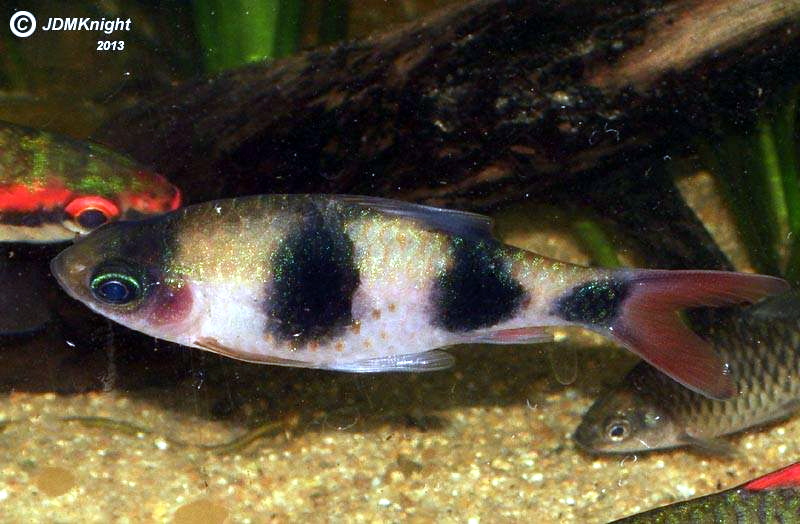
Most barbs on the shop wall are farmed generalists. Dawkinsia arulius is not. The arulius barb is a Western Ghats endemic tied to the Cauvery river system in southern India, and wild populations have been squeezed by dams, pollution and collection. When you buy one, you are usually buying a captive-bred fish that still carries the body plan of a hill-stream cyprinid: a longer, more powerful swimmer than a rosy barb, with a story that does not start in a polybag.
Older books list it as Puntius arulius or Barbus arulius. The move into Dawkinsia grouped it with other South Indian barbs that share a particular skull and colour pattern. It is close to, and often confused with, the filament barb Dawkinsia filamentosa. Shop labels are sloppy. True arulius has a characteristic set of dark blotches along the flank and, in mature males, dorsal rays that extend into filaments. If the fish in the tank is a generic gold barb with no blotches and no filament promise, you do not have this species.
Filaments, blotches, and a fish that outgrows the “community barb” label
Expect 10 to 12 cm in a well-fed adult, which already rules out the 60-litre community many people imagine when they hear “barb.” The body is deeper than a danio, slimmer than a goldfish, with large scales that flash olive, bronze and a dusky lattice. Two or three dark blotches run along the side; the exact number and intensity change with mood and age. Males develop the filamentous dorsal extensions that make photographs famous. Females stay rounder, shorter in the fin, and less theatrical. Both sexes are handsome. Only the male looks like a banner in a current.
Colour is a conversation with water quality and diet, not a paint job. A thin, grey arulius in a bare quarantine tank can look like a different animal from the same fish six months later in a long, planted, slightly tannin-stained display. Do not judge a 4 cm juvenile by adult photos. Do judge the seller by whether they admit the adult size.
The Cauvery is not a rummage-box community
Hill streams and larger connected channels of the Cauvery catchment run over rock and gravel, with seasonal pulses of flow and oxygen. The aquarium that works is a long box, 150 litres as a realistic minimum for a group of five or six, and more length whenever you can give it. Height is less important than a swimming lane. Round river stones, driftwood, and robust plants that tolerate a bit of flow (Java fern on wood, Anubias on rock, Vallisneria in the back) sketch the habitat without pretending you have reproduced a monsoon river.
Current should be noticeable. Arulius barbs will sit in it and then punch through it. A filter outlet or a small powerhead aimed along the length of the tank keeps them fit. Dead, warm, still water makes them sulk and invites velvet and bacterial problems. Temperature of 20 to 26°C covers the year; they do not need the high twenties. pH 6.5 to 7.5 and softness to moderate hardness are appropriate. They are not blackwater specialists and they are not Rift Lake fish. Ordinary, clean, well-oxygenated water with a weekly change is the actual secret.
A sand or fine gravel bed is easier on foraging mouths than sharp laterite. They will pick at the substrate for leftover food. They will also uproot delicate foreground plants if you insist on a carpet in the racetrack. Put the delicate plants in pots or skip them.
A checklist that belongs to this barb alone
- Count adult centimetres before you count decorations. Twelve centimetres times six fish is a lot of muscle in open water.
- Buy an odd-numbered group of at least five so chasing does not collapse onto one victim.
- Confirm you are looking at blotched Dawkinsia, not a dyed or mislabelled farm barb.
- Give them flow they can swim against, then somewhere to rest out of it.
- Include green matter in the diet every week, not as a garnish once a month.
- Keep long-finned, slow fish out of the same volume. Arulius barbs are not sadistic; they are fast, and fins that cannot fold look like toys.
- Do not add them to a tank whose existing residents already claim every inch of midwater at the same size and speed unless the tank is genuinely large.
Omnivore with a bias toward the salad
Gut contents of related Dawkinsia in the wild include algae, aufwuchs, insect larvae and plant fragments. Translate that into a staple of sinking and slow-sinking omnivore pellets, frozen bloodworm and daphnia, and regular vegetable matter: spirulina flakes, blanched spinach, cucumber, or a herbivore gel. A group that receives only bloodworm becomes fat, dull, and prone to constipation. A group that receives only lettuce becomes restless and thin. Rotate. Feed in two spots so the timid end of the school still eats. These fish have a greedy turn of speed; smaller surface-feeders in the same tank will lose.

They will graze soft algae off glass and stones. They will also sample fine-leaved plants. That is not a reason to keep them in a bare tank. It is a reason to choose plants with tougher leaves and to keep the fish full of the greens you actually want them to eat.
Who can live with a 12 cm hill-stream barb
Arulius barbs are not murderous, but they are boisterous. Suitable company is other robust, similarly sized, non-fragile fish that enjoy 22 to 25°C and a bit of current: larger barbs of different pattern (so you can still identify them), big rasboras, flying foxes or other algae-eating cyprinids that can hold their own, and loaches large enough not to be bullied off food. Unsuitable company includes dwarf shrimp, tiny nano fish, and anything with flowing fins that cannot out-swim a darting barb. Large, aggressive cichlids will harass them or eat them. Delicate, slow, long-finned centrepiece fish will be ragged within a week in a small tank.
They should not be kept as a pair. Two fish of this species in 150 litres will often produce a bully and a hideaway. Five or more spreads the chasing into sport.
Scattering eggs in a river you built
Like most barbs, they scatter eggs and ignore them afterward except as food. Serious breeding needs a separate long tank, a grate or dense plant mass, and a well-conditioned group. Slightly cooler, highly oxygenated water and a big water change can trip spawning. Eggs are slightly adhesive. Adults come out as soon as spawning ends. Fry are large enough, by barb standards, to take microworms and brine shrimp nauplii after the yolk is gone. Raising a spawn is a test of water-change discipline more than of secret hormones.
Home breeding of true Dawkinsia arulius is worth doing if you care about the species, because the trade still muddles it with cousins. If your adults develop clear dorsal filaments on the males and the blotch pattern matches published photos of arulius rather than filamentosa, you have something worth documenting. If they do not, you may have a related Dawkinsia. Keep notes. The name on the bag is not a pedigree.
Health, shipping, and the long body
Newly imported or poorly held arulius often arrive thin, with clamped fins and a grey cast. A quarantine tank with a sponge filter, a heater set in the low twenties, and cover in the form of a pipe or plant bunch lets you see them eat before they meet your display fish. Camallanus and other gut worms show up in farmed cyprinids; a hollow belly plus stringy white faeces is a reason to investigate, not a reason to keep feeding colour flakes. Skin flukes cause flashing. Treat the quarantine tank, not the whole house, until you know what you have.
In the display, watch for a fish that cannot hold station in the current you provided. That can be gill damage, nitrite, or simple exhaustion from bullying. Watch for eroded fins, which in this species usually means too few fish in too little space, or a filter intake that is battering them. Watch for sudden deaths after a huge water change with a temperature gap; they are river fish, not unkillable.
Lifespan in good care is often five to eight years. That is a long commitment to a fish that will spend those years swimming hard. If your tank is a 90 cm cube stuffed with ornaments and no lane, this is the wrong barb. If you can offer length, oxygen, a real group, and a diet that includes plants as well as worms, Dawkinsia arulius becomes what the old literature promised: a dignified, active, distinctly South Indian cyprinid, not a generic “barb mix” from a starter kit.
The conservation footnote is not decoration. Wild Cauvery fishes have lost reach and water quality. Captive-bred arulius barbs are the only ethical source. Ask. If the seller cannot say farmed versus wild, hesitate. The filaments on a male are prettier when you know the river they evolved to flag in still has a chance of keeping its own.
Explore other topics
Dive into more aquarium guides across the site.