

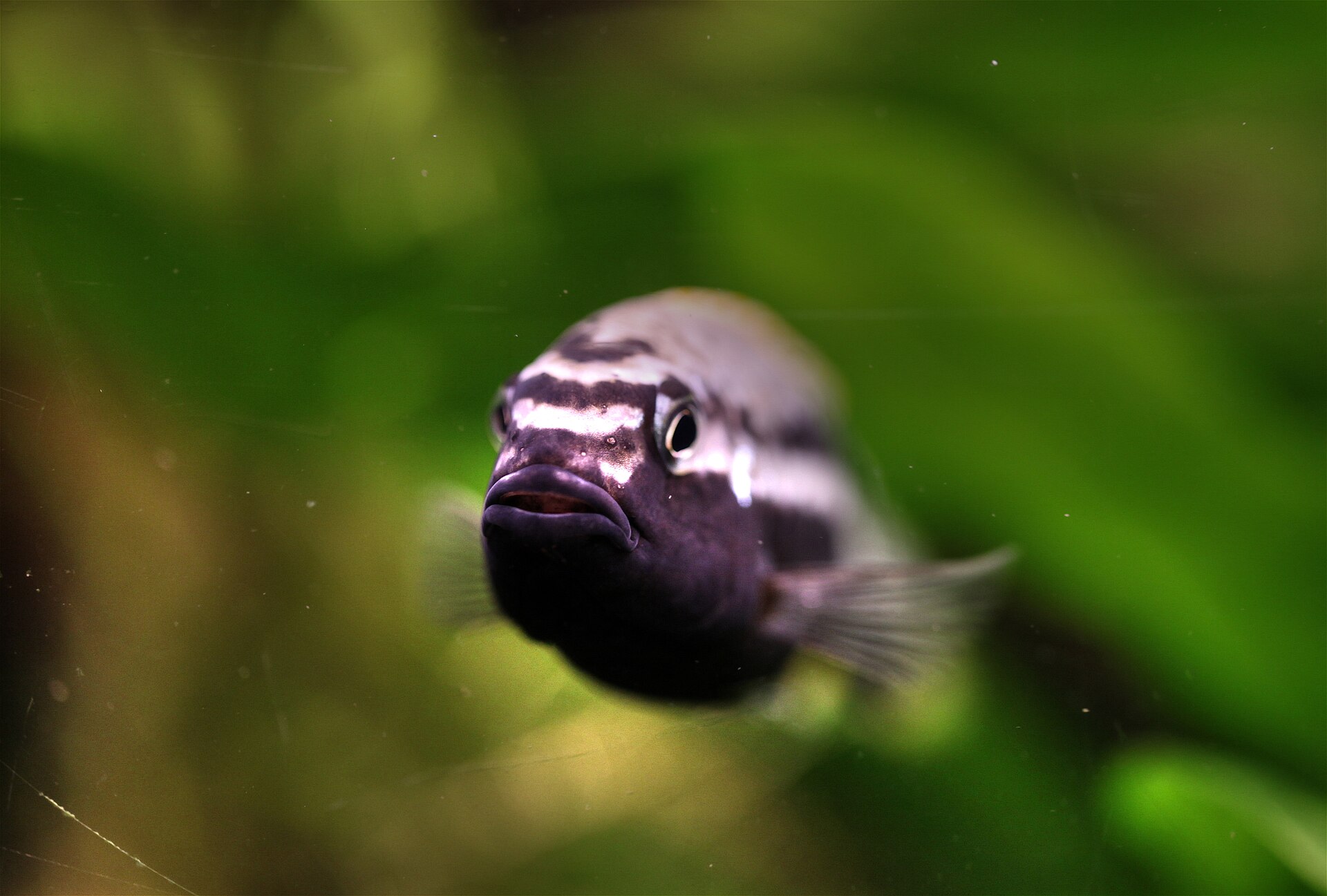
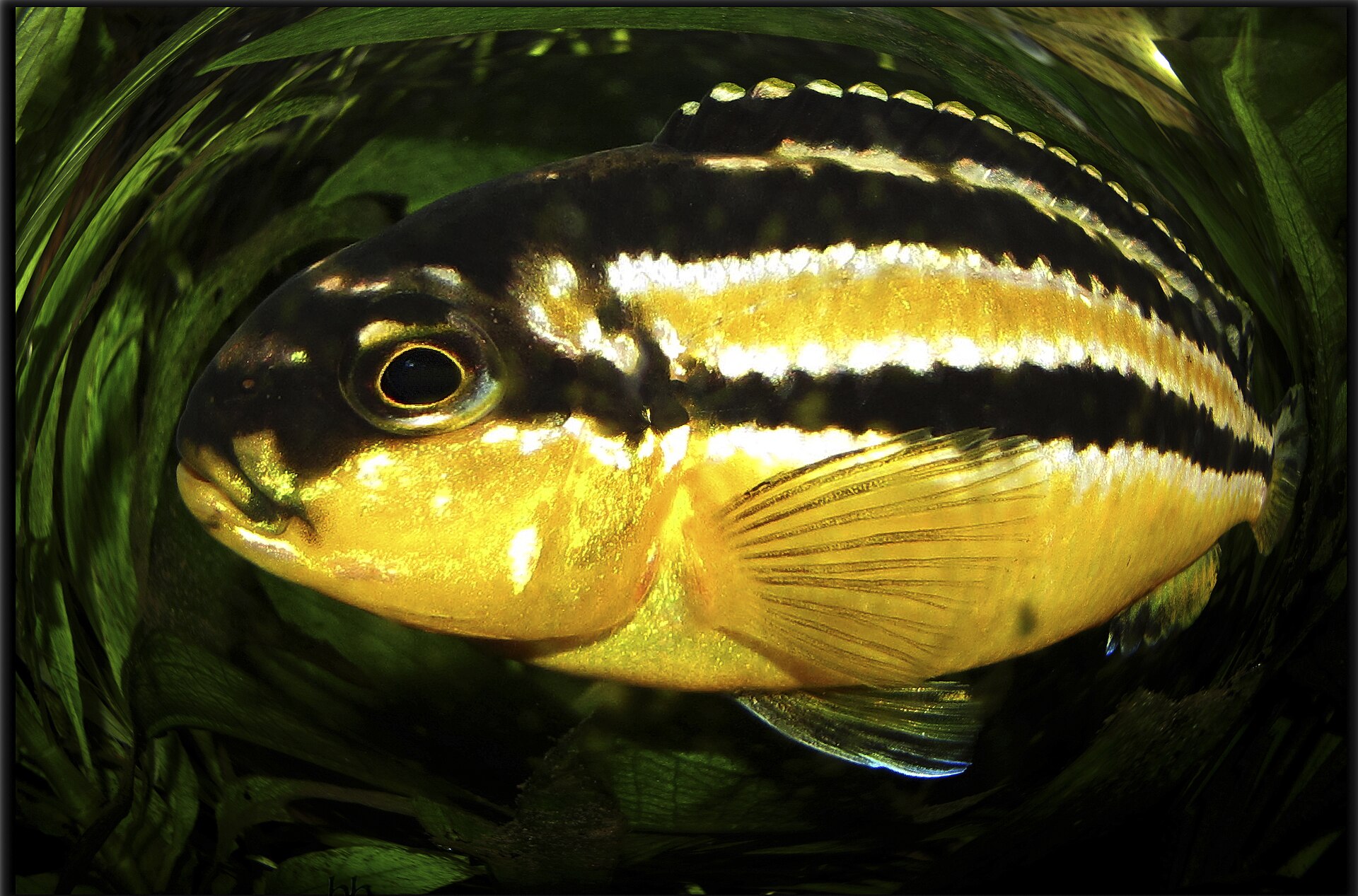
An auratus juvenile looks like a goldfish that learned stripes. Melanochromis auratus, the golden mbuna, starts life — and stays, in females — a buttery yellow with black and white longitudinal bands. Then the males do the Lake Malawi magic trick in reverse of Kenyi: they darken into a near-black fish with electric blue or white stripes, a night version of the same paint. People still try to keep “the pretty gold one” and “the pretty dark one” as a pair of different fishes. They are looking at a female and a male. The gold is not a strain you can lock by selling the dark ones. The dark ones are the fathers.
They come from rocky coasts of Lake Malawi (Nkhudzi Bay and neighbouring stretches are classic). They are mbuna, 10 to 12 cm, aggressively territorial, aufwuchs-feeding, maternal mouthbrooders, and completely unsuited to a sand-only peacock tank or a soft-water planted community. They are suited to a rock-filled, alkaline, overstocked mbuna aquarium where the gold females have places to be not in the male’s face.
The gold is the default; the night is the promotion
Juveniles all wear the female pattern. As males mature, the yellow ground inverts to dark, the stripes become neon edges, and the attitude follows. If your “all gold” group begins to throw dark fish, you are not being invaded by a different species. You are watching sex. Extra dark males need to leave, or the rockwork and stocking need to absorb them, which at this aggression level is a big ask. One mature male, several gold females, and a lot of stone is the usual math.
Rocks that look like too many rocks
Two hundred litres for a mixed mbuna tank that includes auratus, with caves enough that you lose count. Seat every boulder on the bottom so digging — and they dig — does not collapse the hill. Sand in the open. Temperature 24–28°C, pH 7.8–8.6, high KH, bright light, strong filtration, high oxygen. They will graze the aufwuchs on the rock if you let it grow; that is not a dirty tank, that is part of dinner. They will also fight in the open lanes. Sight-breaks are not decoration. They are the difference between a gold female who eats and a gold female who lives in a corner until she does not.
A 80 litre “mbuna starter” with two auratus is a starter for a funeral. Believe the aggression before the centimetres.
Greens, or bloat writes the ending
Herbivore pellets, spirulina, vegetables, the film on the rocks. A little frozen food as a minority share. Auratus that live on bloodworm and beef-style preparations bloat, linger, and die, and then someone blames Malawi as a cursed lake. The lake is fine. The menu was a steakhouse. Feed more than once a day in small passes so subordinates eat. The dark male will claim the first drop. The second drop, aimed at a cave mouth, is for everyone else.

They will shred plants. Do not build a garden and add auratus to “control algae.” They will control the garden.
Do not house them with their own reflection in another species
Other Melanochromis with similar stripe logic (there are several) will fight auratus and hybridise with them. Peacocks will lose. Mild haps will lose. Tiny non-Rift fishes will lose and also dissolve in pH 8.2. Compatible company is other mbuna of different colour language in a large, crowded rock tank, and perhaps a Synodontis that keeps to the floor. Two dark males is a no. A dark male and a similarly dark male of a cousin species is also a no. Gold females of auratus next to gold females of something else is how you lose track of species and produce brown grandchildren.
They are more aggressive than their size, including toward keepers’ hands at feeding time. That is not cute. It is a 12 cm mbuna doing mbuna. Move your fingers.
A gold mouthful of eggs
The female holds. She is still gold, still barred, now with a stretched throat. Three weeks. The dark male does not help except by providing the eggs in the first place and then being a nuisance. Protect her with rock and numbers. Raise fry elsewhere if you want them. The display will eat them. You will get a mix of gold young, and later the males will night themselves. If you sell “gold auratus” you are mostly selling females and juveniles. Tell people. The surprise dark fish is how this article exists.
Reading gold versus night as health
A female that goes pale, not gold, is stressed or ill. A male that cannot hold the dark and looks blotchy may be losing a fight or battling bloat. Ich on gold is easy to see; ich on a dark male is easy to miss until it is late. Quarantine new mbuna in a rock QT. Do not add one auratus to an established colony and walk away; introduce multiples or reshuffle rock.
Lifespan can be five to eight years in good water. That is a long time to maintain a quarry. It is also a long time to watch a species that invented a gold uniform for half the population and a night uniform for the rest. Melanochromis auratus is not a community highlight. It is a mbuna with a costume change. Build the stage out of rock and alkaline water, feed it like a grazer, and let only one actor wear the dark suit. The gold chorus is the rest of the cast. Confusing the costumes for two species is the opening error. After that, every other error is just mbuna care you skipped.
If you wanted the gold look without the night male, you wanted females only, which means a different social problem (they still fight) and no breeding. That can be a stable tank if you stock enough and they are truly all female. DNA and venting are more reliable than hope. Hope is how a second dark suit appears in month six.
Explore other topics
Dive into more aquarium guides across the site.