

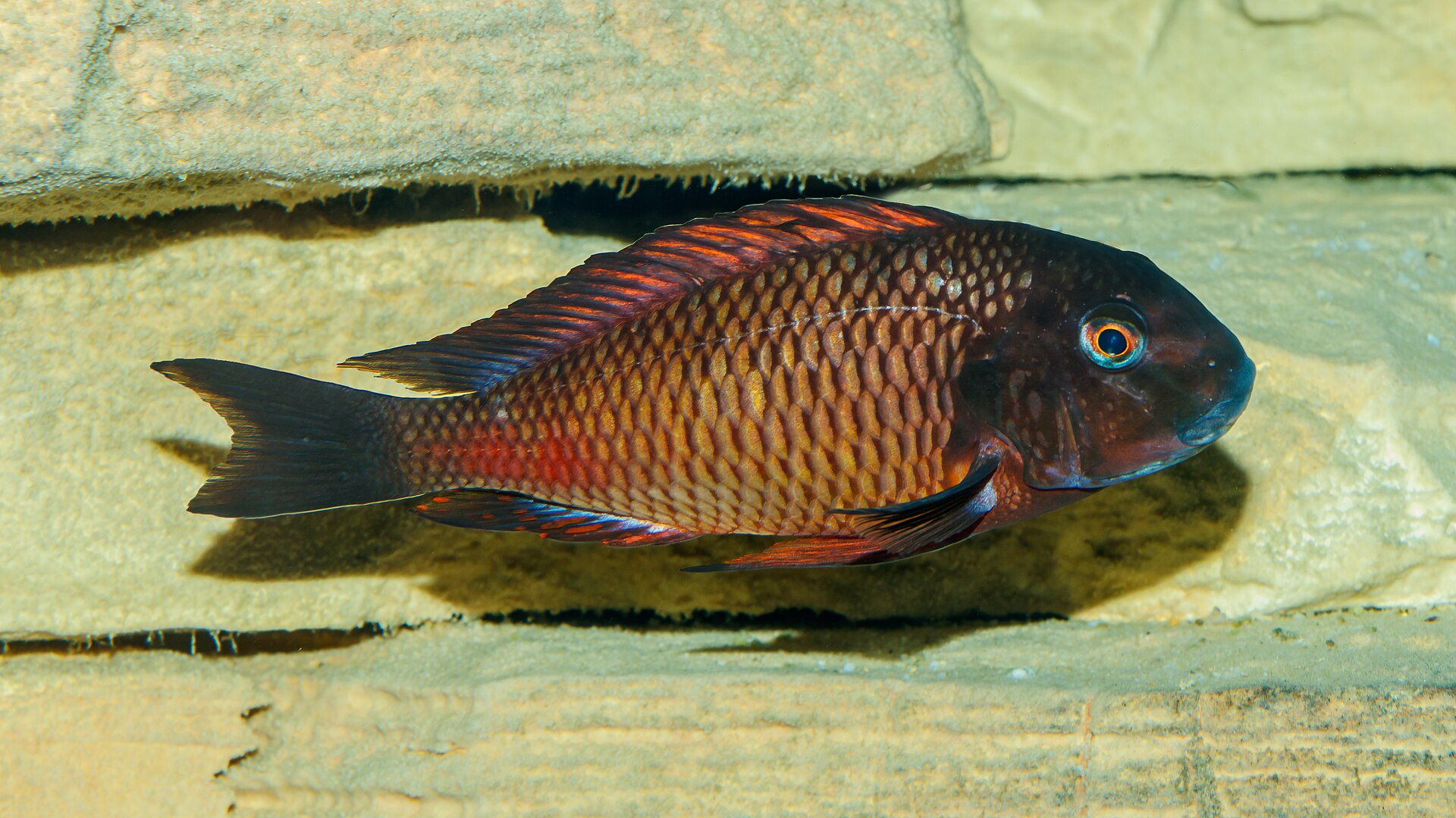
A Tropheus does not want a treat. A Tropheus wants a job. Tropheus moorii, from the rocky coasts of Lake Tanganyika, spends its day combing biofilm off stone, in a colony, in water so mineral it makes Malawi look almost ordinary. The hobby kills more of them with kindness — a frozen cube of bloodworm, a lonely pair, a pH crash, a shipping bag left warm — than with neglect. They are not beginner cichlids. They are not “another mbuna.” They are a Tanganyikan grazing specialist with a gut built for aufwuchs, a social life built for a crowd, and a reputation for bloat that is really a reputation for being fed like a predator.
Locality names matter here in a way they do not for a farmed platy. Moliro, Ikola, Kaiser, Kiriza, and a dozen other coastlines wear different bars and blushes. Mixing localities produces a brown compromise and a conservation shrug. If you can, pick one colour form and stay there. If you cannot, still keep them as Tropheus: colony, rock, vegetables, alkaline, oxygen.
The colony is the animal
A pair of T. moorii in 200 litres is a dominant fish and a victim. A colony of twelve to twenty in 400 litres or more, with a wall of rock, is a functioning Tropheus. They will still chase. Chasing in a crowd is a language. Chasing in a pair is a sentence. Buy a group of juveniles together and grow them as a set. Adding one adult later is how you donate a punching bag. Rearranging rock when you add is only a partial reset. The species wants to know its neighbours from a young age.
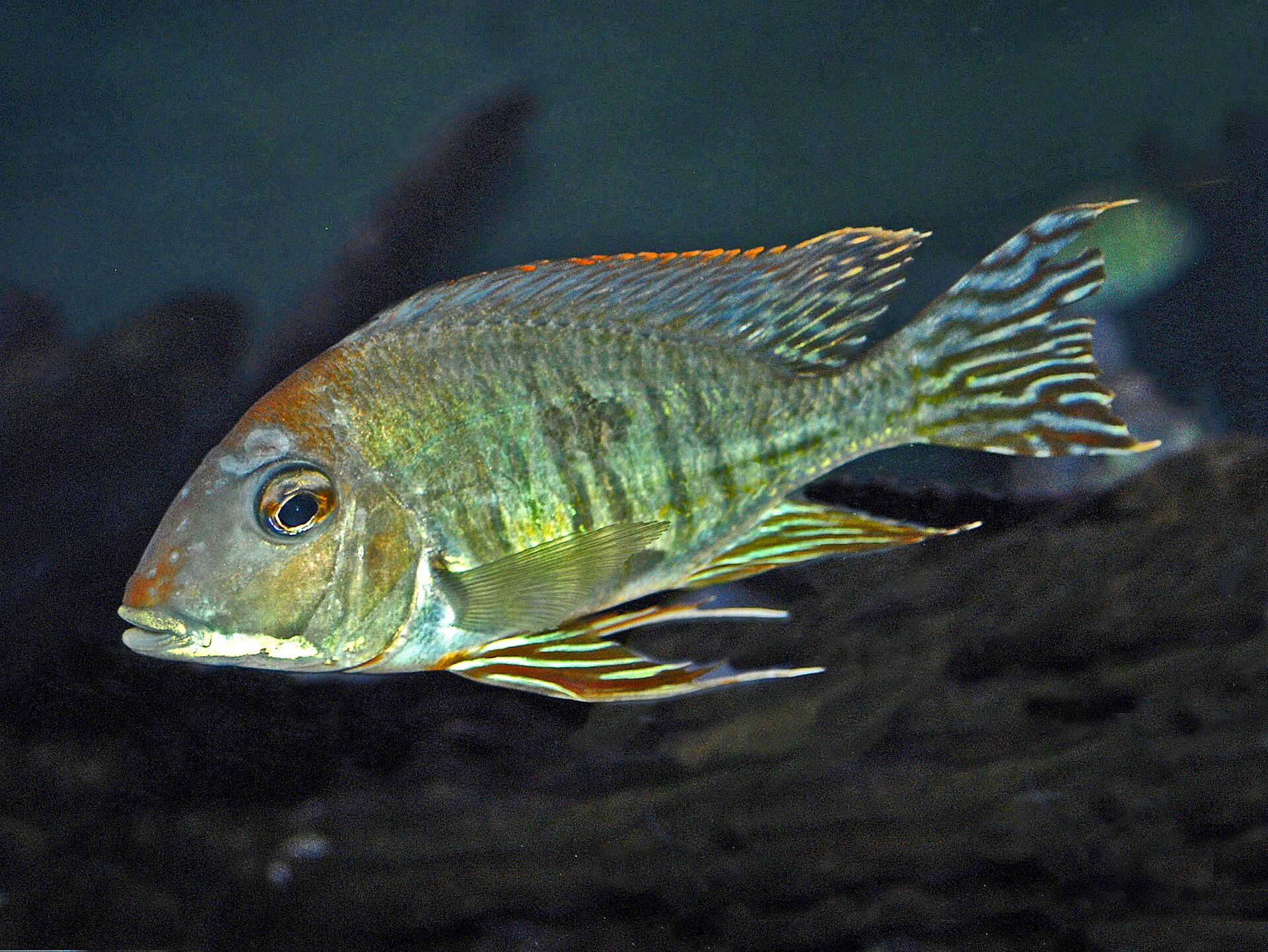
Adults reach 10 to 15 cm depending on locality. Bodies are oval, tough, with a mouth like a scraper. Colour is locality: a central bar, a rust blotch, a yellow wash, a dark fish with a bright band. Sexing is hard. Males may be slightly larger and more aggressive. Venting is used by people who breed them. The rest of us watch behaviour and keep numbers high so one male cannot own every female.
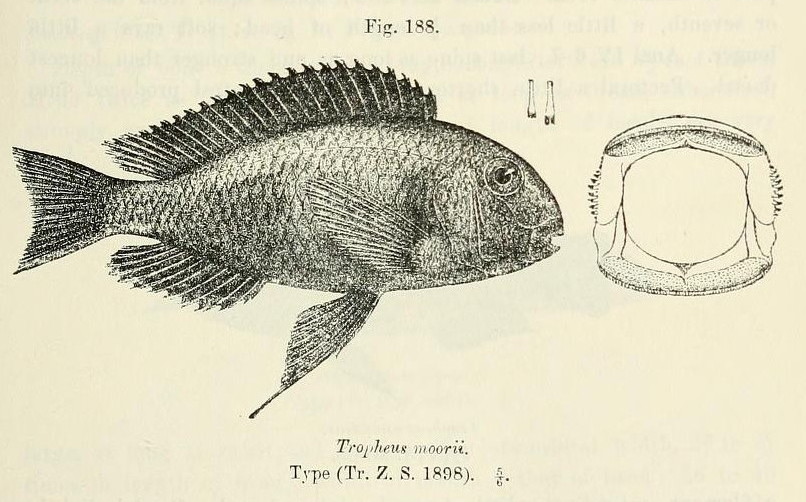
Tanganyika is not a suggestion
pH 7.8 to 9.0, high KH, high GH, temperature 24 to 27°C (hotter pushes metabolism and bloat risk). Conductivity in the range used for Tanganyikan rock dwellers. If your tap is liquid peat, you use RO and a Rift mix. If your tap is already hard and alkaline, you are lucky, and you still test. Sudden changes kill Tropheus. They are not discus, but they are not hardy in the goldfish sense either. They hate filth, they hate empty bellies, they hate a feast of protein, and they hate being alone.
Rock from bottom to near-surface, stacked on the glass. Sand in front. Strong flow, high oxygen, no heaters that they can lodge under as a death cave. Lighting can be bright; algae on the rocks is a feature. You may still feed; wild aufwuchs is richer than tank glass film. You should not strip every green film off the stone every week in a panic about “algae problems.” The algae is part of the furniture.
The contract: fibre in, bloodworm out
Spirulina flakes, specialised Tropheus or herbivore granules, blanched courgette, spinach, nori, and the rock film. Animal food is a rare condiment, not a Tuesday habit. No beef heart. No daily bloodworm. No feeder fish, obviously. Bloat — distended belly, stringy faeces, lethargy, death — follows a protein binge or a starving-then-gorging schedule. Feed small amounts, more than once a day, every day. A Tropheus that fasts for a weekend because you were away is a Tropheus at risk; get an automatic feeder that actually drops the right food, or get a neighbour who understands the contract.

New fish should be eating the vegetable staple in quarantine before they meet the colony. A Tropheus that only knows frozen mysis is not ready.
Who else is allowed on the rock
Other Tanganyikan rock dwellers of similar toughness can work in huge tanks: some Julidochromis if caves are plentiful, some Neolamprologus that will not be flattened, maybe a group of Cyprichromis in the open water if the Tropheus stay on the wall. Malawi mbuna are the wrong lake. Peacocks are the wrong temperament and the wrong diet. Soft-water Amazon fishes are a chemistry crime. Many keepers run Tropheus-only colonies and sleep better. That is a valid design. It is also the one that looks most like the coast.
They will kill a newcomer. They will kill a weak colony member. Count them. Have a hospital tank at the same pH, already running, because a Tropheus moved to soft tap “for treatment” is a Tropheus you may bury.
A small brood, a long hold
Maternal mouthbrooder. Broods are small compared with mbuna, often a dozen or two, sometimes fewer. Hold time can be a month-ish. Females need to eat aufwuchs-style food even while holding, in small amounts, or they crash. Do not strip unless you know Tropheus; the fry are precious and the female is easily wrecked. Colony breeding happens if the group is stable. Raising fry in the colony is possible if the rock is endless and you are lucky; many people pull holding females to a nursery with the same water. Same water. Write it on the bucket.
Shipping, fasting, and why they arrive dying
Tropheus are famous for dying after import because they were starved in transit, then fed a steak, then dumped into a new chemistry. Your job as a buyer is a dealer who feeds them greens, a drip acclimation that takes the time it takes, a quarantine colony or at least a group QT, and the vegetable contract from day one. A single cheap Tropheus is not a bargain. A group from a local, already-adapted colony is the expensive thing that actually lives.
Ich treatments, antibiotics, and anti-bloat protocols should be chosen with alkaline-water and herbivore guts in mind. Not every community-fish bottle is safe. Research before you pour.
The job, again
If you can keep a crowd, a rock wall, and a diet that looks like a salad bar, Tropheus moorii is one of the great Tanganyikan experiences: a moving, grazing, arguing tapestry of a single coastline. If you wanted a pair of colourful cichlids for a 200 litre planted show tank, this species will punish the idea until you either upgrade your life or rehome the fish. There is no middle Tropheus. There is the colony and the contract, or there is bloat and a gap in the rock where a fish used to graze. Pick the colony. Feed the job. Stay in Tanganyika. That is the whole species, including the pretty bar on a Moliro, which was never a treat. It was a wage earned on stone.
Explore other topics
Dive into more aquarium guides across the site.