

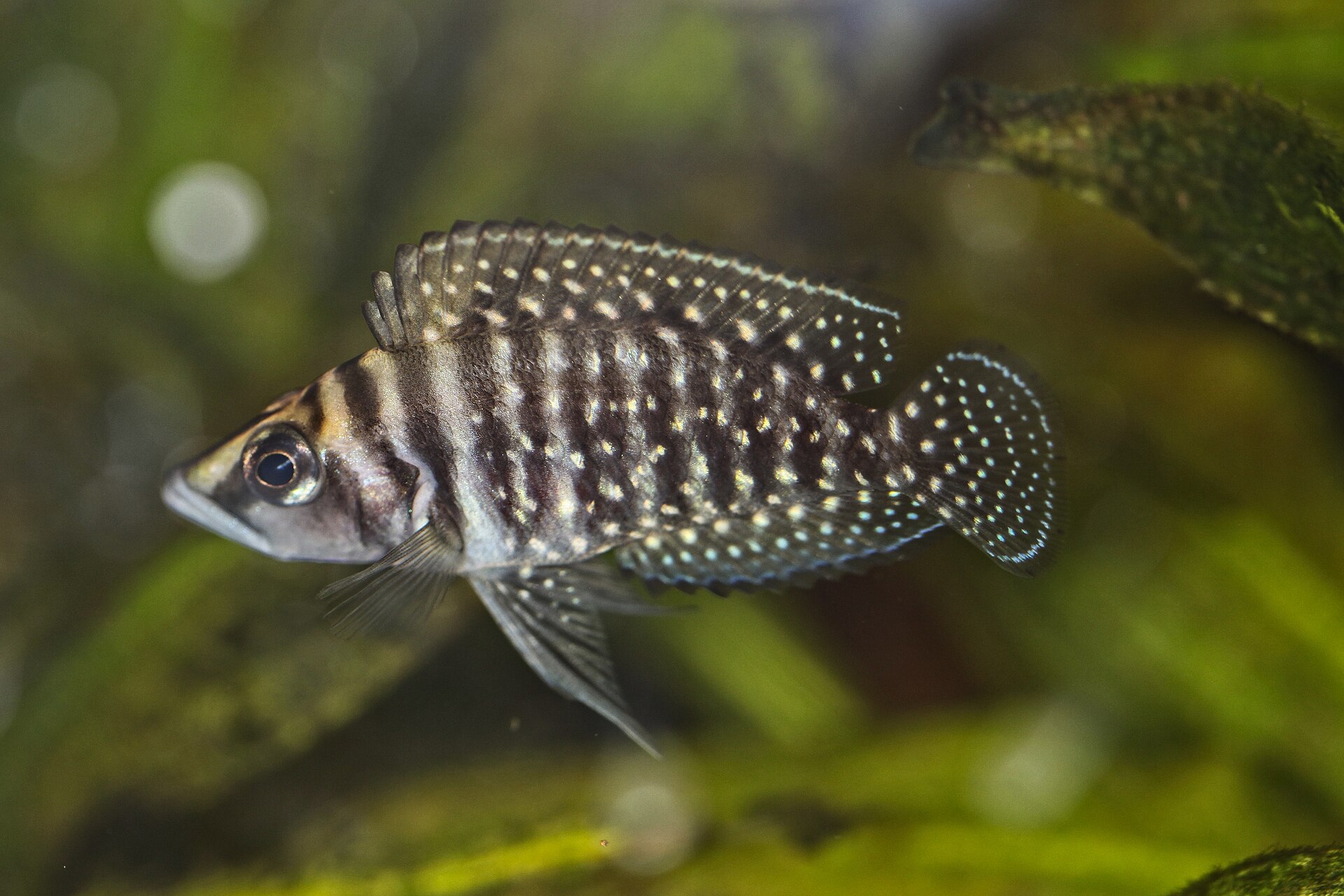
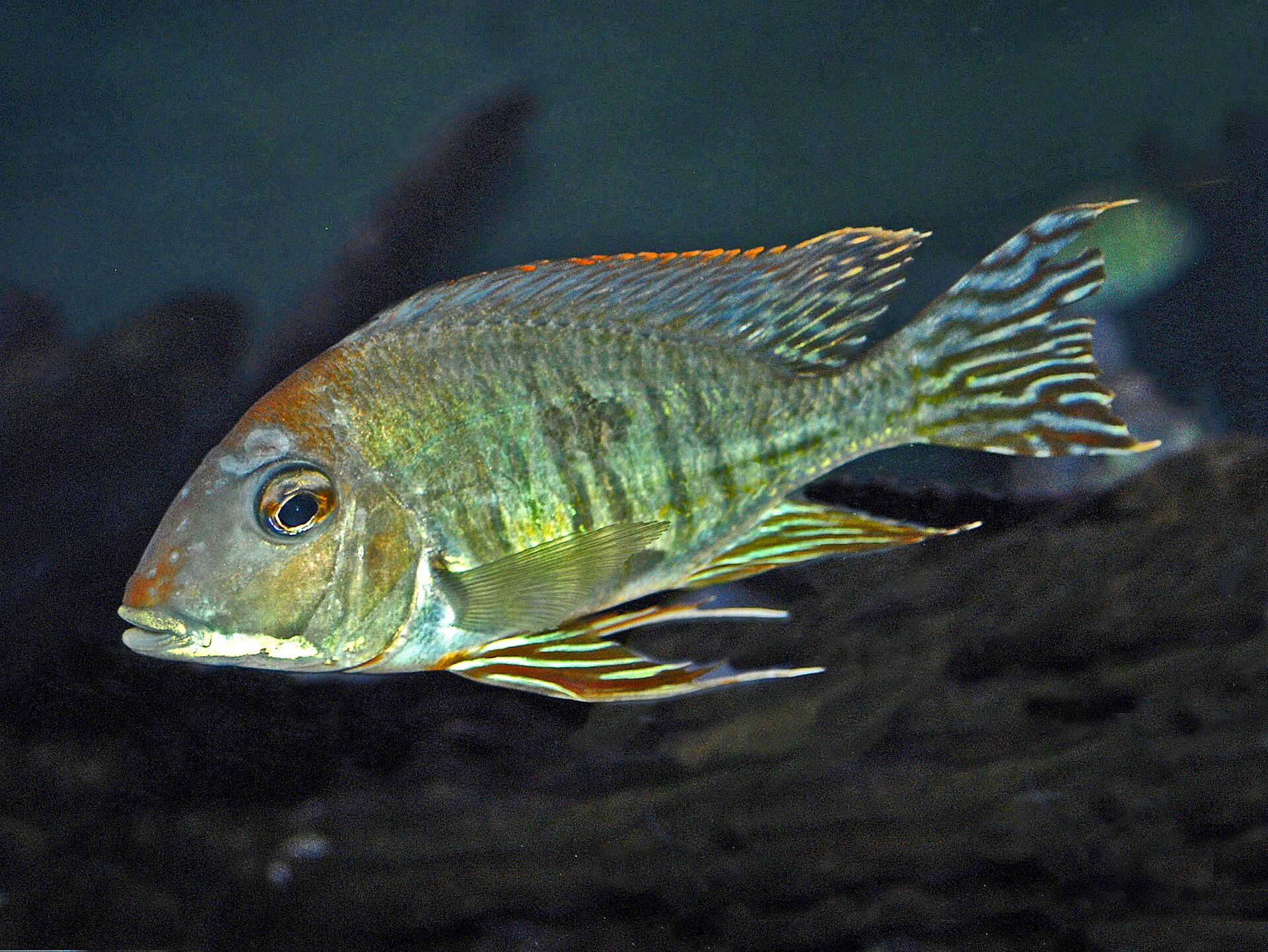
Seen from above, Altolamprologus calvus is a knife. Seen from the side, it is a compressed, high-backed Tanganyikan cichlid peppered with pearls, sliding into rock fissures that would stop a rounder fish. The calvus — white, black, or yellow by locality, Kapampa and other names attached to the better lines — hunts like a thought: slow, then a snap. It eats shrimps, insect larvae, and fishes small enough to share a crack. It is not a community dither. It is not a mbuna. It is a specialist predator that spawned a hobby of watching a fish do almost nothing, beautifully, until something small enough moves.
The cousin Altolamprologus compressiceps is the one with more of a forehead hump and a slightly different compression. Calvus is the “bald” one in the Latin, slimmer in the head, still a laterally flattened hunter. Care is the same family: mineral water, rock with vertical slots, a pair that may not be a pair, and no tank-mates that fit in the mouth if you wanted to keep those tank-mates.
Pearls on a blade
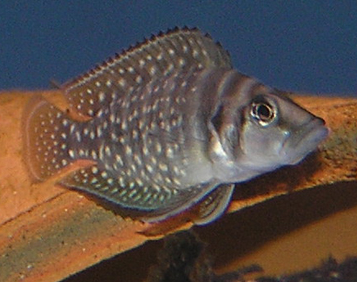
Adults reach about 10 to 13 cm, females smaller, which is the whole breeding system in one measurement. The female can enter a tight cave or a large shell; the male often cannot. Eggs go where the female fits. The body is armoured-looking, the mouth is terminal and capable, the eye is high. White calvus look like ghosts with dots. Black calvus look like wet basalt with stars. Yellow is a locality treasure. Mixing colour forms makes muddy grandchildren and muddy identity. Pick one if you care. Keep the husbandry either way: slots, sand, alkaline, slow hunting.
Vertical rock is the method, not the décor budget
A 150 litre tank can house a pair if the rock is plated to create fissures, not piled into a rubble cone with only round caves. Think books on a shelf, gaps between, some too thin for the male. Sand in front. A few large shells if you like; some females will use them. Temperature 24 to 27°C. pH 8.0 to 9.0. High KH. Clear, oxygen-rich water. Flow that brings food past the ambush without knocking the fish out of the slot. They are not open-water cruisers except when they choose to be. They are not Tropheus on a graze circuit. Lighting can be moderate; you want to see the pearls, not bleach them.
A lid helps. A startled calvus can still bolt. Sharp plastic plants are a way to split a compressed body. Skip them.
If it wriggles and fits, it was food
Feed mysis, chopped prawn, krill, quality pellets that sink, insect mixes. They can be slow to recognise flake. They can be slow to eat in front of you. Target-feed at the fissure after lights settle. Live foods convert well and also convert your shrimp colony into a memory. Do not keep dwarf shrimp with calvus and then write a surprised post. Do not keep tiny fish with calvus. Suitable tank-mates are Tanganyikans too large to swallow that occupy different space: robust rock dwellers in a big tank, open-water cyprichromis well above the ambush line, perhaps a catfish that is not snack-sized. Unsuitable: anything 3 cm and curious about caves.

They are territorial around the chosen crack, not around the whole lake. A large tank with mapped fissures can hold more than one female with one male, which matches the size difference. Two males is a compressed war. Watch introductions. A new calvus stuffed into an owned slot is a dead calvus.
She goes in; he does not
That sentence is the spawn. The female lays in the crevice. The male fertilises from outside or from a position his head will allow. She guards. He guards the neighbourhood. Fry are small and stay in the slot. Parents are generally competent. Tank-mates that wait at the crack are not. A species tank or a very well-structured Tanganyikan tank is how fry survive. You can collect fry from the fissure with a turkey baster if you are gentle and the parents forgive you, which they may not. Many keepers leave them and accept low recruitment.
Sexing: females smaller, often rounder when full of eggs; males longer, more blocked from the nursery. Juveniles are a guess. A group of young in a large, fissure-rich tank can sort into a harem. Pull extra males early.
The slow fish that is not lazy
Calvus spend a lot of time still. That is hunting, not lethargy. A truly lethargic calvus hangs at an odd angle, refuses mysis, and darkens or pales beyond the morph. Check water, check a blocked cave (bullied), check internals. They are not as bloat-famous as Tropheus because they are allowed protein, but they are still Rift fishes that hate filth. Ich on a white calvus is blatant; on a black calvus you have to look for the pearls going matte and the flashing.
Quarantine in a tank that has a slot. A bare box produces a stressed knife that will not eat and will not show normal behaviour, which is the only baseline you have for this species. Acclimate to pH slowly. A calvus from 8.4 into 7.0 is a chemistry experiment with fins.
Why a knife is worth a 150 litre crack
Because no other common Tanganyikan moves like this: the hover, the tilt, the slide into a gap that should not fit, the pearls catching light like a mistake on a black ground. Altolamprologus calvus is a fish you keep for watching, not for a school, not for a garden, not for a peaceful community certificate. Build the fissures. Feed the ambush. Keep the lake chemistry. Leave the shrimp in another room. If that sounds like too much architecture for one predator, it is, and you should buy a fairy cichlid and enjoy a palace instead. If it sounds like the point of rockwork, you already understand calvus. The compression is not a deformity. It is a key. Cut the lock to match, and the pearls come out at dusk to work.
Locality names on a bag are worth paying for if they are real. If they are not, keep the fish as a calvus anyway: slots, minerals, a female-sized nursery, a male who waits outside. That architecture is the species better than a fake village name. The knife does not care what the coast was called. It cares whether the crack fits.
Explore other topics
Dive into more aquarium guides across the site.