

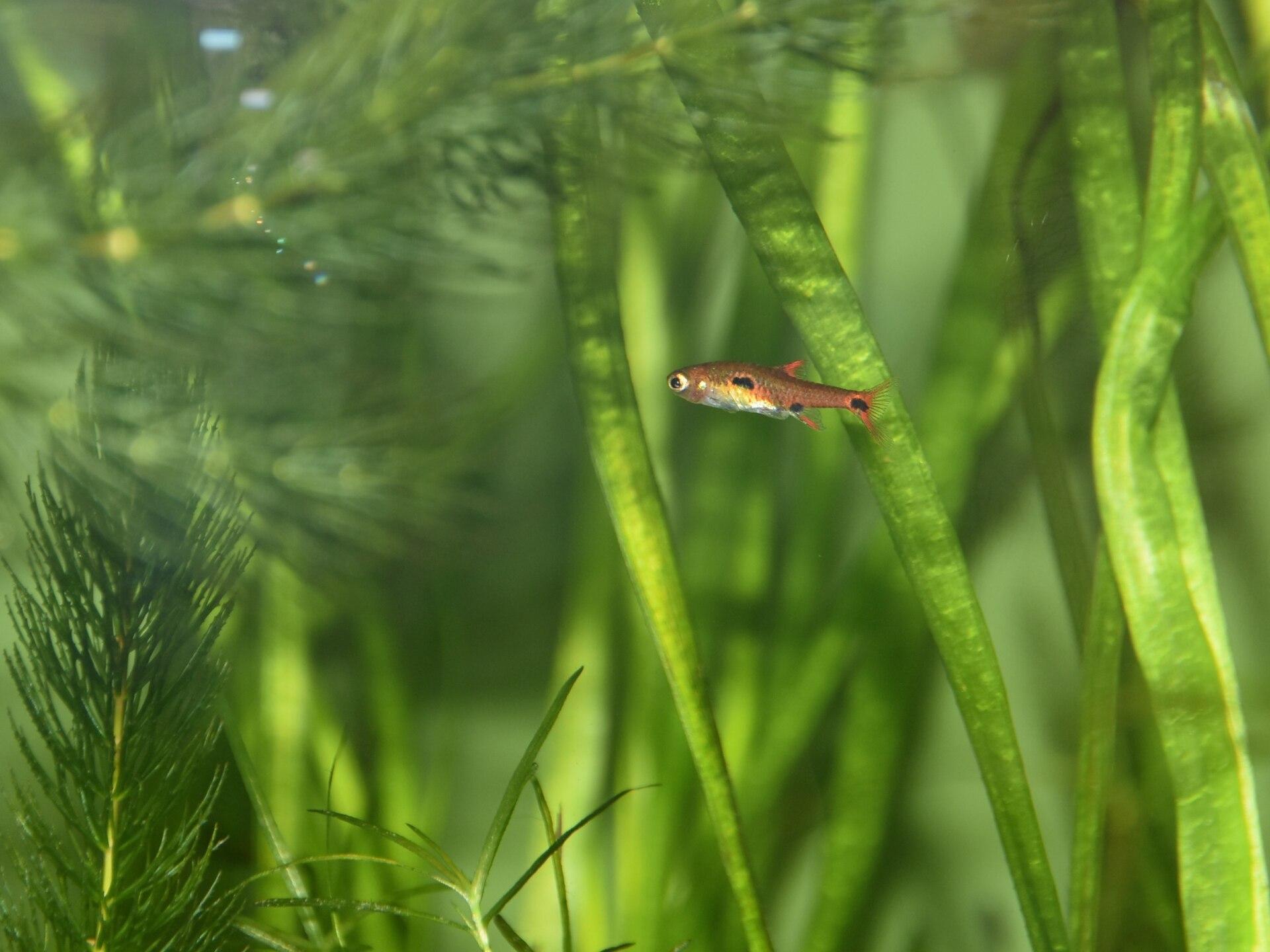
The clown rasbora is a fish you almost miss until the light hits the right angle. Boraras maculatus does not school like a tetra in open water. It hangs in stained, plant-choked peat swamp, and the whole point of keeping it is to recreate that dim, acidic pocket — not to drop a handful of “small red fish” into a hard-water community already full of barbs and Corydoras.
Adults top out around 2 to 2.5 cm. That is not a juvenile size. The mouth is a pinprick. If you feed the same pellets you use for a harlequin rasbora, this species will starve in a tank that looks well fed. Get that fact into your head before you buy the bag.
Peat swamp, not a river run
Wild fish come from Peninsular Malaysia and Sumatra, from blackwater peat swamps where the water is the colour of strong tea, the bottom is leaf mush and fine sand, and the canopy cuts most of the sun. Current is weak. Dissolved minerals are scarce. pH can sit well below 6. The fish live among roots, submerged grasses, and tangles of decaying plant matter, not over bright gravel in a box with a powerhead.
That habitat explains almost every husbandry rule. Hard, alkaline tap water bleaches the red and the spots. Bright overhead LEDs without shade push the school into a corner. A filter that turns the tank into a washing machine exhausts a fish this small. You are keeping a swamp minnow, not a stream rasbora and not a Lake Tanganyika cichlid.
How to recognise a true clown
The common name comes from the dark blotches along the flank, more like a scatter of ink than a clean lateral stripe. Body colour runs from copper-orange to a deeper rust when the fish is settled and the water is soft. Males in display look tighter and more intensely marked; females carry a rounder belly when they are feeding well. There is no “giant” form. If a shop fish looks 4 cm long, you are looking at a different cyprinid.
Do not confuse B. maculatus with the chili rasbora (Boraras brigittae) or the strawberry rasbora (Boraras naevus). Chili fish are a cleaner crimson with a dark lateral dash and come from southern Borneo. Strawberries wear a rounder mid-body patch and are a southern Thailand peat fish. Mixing the three in one nano tank is possible only if every fish is this small and the water is peat-swamp chemistry — it is not a reason to treat them as colour morphs of one species.
A swamp in 30 to 40 litres
A 30–40 litre tank is enough volume if you treat it as a dedicated blackwater cube, not as a starter kit for six random community fish. Footprint matters more than height. Cover most of the surface with floating plants or a raft of frogbit so the clown rasboras can sit in mottled shade. Plant the back and sides densely — Java moss, Taxiphyllum, fine-leaved stems, Cryptocoryne if your water will support them. Leave a small open lane in the middle so you can actually see the school.
Substrate should be fine and dark. Leaf litter (catappa, oak, or similar botanicals) is not decoration; it is the furniture this species uses. A sponge filter or a heavily baffled hang-on is the right kind of movement: surface stir for gas exchange, almost no current in the water column. Skip the waterfall intake. Skip crushed coral and limestone. This is not a rift-lake layout.
Stock a group of ten or more. Six fish in a bright, open tank will plaster themselves against the glass and look diseased. Twenty in a stained, planted 40 litre look like a living constellation. That is the behaviour you are buying.
Water that tastes like peat
Aim for 23–28°C. Cooler than that and they sit; hotter than the high twenties and a tiny body has no reserve when oxygen dips. pH 4.5–6.5 is the real range, not a “tropical 7.2” compromise. Soft water is not optional for colour or for long-term health. If your tap is liquid rock, mix reverse-osmosis water and remineralise only enough to give the fish a little conductivity — do not dose Rift Lake salts, and do not dump pure RO into an established tank in one go.
Ammonia and nitrite must stay at zero. Nitrate should be modest; in a small planted swamp that means small, frequent water changes of water that matches temperature and chemistry, not a 70 percent dump of cold tap once a month. Tannins from leaves will stain the water. That stain is correct. Clear, sparkling water is what a clown rasbora looks faded in.
Cycle the aquarium fully before these fish go in. A 2 cm cyprinid does not survive the ammonia spike that a larger rasbora might stagger through. If you are new to cycling, read a proper cycling guide and wait for a mature filter, not a bottle of “instant bacteria” and hope.

Food sized for a pinhead mouth
Clown rasboras are omnivores that take zooplankton and tiny particles in the wild. In the tank that means powdered or crumbled foods, baby brine shrimp, cyclops, microworms, vinegar eels for fry, and the occasional grindal worm. Frozen daphnia can work if the pieces are small enough. Standard 1 mm pellets will sit on the sand while the fish ignore them and slowly hollow out.
Feed twice a day in amounts that vanish in a minute. Watch the back of the school; the shy fish at the rear are the ones that starve when midwater tetras or a hungry gourami are in the same box. After a water change, they often feed more boldly. A well-fed male shows a cleaner edge to the spots and a warmer body. A hungry group looks grey-brown and glued to the plants.
Who belongs in a swamp this small
Tankmates must be as small and as gentle as the clowns. Other Boraras, celestial pearl danios in a slightly less acidic setup, tiny pencilfish, dwarf shrimp that can handle soft water, and perhaps a pair of sparkling gouramis in a larger planted tank are the usual conversation. Do not add Corydoras that will outcompete them at the bottom for the same micro-foods while adding bioload. Do not add hatchetfish that want a long, open surface. Do not add any cichlid, even a “dwarf” one. An apisto will eat these fish. A shell-dweller lives in the wrong water entirely.
Snails that do not require hard water can help with leftover powder, but skip mystery snails that prefer mineral-rich tanks. If you want shrimp, choose species that tolerate low pH, and accept that rasbora fry and shrimplets will not share a tank forever.
Scattering eggs in moss, then ignoring them
Males are slimmer and, in a settled group, more vividly spotted. Females thicken through the abdomen. They are egg scatterers. There is no cave, no shell, no mouthbrooding. In a densely planted, mature swamp a few fry may survive in the moss if you do not siphon every leaf. If you want a real spawn, condition the group on live foods, move a pair or a small group to a dim tank with Java moss and a sponge filter, and remove the adults after they scatter. Fry need infusoria or commercial fry powder before they can take baby brine.
Do not expect a clutch on a schedule. Peat-swamp Boraras spawn when they are fat, unstressed, and sitting in water that already looks like their home. Chasing pH with acid buffers the night before a “breeding attempt” is how you lose the adults.
What actually kills clown rasboras
Ich and velvet hit tiny fish fast; by the time you see spots, a 2 cm body has little margin. Prevention is quarantine of new fish in a planted hospital tub with a sponge filter, matching chemistry, and observation of appetite — not a copper sledgehammer in the display. Clamped fins, hovering at the surface, and a hollow belly are the three signs to act on. Test the water before you medicate. Most “mystery deaths” in nano rasboras are ammonia, a temperature crash, or a tankmate that ate them.
Shipping bags are brutal for this species. Float and drip-acclimate slowly, especially if the bag water is more acidic than your tank. Do not dump them into a brand-new, crystal-clear aquascape with a strong lily pipe. Let the tank brown up. Let the plants grow in. Then add the school.
Long-term, the work is small water changes, keeping the sponge from choking, and never letting the food size creep up because you bought a new tub of pellets for other fish. A clown rasbora that still has round flanks and active, slightly nervous schooling after two years is a fish you have kept properly.
If you wanted a different rasbora
If you want a larger, silver schooling fish for a community, look at harlequin rasboras or a true river Rasbora. If you want the reddest nano in the peat swamp, compare this species with the chili rasbora and decide based on markings and origin, not on which bag was cheaper. Soft, acidic water is the shared language of the genus; the clown’s language is spots, leaf litter, and a mouth that will not forgive lazy feeding.
For the chemistry that makes or breaks a peat tank, start with aquarium water chemistry basics. Then build the swamp, wait until it looks lived-in, and only then buy Boraras maculatus.
Explore other topics
Dive into more aquarium guides across the site.