

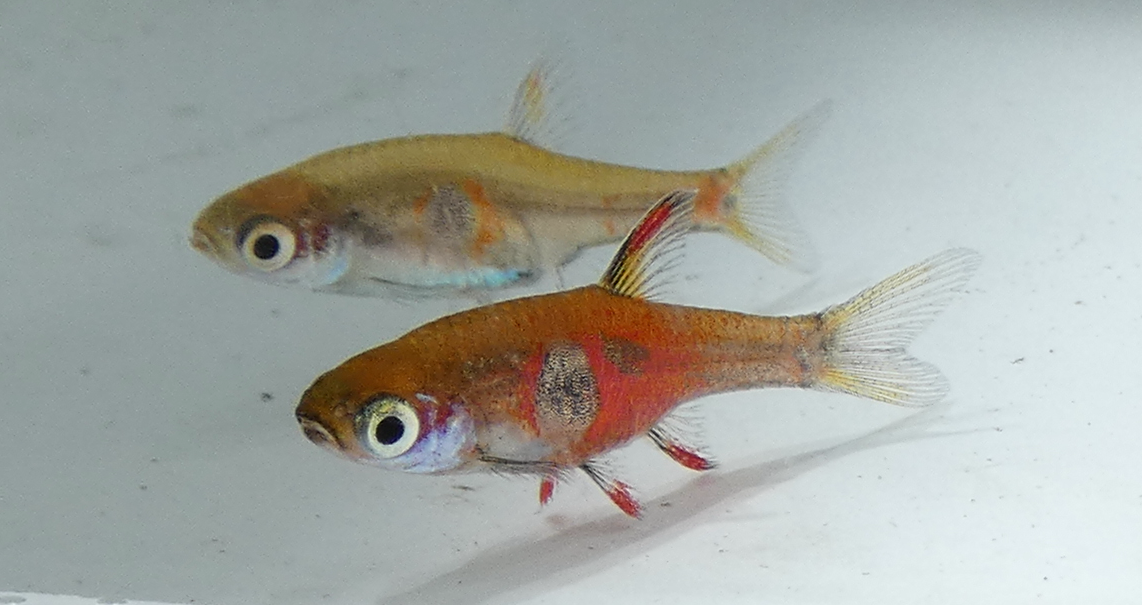
Call it strawberry rasbora if you like the trade name, but the fish you are actually buying is Boraras naevus, a southern Thailand peat-swamp cyprinid that wears a round, bruise-like patch on the side. It is not a faded chili rasbora, not a baby harlequin, and not a community “filler” for a 60 litre tank already stocked with tetras. At 1.5–2 cm adult length it is among the smallest vertebrates in the hobby, and it behaves like it: huddle in shade, pick at specks, panic if the room is too bright.
Keepers who succeed with this species stop thinking in gallons of “tropical community” and start thinking in teaspoons of water chemistry and millimetres of food. That is the entire care sheet, stretched out into a tank that looks like flooded peat.
Thailand’s peat, not Borneo’s chili swamp
The strawberry rasbora is tied to peat habitats in southern Thailand. The water there is soft, stained, and poor in minerals. Vegetation and decaying plant matter break up the light. Current is an afterthought. When you copy that at home, you are not copying a Malaysian clown rasbora swamp or a Bornean chili habitat even though all three genera of tiny red fish like similar numbers on a test kit. Origin still matters for how the fish is collected, how captive-bred lines behave, and which lookalikes you might be sold.
If a shop labels every red nano “chili,” look at the mid-body mark. B. naevus has a more ovoid, concentrated patch. B. brigittae shows a darker longitudinal marking on a cleaner red body. B. maculatus is a clown-spotted fish from further south. Buying a mixed bag and hoping they school as one species is how you end up with a stressed, mismatched group that never colours up.
Reading the patch and the belly
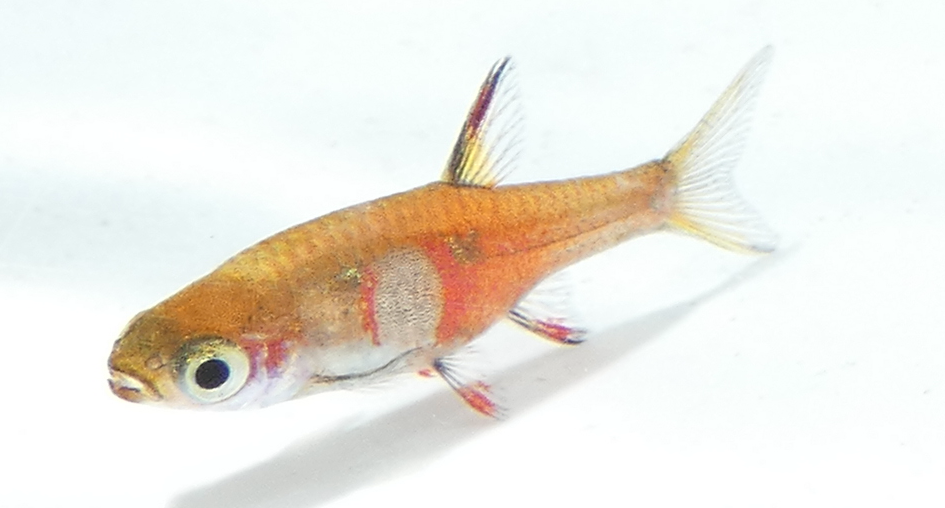
A healthy strawberry rasbora is not neon. It is a warm, fruit-skin red to orange with that namesake naevus on the flank. In poor water or under white gravel and blasting light, the same fish turns dusty and the patch fades to a grey smudge. Males in a settled school look slimmer and more saturated; females fill out when they are eating well. You will not sex them reliably in a dealer tank under fluorescent lights. Wait until they have been in your stained water for a few weeks.
There is no ornamental “longfin strawberry.” If the fins look shredded, that is damage or disease, not a variety. If the fish is 3 cm long, it is the wrong species.
Twenty-five litres of still, brown water
A 25–40 litre aquarium is the right scale if it is dedicated. That does not mean a bare kit tank. Cover, botanicals, and a crowd of twelve or more fish are what make 25 litres work. A single pair in a 10 litre desktop is a slow death by loneliness and parameter swing.
Plant heavily. Use a dark, fine substrate. Float a layer of plants so the surface is broken. Add leaves and alder cones until the water holds a tea tint — then stop adding botanicals if pH is still crashing below the range you can measure stably. Filtration should be a sponge or a gentle internal filter. You want the surface to move. You do not want the fish to mill in a circuit because the outflow is a jet.
Lid the tank. These fish do not hunt like hatchetfish, but a startled nano will jump, and a 2 cm body on the carpet is a body you will not find until it dries.
Numbers on the test kit
Temperature 24–28°C. pH 4.5–6.5. Soft water. Zero ammonia, zero nitrite. That is the box. Captive-bred fish may tolerate the upper end of pH better than wild peat fish, but they still look wrong in liquid limestone. If you cannot provide soft water, pick a different cyprinid. Hardness is not a personality test; it is physiology.

Because the tank is small, evaporation concentrates everything. Top off with RO or distilled, not more tap. Change water in 15–20 percent slices with temperature-matched, chemistry-matched water. A strawberry rasbora does not need a “deep clean.” It needs you to stop resetting the swamp every Saturday with a gravel vacuum that removes every leaf.
Learn what your tap actually is. Read water chemistry basics before you buy peat and hope. If the tank is not cycled, do not add these fish. They have no biomass buffer. See how to cycle an aquarium.
Watching them eat — if you can
The diet is omnivore in the textbook sense and zooplankton in practice. Powdered foods, crushed flakes that have been crushed again, baby brine, cyclops, infusoria-grade products, and microworms are the menu. Drop a bloodworm in this tank and you have decorated the sand. Feed in the shade line where the school actually sits, not in the open bright corner where you like to watch.
A well-conditioned female shows a fuller outline. Males flicker at each other without tearing fins. If the group ignores food, check temperature, ammonia, and whether a larger fish is intercepting every particle. These rasboras will not compete with danios. They will not compete with most tetras. They lose.
Tankmates that will not inhale them
Best: a species tank of strawberry rasboras. Next best: other Boraras, or shrimp that tolerate the pH. Possible in a carefully built larger planted tank: celestial pearl danios, the smallest pencilfish, maybe a small Otocinclus group if you can feed both the otos and the rasboras. Bad: anything that hunts, anything that is boisterous, anything from Lake Tanganyika, anything sold as a “dwarf cichlid,” and any catfish that treats 2 cm fish as food.
Do not use this species to “dither” an apisto tank. The apisto will dither them into a gut. Do not put them with Corydoras “because both like sand.” Corydoras want different social structure, different food size, and often harder water than a Thailand peat specialist.
A scatter spawn you might never see
Breeding is egg scattering among plants and roots. Parents eat eggs. Fry are nearly invisible. A dedicated breeding box with moss, dim light, and infusoria is how serious keepers get numbers. In a mature display, accidental fry appear as tiny needles in the back corner if you are lucky and understocked with shrimp. Sexing is easiest when the group is fat and the males are displaying that extra warmth of red around the patch.
Do not strip-spawn them like barbs. Do not use a mesh breeder in a community tank and expect survival. The fry are peat-swamp plankton eaters. Treat them that way.
Fading, fungus, and empty bellies
Velvet is a classic killer of nano cyprinids; the gold dust is easy to miss on a red fish in brown water. Quarantine new arrivals. Watch breathing rate. Watch whether they still mill as a group. White fungus on the mouth often follows shipping damage. Salt-heavy “community meds” and high pH treatments are a poor match for a fish that lives at pH 5. When in doubt, fix water, warmth, and food size before you invent a disease.
The long game is boredom in the best sense: the tank stays brown, the sponge stays clean enough to flow, the school stays large, and you keep feeding dust. If you wanted a fish that patrols like a scissortail, you wanted Rasbora trilineata, which is a different animal in a different sized river. Strawberries are the opposite of that fish.
Compare markings with the chili rasbora and the clown rasbora before you click buy. Then build the peat, not the community list.
Explore other topics
Dive into more aquarium guides across the site.