

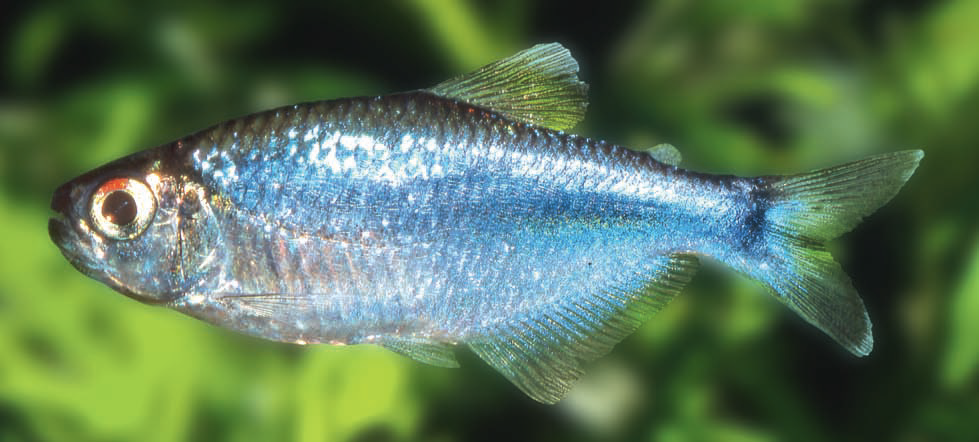
Cochu’s blue tetra is one of the few small characins that actually looks blue in a living room, not just in a shop LED. Boehlkea fredcochui (named for importer Fred Cochu) comes from the upper Amazon in Peru. The blue is a structural sheen on a 4–5.5 cm body. It shows when the school is large, the water is clean, and the fish are not being chased. It vanishes when you keep four of them as “colour” in a goldfish-bright tank.
A Peru blue, not a Congo blue
People mix this species with African “blue” tetras and with Congo tetras. Cochu’s is a South American characin, smaller than Phenacogrammus, and it wants Amazon-leaning water: 22–27°C, pH about 6.0–7.5, softness preferred but not peat-swamp extreme. Congo tetras are African alestids that need more space and a different body language. If your tank is built for Congo tetras, Cochu’s will be a sparkly snack-sized side school unless the volume is generous and feeding is careful.
Wild habitat is forested rivers and tributaries with current in places and cover in others. They use midwater. They are not hatchets. They are not cave morphs.
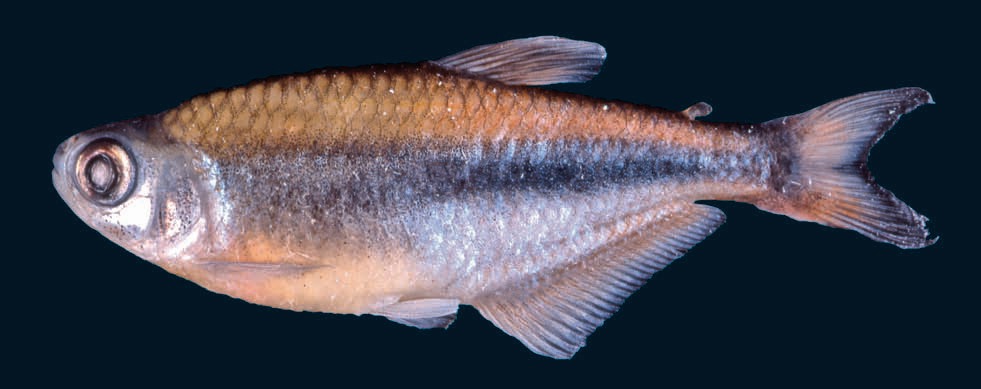
When the blue turns grey
Adults are torpedo-shaped with a steel-blue to electric-blue wash, darker dorsally, and reddish hints in the fins on good males. Stress, hard alkaline water, and a tiny group bleach them to grey-pink. Lighting from the front or side over a dark substrate shows the blue; overhead white blast on pale sand hides it. Males are slimmer and often more intense; females are rounder. The difference is not as theatrical as a male black phantom’s dorsal.
They reach 5–5.5 cm. That is large enough to nip if understocked. A school of ten or twelve dilutes chasing. A school of four produces a boss and three faded subordinates.
Midwater layout with a little current
A 80–100 litre tank is a sensible start for a proper group. Give them a swimming lane and planted or wooded sides. Gentle to moderate flow keeps them active without turning the tank into a danio river. They will use the whole middle third. Surface plants take the edge off lighting and reduce jumping, but they are not surface-bound. A lid is still required; startled Boehlkea can jump.
They produce a moderate bioload. Weekly water changes matter because the blue sheen is also a health sheen. Nitrate-tolerant is not the same as nitrate-pretty.
A school with a slightly sharp edge
Cochu’s blues are generally peaceful community fish, with an asterisk: they may nip long fins, especially in small groups or in too-small tanks. Slow angelfish, bettas, and fancy guppies are a risk. Better companions are other robust small tetras, pencilfish in a large planted tank, Corydoras, and rainbowfish that share temperature. Avoid mixing them with tiny Boraras; the blue tetras are too fast and too large at feeding time.
They can coexist with hatchets if the hatchets get surface food and the Boehlkea get midwater food. They should not be used as dither fish for large cichlids.

Colour as a feeding problem
They are omnivores that hunt small invertebrates. Flakes and micro pellets are a base; frozen bloodworm, daphnia, and brine shrimp bring condition and colour. They will take food throughout the column, which makes them easier to feed than hatchets and harder to keep thin than splash tetras. Two small feedings beat one feast. Overfed fish lose shape and foul the water, and then the blue goes anyway.
Live foods help condition spawners. They are not obligatory for display fish if frozen substitutes are varied.
Scatter spawning a blue school
Egg scatterer. Fine plants or mops, slightly softer water, and a conditioned pair or group. Adults eat eggs. Fry are typical small characin fry. There is no jumping spawn and no cave-form ritual. If a care sheet tells you to lower the water for aerial eggs, it stole a splash tetra paragraph. If it tells you to provide shells, it stole a Tanganyikan paragraph.
Raising fry needs infusoria then baby brine shrimp and protection from the parents. A species tank with moss can yield accidental young; a mixed community will not.
Shop blues and dyed impostors
Some cheap “blue tetras” are dyed. Cochu’s blue should look even, metallic, and able to fade with mood, not like ink blotches. Quarantine new fish; mixed tetra vats share ich. They are tougher than marbled hatchets and more temperature-flexible than Costello tetras, but they are not Astyanax. Watch for nipped fins inside the school as a stocking clue: add more Boehlkea or add cover, do not add a random tetra from another continent.
If the blue you wanted was African and twice the size, look at yellow-tail Congo tetras or true Congo tetras and give them African space. If you wanted a Peru school that lights up like brushed steel, Boehlkea fredcochui is the one, and the group size is the dimmer switch.
Blue as a stocking dial, not a light bulb
People buy extra LED strips when Cochu’s blues look grey. The sheen is structural; blasting the tank often makes them hide, which makes them greyer. Turn the light down, add six more fish, and feed frozen invertebrates for two weeks. If the blue still fails, test hardness and nitrate. If those are fine, look at nipping: a shredded anal fin on a subordinate is a group that is too small or a tank that is too short.
Fred Cochu’s export pipeline is a history note, not a husbandry method. Modern fish are farmed in various places. Farmed stock is still Boehlkea fredcochui. It still nips when lonely, still jumps when startled, and still looks like brushed steel only in a crowd. A “blue tetra” bag that never fades is dyed. A bag that goes dull in the car and brightens in a planted Peru-style tank is the real animal.
Weekly maintenance should protect the midwater lane. Do not rearrange the whole scape every Sunday; they settle against known wood. Siphon waste from the ends, not by tearing out the swimming corridor they use to show colour.
Explore other topics
Dive into more aquarium guides across the site.