

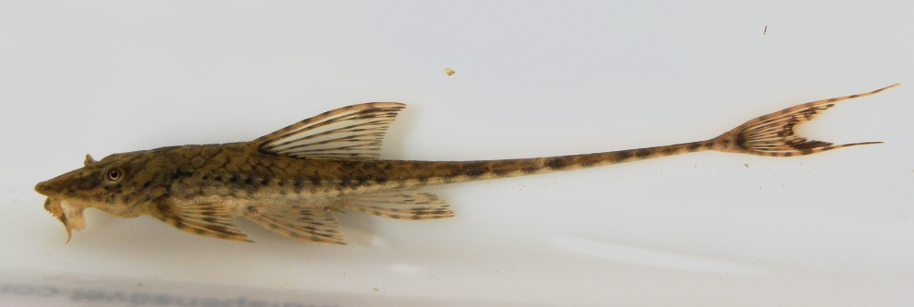
Common does not mean Corydoras. Common Whiptail (Rineloricaria parva) is a small, flattened loricariid from the Paraguay basin that sits on sand and wood, rasps a mixed diet, and spawns in tubes. It is the “easy whiptail” of the three in this batch: less film-dependent than Farlowella, less bulky-royal than Sturisoma, still nothing like a schwartzi on the same sand. If you wanted a catfish that uses a cave like a loricariid, you are in the right place.
A small whip with a Paraguay address
Adults are about 10–12 cm, sometimes quoted a little either side, with a depressed body, bony plates, a suckermouth, and a tail that tapers without always growing the extravagant filament of a royal Sturisoma. Colour is mottled brown, excellent camouflage on sand and leaf. Sexual dimorphism shows in breeding males: odontodes on the sides of the head and pectorals, a slightly stockier look, and ownership of a tube. Females are rounder when full of eggs. It is not R. fallax or every other Rineloricaria in the trade; parva is the small Paraguay species widely moved as “common whiptail.” It is not a Farlowella stick. It is not a cory with armour jokes — the mouth is a sucker, the eggs go in a cavity, the male guards.
Paraguay sand, wood, and pipes in nature’s language
The Paraguay River system: subtropical to tropical, seasonal, sandy and muddy bottoms, snags, and cavities. Water is often nearer neutral than a forest blackwater. They rest on the bed more than Farlowella does, which is why people park them in the same visual slot as corys — then feed them like corys and wonder why the whiptail is thin. They graze surfaces and also take foods off the sand. They hide in hollows. That cavity instinct is the breeding story.
A tank with tubes on purpose
80–100 cm for a pair or a small group. Fine sand they can sit on (rounded, not sharp — they have soft undersides and barbel-like oral structures that still hate silica knives). Wood. Plants. And caves: terracotta tubes, PVC, coconut shells, narrow rock gaps. Current gentle to moderate. They are more tolerant of still community tanks than Sturisoma, and they still appreciate oxygen. Lid on. Filter intakes covered; a 10 cm flat fish can still vanish into a gap. They will lie in the open when confident, looking like dead leaves. That is success, not illness, if the belly is not concave.
Paraguay parameters for a small whip
Temperature 22–27°C. pH 6.0–7.8. Soft to moderately hard. Paraguay-basin flexibility is real; dirt is still lethal. They handle community chemistry that would fade Adolfoi. They do not handle uncycled tanks. Water changes, siphon around the tubes without evicting a guarding male if you can see eggs.
Pairs, harems, and not a school of six clones
You can keep a pair, or one male and two females, or a small group in a larger tank with extra tubes. They do not psychologically require a Corydoras-style shoal of six identical fish, though they are peaceful in groups when caves are not limiting. Two males and one tube is a contest. Provide more caves than fish. They will stack in a tube like a bad decision if that is the only cave; give options.
Diet: grazer plus sinking food

Algae, biofilm, sinking wafers (including some protein), blanched vegetables, frozen bloodworm as a supplement. They are easier to keep eating than Farlowella because they will take wafers off the sand. They are still not “leftover flake” fish. Feed at dusk and see the whip move to the food. Snails and otos compete. A fat rineloricaria has a gentle oval cross-section; a starving one is a brown ruler.
Community use
This is the whiptail that actually works in a peaceful community: small tetras, rasboras, Corydoras on the same sand (feed both guilds), dwarf cichlids that do not claim every tube. No large predators. No synos that want the same hole. Hastatus can occupy midwater in a Paraguay-themed tank while parva owns the floor and tubes — that is a coherent basin story if you feed the pygmies separately.
Spawning in the tube
Male cleans the cavity. Female enters, lays, leaves. Male guards and fans. You will see a tail in a pipe for days. Do not extract him for a photo. Eggs fungus in dirty water. Fry stay in the tube then emerge as tiny copies; they need biofilm, crushed foods, and no hungry tank mates. This is the accessible loricariid spawn, more reliable in home tanks than synos and more cavity-based than Sturisoma’s glass patch. If eggs are on glass instead, you may have a different whiptail — or a pair that used the pane as a plan B.
Filaments and a Paraguay whip
Concave belly, eroded mouth, ich, jumping, crushed by rockwork. Quarantine with a tube and food they will eat, or they hide and starve. Medications that strip slime are harsh on loricariids. They are tougher than twigs and still die in gravel-and-neglect starter kits.
The common whip is still a whip
Keep Rineloricaria parva because you want a small Paraguay whiptail that sits on sand, rasps, and breeds in tubes. Keep Farlowella if you wanted a stick and a mature-film project. Keep Sturisoma if you wanted a royal filament and glass-guarding in current. Keep Corydoras if you wanted a sifting shoal and T-position eggs. The tube is the behaviour. The Paraguay map is the water. The suckermouth is the family. Common is the trade name, not an instruction to treat it like every other brown catfish you have owned.
Tubes as furniture, not an afterthought
Buy the terracotta before you buy the fish. A parva male without a pipe is a loricariid with nowhere to do the one behaviour that makes the genus obvious. Place tubes on sand, slightly nose-down if you like, in the current shadow of wood. When a tail hangs out for days, look with a torch rather than a grab. Eggs look like a pale patch. Leave them. Increase oxygen. Delay the gravel-vac heroics. That is community breeding you can actually see, unlike a syno that will never spawn in your living room.
If the male is evicted by a ram or a crab, you will get fungus and a thin whip. Choose neighbours that do not want the same hole. Paraguay sand is big enough for corys and a whiptail if the corys have open floor and the whip has a tube. Feed both. The suckermouth will not live on cory crumbs.
Explore other topics
Dive into more aquarium guides across the site.