

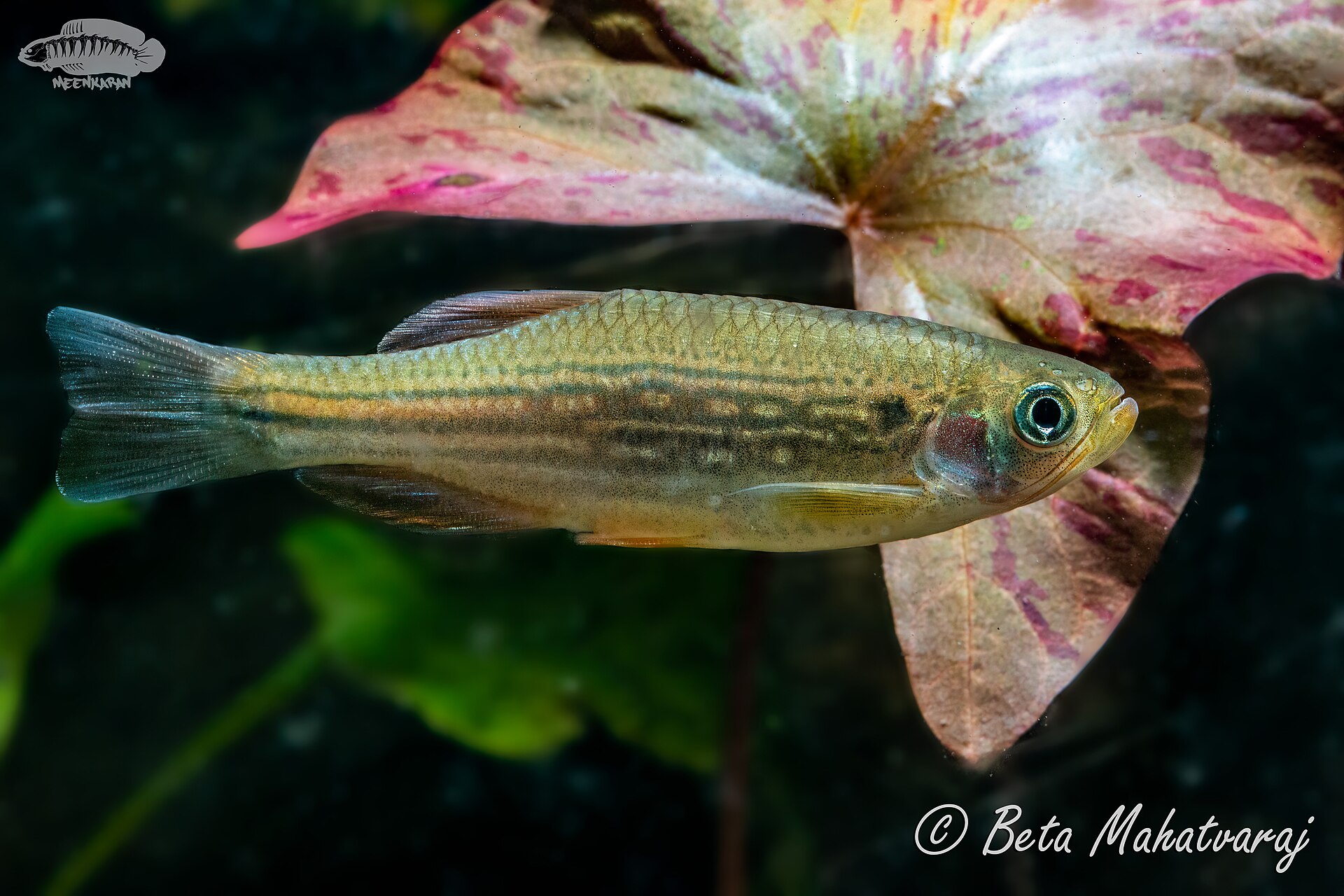
Danio dangila is the moustached danio — a barbelled, heavy-shouldered fish from Himalayan foothill rivers of India, Nepal, and Bangladesh. It is one of the largest species remaining in Danio rather than Devario, with adults commonly 8–12 cm and some reports higher. If your image of a danio is a 4 cm zebra, this animal will surprise you. It wants cool, fast, long water and a diet to match a river opportunist.
Barbels you can see, size you must plan for
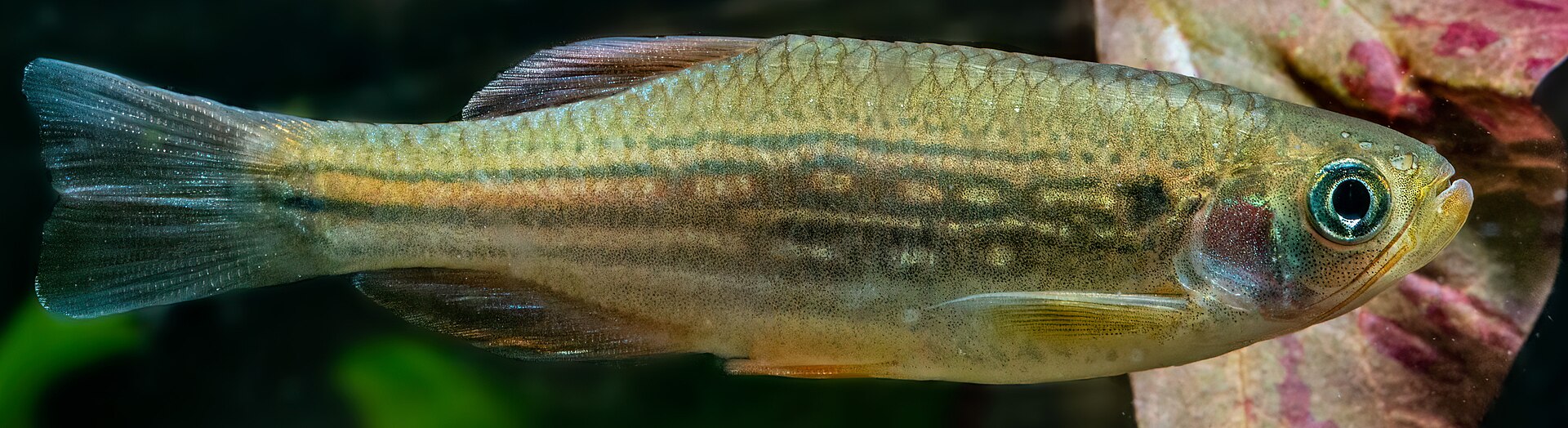
The pair of barbels gives the moustache. The body is olive to brown with blue-green sheen and irregular marks, more substantial than kyathit, less vertically barred than pathirana. Males are slimmer; females are deeper. Juveniles in shops look like “large zebras.” They are not. They will outgrow a 90 cm community that already holds tetras.
Wild rivers of the Himalayan foothills run cool and oxygen-rich. Aquarium temperature 18–24°C is the honest band. Heating to 27°C because the rest of the fish are Amazon tetras is how you keep dangila in the wrong climate. pH 6.5–7.5, moderate hardness. They are not peat-swamp nano fish. They are not cave tetras. They are barbelled current fish.
A long tank for a large cyprinid
Think Malabar-scale hardware even though the Latin genus is Danio: 120 cm and 200 litres for a group of five to seven is not an exaggeration. Strong flow along the length, rounded stones, a lid that can take a hit from a jumping 10 cm fish. They will wreck delicate plants and they will eat small tankmates. This is closer to a small river carp than to a chili rasbora.
Filter for the bioload. They eat a lot and they swim a lot. A sponge filter meant for a Betta hospital will not do.
Temperament of a moustached sprinter
They school, they chase, they dominate slow fish. Keep them with similarly sized, similarly cool-water companions, or keep a species tank. They will consume neon tetras, pencils, rasboras, and shrimp. They may coexist with large loaches and other big, fast cyprinids. They should not share a tank with hatchets, splash tetras, or sun tetras. Mexican tetras overlap a little in temperature breadth; in practice a mixed “big tetra plus dangila” tank becomes a food and space argument unless the volume is huge.
Barbels are sensory tools for a fish that also picks food from drift and from the substrate more than a zebra does. That does not make them Corydoras. They still occupy the middle and upper water for most of the day.
Diet of an opportunist
Pellets, flakes, frozen foods, insects, chopped prawn, blanched vegetables. They are omnivores with appetite. Feed twice a day in amounts that do not pollute. They will take sinking food more readily than hatchets and more readily than many slim Danio. Watch weight: a deep-bodied dangila can slide from robust to obese in a week of goldfish-style feeding.
In nature they take whatever the monsoon delivers. In the tank that curiosity includes tankmates’ fins and eggs.

Breeding a foothill Danio
Egg scatterer, lots of eggs, adults eat them. You need a large breeding setup or a very clever grate. Fry grow fast and need space. Cooler water changes can trigger spawning. Do not copy discus heat. Do not copy Copella humidity gaps — you still need a lid, but the eggs are in the water, not on the glass above it.
Hybridising with zebra danios is possible in messy community tanks and produces fish that help no conservation story and no clean hobby line. Keep dangila with dangila if you spawn them.
Cool, fast, and easy to underestimate
Quarantine. Large wild-caught or farmed fish can carry parasites that a 4 cm zebra would not survive to show. Ich, flukes, and bacterial issues after shipping in warm bags into cool tanks are a chemistry crash: acclimate slowly. They are hardy in the right river tank and fragile in a short, hot tetra box.
If you wanted a 3 cm spotted Myanmar danio, that is tinwini. If you wanted a 15 cm Ghats Devario, that is Malabar. If you wanted barbels, cool current, and a danio that fills a four-foot tank, Danio dangila is the moustached one, and the stand has to be built for a river fish, not for a name that happens to include “danio.”
See Malabar danio for a similar space conversation in a different genus, and do not assume dangila stays zebra-sized because the bag says Danio.
Moustaches, monsoon rivers, and a filter that can keep up
Barbels get damaged in coarse gravel and in nets. Use rounded substrate and herd them with a container rather than chasing a 10 cm danio through wood. Damaged barbels on dangila are a husbandry mark, like a hollow keel on a hatchet: you are keeping the fish in a way that fights its anatomy.
Foothill rivers flood. Your tank cannot flood, but it can receive large, cool water changes that keep nitrate down and trigger spawning. Match temperature. A 5°C mismatch on a water change is how large cyprinids crash after you thought you were being diligent.
They are loud visually. People add them to planted show tanks and then complain about uprooted stems. Either plant for current and heavy fish (attached epiphytes, heavy hardscape) or do not buy dangila. A Dutch scape and a moustached danio are different hobbies that share a water molecule and nothing else.
If a shop labels dangila as a “giant zebra,” believe the giant and ignore the zebra. Barbels, cool current, and a four-foot run are the species. Everything else — peat, caves, aerial eggs, nano powdered food as a sole diet — belongs to some other animal in this batch.
Netting a moustached danio in a decorated river tank is how barbels tear. Trap them with a glass or plastic box, move décor instead of the fish when you can, and accept that a 10 cm current cyprinid is a maintenance project the size of a small rainbowfish, not a 4 cm zebra you once kept in college.
Explore other topics
Dive into more aquarium guides across the site.