

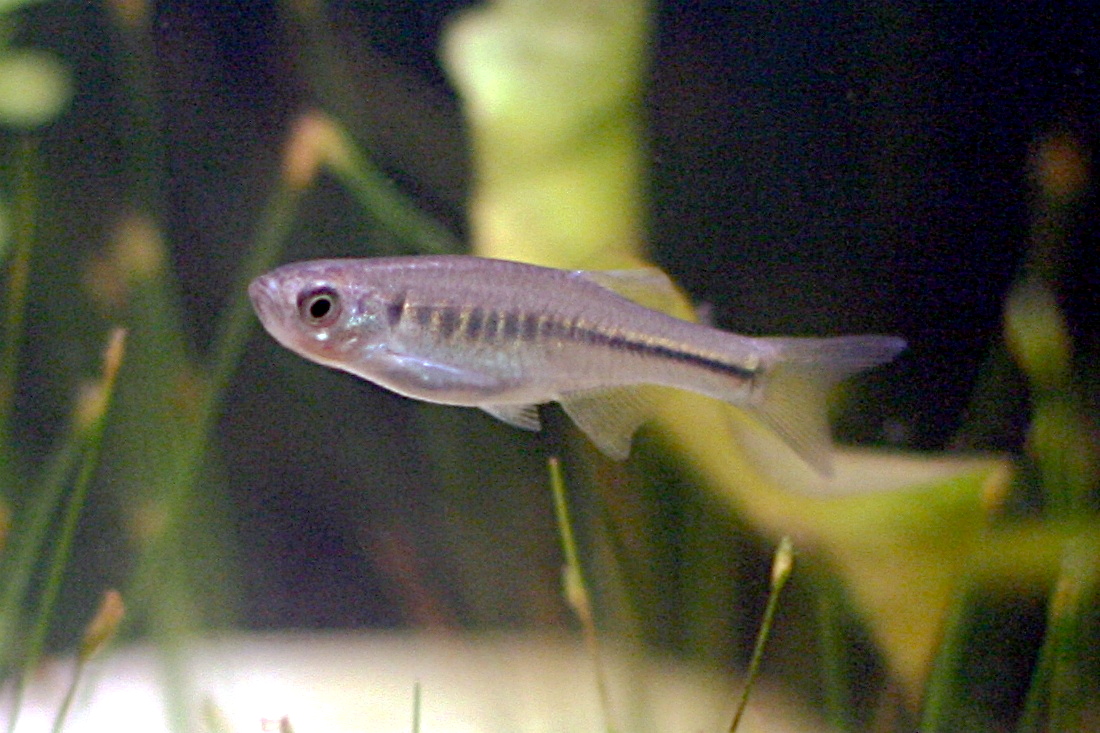
The fire bar danio is a compact Thai Devario from the Mae Taeng River system in northern Thailand. Devario maetaengensis stays around 5–6 cm, wears reddish vertical marks on a gold-olive body, and wants hill-stream conditions in a smaller footprint than a Malabar — not still tetra water, and not a 15 cm giant’s 200 litre hall.
Mae Taeng red on a small Devario
The species is locally named for that river. Wild fish live in flowing, well-oxygenated water among stones and roots. In the tank, 20–26°C is a fair range, pH 6.5–7.5, moderate hardness. They colour up in current. They fade in a warm, still community heated for discus. They are more tropical than a high-elevation white cloud, less tropical than a rummynose.
Males are slimmer with stronger red-orange bars; females are rounder. The “fire” is a condition colour, not a painted morph. Shop fish under yellow LEDs look hotter than they will in a cool white sterile tank; fix the tank, not the LED, if you want the bars to read as fire.
A compact river tank, not a nano cube
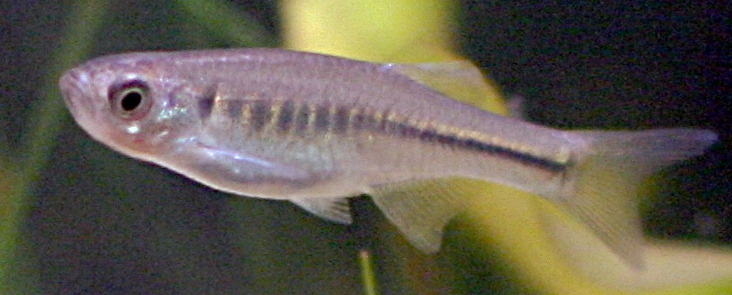
A 80–90 cm tank with a school of eight is the right scale. They need length and flow more than depth. A spray bar creates a lane; plants and stones create eddies. They jump. Cover every gap. They are less likely to demolish tankmates than Malabars simply because they are smaller, but they will still eat tiny fry and they will still harass slow long-fins.
Do not squeeze them into a 30 litre “danio nano.” That is a Hikari-sized idea at best, and even tinwini prefers length. Fire bars are Devario: deeper bodies, more presence, more waste than a 3 cm Danio.
Mixing with other Asian barbs and minnows
They can live with similarly sized, similarly fast Asian cyprinids: some Puntius/Pethia that like current, other small Devario if you accept identification headaches, loaches that share temperature. They should not live with Phoenix rasboras, dwarf pencils, or sun tetras. They can live with zebra danios in a long tank; the zebras may be slightly faster at food. They should not live with adult Malabars unless the tank is enormous — the Malabars will own the current and the menu.
Barred danios (D. pathirana) also have vertical marks. Mixing the two muddies conservation and identification. Keep fire bars as fire bars if you care about the Mae Taeng look.
Feeding in moving water
Omnivore. Flakes, frozen daphnia, bloodworm, brine shrimp, a little vegetable. Feed in the lane so the school hits food on the swim. They will take surface flakes but they are not hatchet film-specialists. Skinny fish with dull bars are underfed or outcompeted. Fat fish in still water still look dull because the habitat is wrong.
They have a higher oxygen demand than a garnet tetra. If they hover at the surface with the lid closed and the filter weak, that is not a request to be restocked as hatchets. Increase agitation and check temperature.

Spawning maetaengensis
Egg scatterer over a grate or fine plants. Water change, cooler rain pulse, remove adults. Fry are typical small cyprinid fry. Hybridising with pathirana or malabaricus is how distinctive Thai fire bars disappear into “assorted Devario.” Don’t.
No aerial eggs. No cave. No peat requirement. A covered stream tank is the breeding room.
Thai stream fish in a shop tetra vat
They often sit next to tetras in stores. The vat chemistry is a compromise that suits neither for long. Quarantine in moving, cooler water. Watch for ich (spots on gold are visible) and for damaged noses from jumping in uncovered vats. They are hardier than wild marbled hatchets, more flow-dependent than Cochu’s blue tetras, and smaller than the word “barred danio” sometimes implies in English-language lists that mix all Devario together.
If you wanted Sri Lankan vertical bars on a threatened endemic, that is pathirana. If you wanted northern Thai fire on a 6 cm school in a long, covered current, Devario maetaengensis is the Mae Taeng fish, and the heater should be a modest tool, not a tropical blanket.
Related: rose danio for a slimmer hill-stream Danio from the same general region of Asia, with a different pattern and a slightly different size class.
Mae Taeng current in a Bangkok-sized room
Not everyone can house Malabars. Fire bars are how you keep a Devario river in a 90 cm tank. That does not make them nano fish. They still want flow, oxygen, and a lid. They still eat tiny companions. Scale the river down; do not scale the biology into a chili rasbora box.
Northern Thailand has a cool season. If your fire bars look dusty, try 22°C and more agitation before you add colour food. Red bars are a current-and-condition signal. They are not a pH 5 signal. Peat will not help. Salt will not help. A powerhead aimed down the glass, with a plant thicket at the far end for rest, will help.
Do not stock them from a mixed “assorted danio” bag if you can see vertical red marks next to spotted tinwini next to striped zebras. You will not be able to feed all three fairly, and you will not be able to breed any of them true. Pick the Mae Taeng fish and build the lane for that one school.
Mae Taeng fire is a current colour. If you remember only one number, remember tank length, not a tetra pH chart. A 90 cm covered stream with eight fire bars will outshow a 40 litre stained cube every time, because this Devario never evolved to pose in tea-coloured still water.
A powerhead should create a lane, not a whirlpool that pins 6 cm fish to moss. Aim along the glass, break the far end with plants, and feed where the school already runs. Fire bars that refuse to leave a corner are usually fighting flow geometry, not “just shy tetras” in a mislabeled bag.
Explore other topics
Dive into more aquarium guides across the site.