

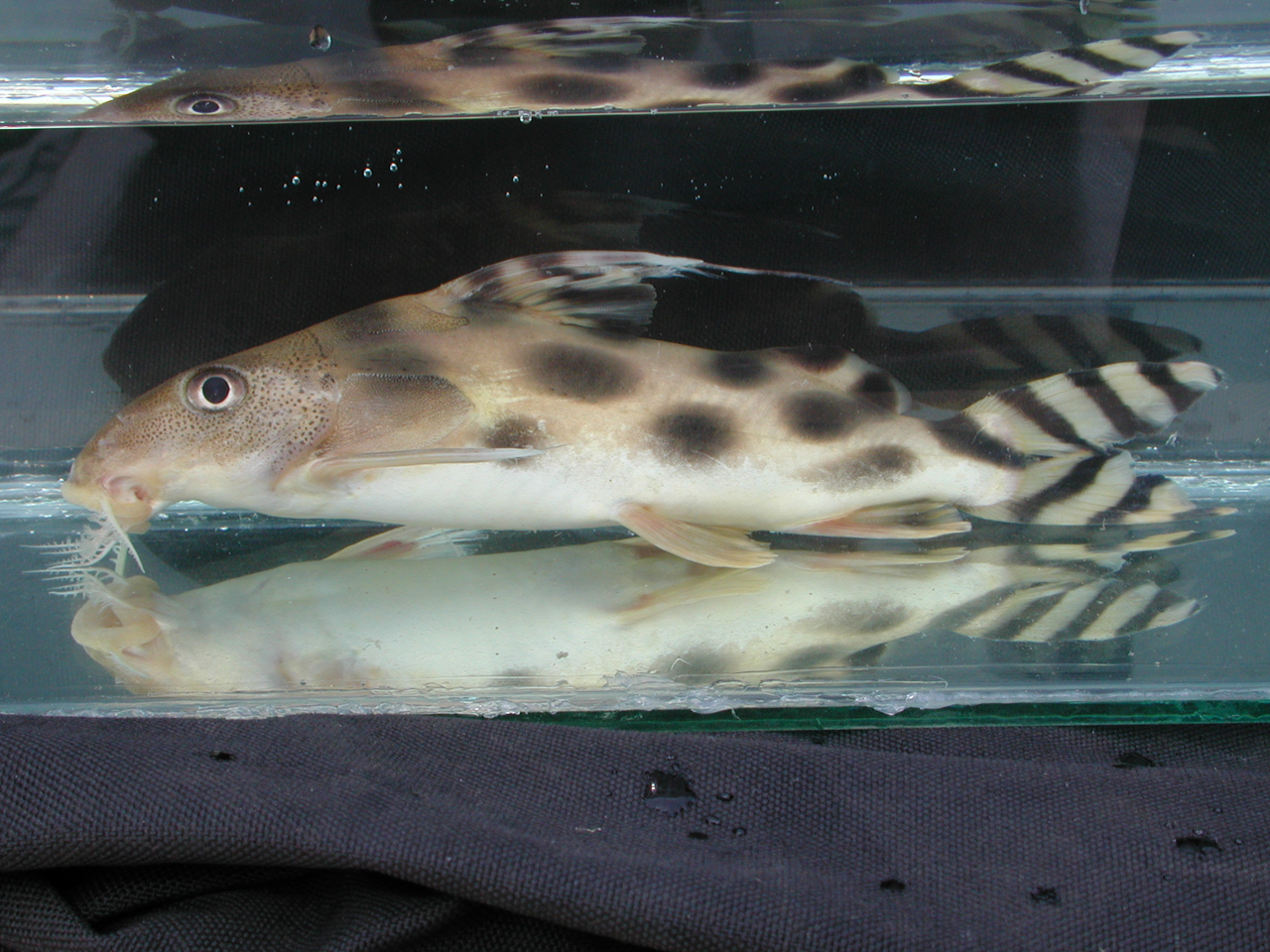
Congo water does not produce Corydoras. Decorated Synodontis (Synodontis decorus) is a mochokid squeaker from the Congo basin: a large, patterned, nocturnal catfish with an elongated dorsal filament, a mouth built for a different job than sand-sifting, and a personality that can include territorial nights and missing tank mates that fitted inside it. If you arrived from a cory article, reset your tank-size expectations before you fall for the juvenile in the shop.
The filament and the Congo paint job
Young S. decorus are the ones in stores: maybe 6–8 cm, boldly marked with dark bars and spots on a pale to golden ground, plus a dorsal fin whose first ray already hints at a streamer. Adults are a different animal. They commonly reach 20–30 cm in aquaria, with a long dorsal filament, a forked tail, and a pattern that can shift and break as they grow. The body is the typical Synodontis shape — humped nape, armour of thick skin and scutes, stout pectoral spines that lock and hurt. Three pairs of barbels, including maxillary barbels that may show membranes or branching depending on age, work the water and décor, not a Corydoras-style sand plough.
It is not S. angelicus (polka dots on dark, also large, also Congo). It is not S. nigriventris (the true upside-down catfish, much smaller). It is not a decorated pleco. The trade name “clown syno” gets used; look at the filament and the barred-spotted Congo pattern rather than at clown loaches.
A big river, not a forest puddle
Native range is the Congo River basin in central Africa. That means warm, often slightly acidic to neutral water, wood, rocks, caves, and serious volume. Current can be moderate. The fish is crepuscular and nocturnal, hiding by day in snags. In the wild it is an opportunistic omnivore-predator of insects, crustaceans, plant matter, and smaller fish. A 60 litre “catfish tank” is a joke it will outgrow in a year if it lives.
Housing a decorated adult, not a decorated postcard
Think 200 litres as a starting conversation for one adult, more for a pair or for a community of large African fish. Horizontal swimming room and a strong lid matter; synos bolt and jump. Décor should be driftwood caves, rock overhangs, and pipes they can claim — they are territorial about holes, especially as they age. Substrate can be sand or rounded gravel; they are not barbel-sifting corys, but they will still root and they will still cut themselves on lava rock. Filtration must match a messy, growing carnivore. Heaters need guards; spines and heaters fight.
Lighting can be moderate. They will show more by day if they have security and if you feed on a schedule, but they are not a schooling sand display. A single decorus in a huge scape will still pick a cave and defend it at night.
African river water
Temperature 24–28°C. pH 6.2–7.8. Soft to moderately hard. They are tougher than a Negro cory and still hate ammonia. Large water changes, strong biological filtration, and oxygen. Congo chemistry is not Malawi soda. Do not mix decorus with mbuna in a rift recipe because “Africa.” It is a river fish.
Temperament: not a community dwarf

Juveniles may mill together. Adults often become quarrelsome with other synos, especially in cramped caves. They may eat fish that fit in the mouth — including expensive tetras you forgot grew slower than the catfish. They can produce the squeak mochokids are named for when distressed. They are not peaceful in the Corydoras sense. Compatible neighbours are size-matched, robust, non-boisterous African tetras of the large kind, Congo tetras in big tanks, other large but non-target fish, and no 3 cm showpieces. Two decorus need visual breaks and extra volume or you will have a winner and a hide-until-death loser.
Diet of a river omnivore
Sinking carnivore pellets, frozen prawn, mussel, bloodworm, insect foods, some vegetable matter (spirulina wafers, blanched veg). Feed at dusk and confirm the fish ate. They will scavenge, but a growing 25 cm syno is not living on leftover flake. They will also scavenge tank mates. Overfeeding fouls a large tank fast. Fast one day a week if the belly is always taut.
Breeding — mostly a rumour in home tanks
Wild synos often spawn with seasonal floods and in conditions home aquaria rarely copy. Captive breeding of S. decorus is not the T-position-on-glass routine. Do not buy a pair expecting eggs next month. Sexing is difficult; males may have a more pointed genital papilla. If you want a catfish you can spawn on a weekend, buy a cory. If you want a Congo character fish, enjoy the adult.
Spines, slime, and imports
Locked pectoral spines tangle in nets — lift with a container. Skin slime and holes-in-the-head-type issues appear in poor water. Ich happens. Quarantine; African wild cats carry parasites. They grow. The person who bought a 7 cm decorus for a community of neons will be on a forum in eighteen months. Be that person’s opposite.
Decorated means the adult
Keep Synodontis decorus because you want a large Congo squeaker with a dorsal filament and a barred-spotted coat, in a big, cave-rich tank, fed like a predator-omnivore. Keep angelicus if you wanted polka dots. Keep nigrita if you wanted a more commonplace West African syno. Keep Corydoras if you wanted a sand shoal. The filament is the silhouette. The Congo is the map. The adult size is the rule you cannot negotiate.
The filament as a growth chart
Measure the fish, not the dorsal streamer, but use the streamer as a hint. A decorated syno that still looks like a 7 cm clown in year three is either stunted or misidentified. Good growth means a heavier body, a longer filament, and a pattern that may break from neat bars into a more adult scatter. That is not a reason to panic; it is a reason to have already built the 200 litre river. People who loved the juvenile and refused to upgrade invent stories about “they stay small if the tank is small.” They stay dead or deformed. Decorated means the adult dress, not the shop bag.
When you move them, forget the net. Spines lock. A plastic box and a lift of water is slower and saner. The squeak is a warning, not a cute trick for guests. Guests can look through the glass while the fish keeps its cave.
Explore other topics
Dive into more aquarium guides across the site.