

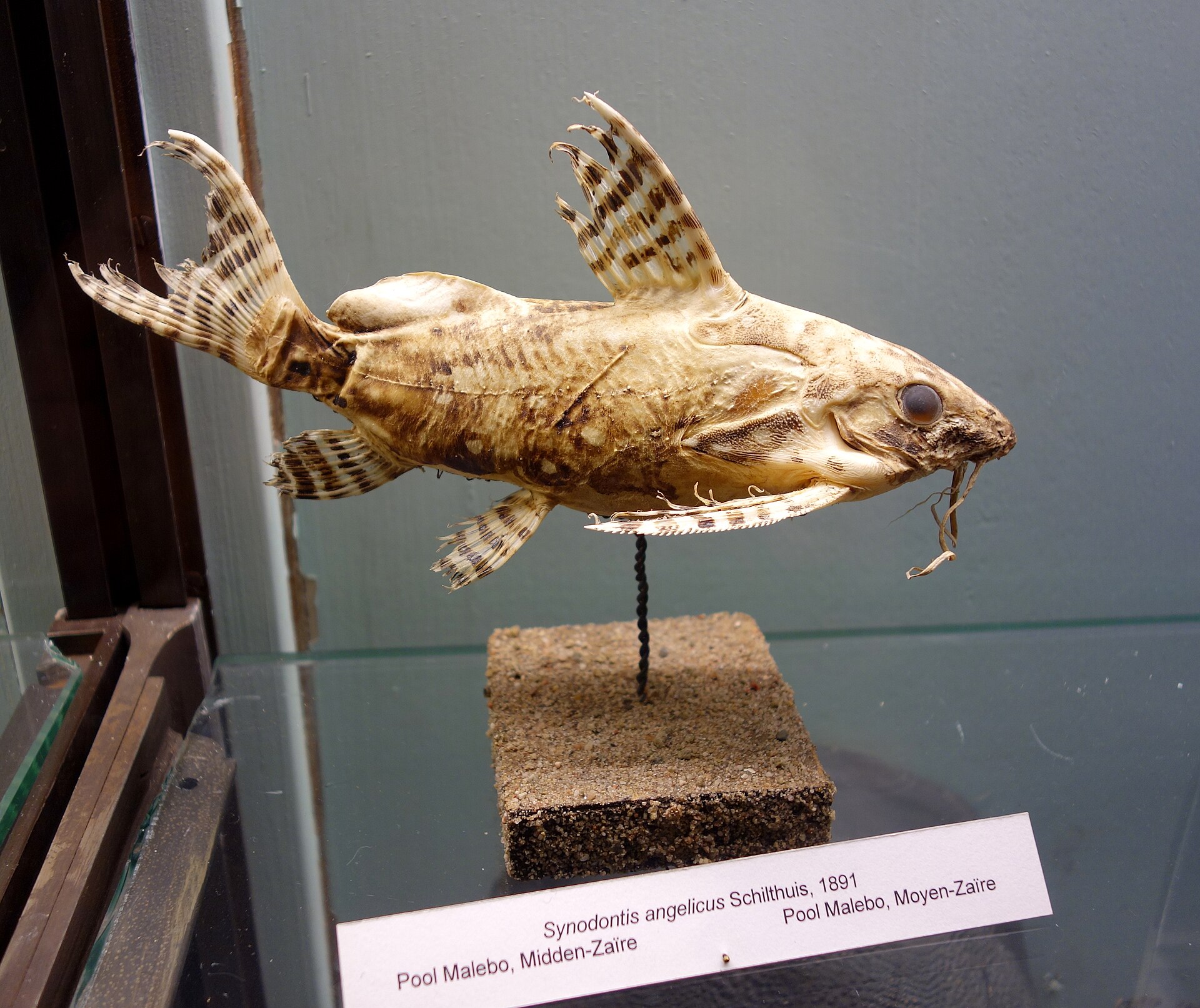
Polka dots on a black velvet body: that is the juvenile postcard. Angelicus Synodontis (Synodontis angelicus) is a slow-growing Congo squeaker that turns into a 20–25 cm, expensive, territorial catfish whose spots break and fade with age. It is not a decorated syno (different pattern, filament emphasis), not a dwarf upside-down cat, and not a “cory but African.” If the price tag did not scare you, the adult should.
Spots that do not stay still
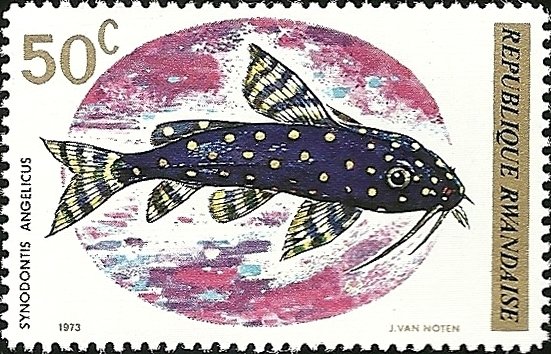
Young S. angelicus — the polkadot squeaker of old books and of a Rwandan stamp — wear creamy to yellow spots on a dark brown to black body. The arrangement is irregular, not a sterbai grid. As the fish grows, spots can enlarge, merge, or wash into a mottled adult dress that disappoints people who wanted a permanent dalmatian. The body is robust, with the mochokid hump, strong spines, and barbels for tasting the night water. There is no Corydoras armour pattern of two even scute rows in the same cute sense; this is a thicker, spine-armed river cat. Adults are simply large.
Lookalikes include other spotted synos and tank-raised hybrids. True angelicus has long been a premium import from the Congo basin. If the fish is cheap and 15 cm already, ask harder questions.
Congo basin nights
Central African river: wood, dimness, warm water, omnivorous-predatory feeding in the dark. They hide by day in snags. They are not sand-shoal animals. They are not plant-scraping whiptails. The hobby has kept them for decades as show catfish, which means a lot of photographs of juveniles and a lot of under-housed adults.
A tank that assumes the fish will live
Plan for the adult. 200 litres-plus, caves, wood, a lid, serious filtration. Sand or smooth gravel. Dim zones. They will rearrange décor and sit on heaters. One fish can be a centrepiece. Two need a mansion and extra caves or you paid twice for a civil war. They are nocturnal; a red night light or a feeding torch tells you whether the expensive dots still eat.
Do not “start it in a 80 litre until it grows.” Synos remember territories and water quality; stunting and spine-locked stress are not a growth strategy.
Congo cave chemistry
24–28°C, pH 6.0–7.8, soft to moderate, excellent oxygen, low waste. They tolerate a range better than a blackwater tetra and worse than a myth of invincibility. Large water changes. Do not dump them into Malawi mix. Do not keep them in a soup because they are “ugly-tough cats.” Angelicus is expensive because it is not farmed like a bronze cory; dead ones stay dead.
Who gets eaten, who gets chased
Small fish disappear. Slow, long-finned fish get chewed. Other synos of similar size may fight, especially angelicus versus angelicus in a box of one cave. Possible neighbours: large robust tetras, other big West/Central African fishes that are not swallowable, maybe a large peaceful cichlid in a huge tank if personalities allow — no guarantees. No neons, no pandas, no guppies as “dither.” This is not a community recommendation of the cory kind.

Feeding a slow, costly omnivore
Sinking pellets of high quality, frozen mixed seafood, insects, some plant matter. Feed after dark. They can be shy at first; do not assume they are getting leftovers from daytime fish — daytime fish may be getting the catfish’s food, or the catfish may be getting the daytime fish. Growth is slow compared with decorus in many reports; that is not a reason to underfeed, it is a reason to be patient and keep water perfect for years.
Spawning a spotted Synodontis
Not a home-aquarium routine. Seasonal river cues, possible cave spawning in nature, rare in captivity without specialist setups. Sexing is subtle. Buy this species to keep, not to spawn on a schedule. If someone offers “proven breeding pair” in a 100 litre tank, walk away.
Health and handling
Spines lock in nets. Use a bucket. Quarantine wild Congo fish for parasites. Watch for skinny weeks after import — they may refuse food until caves feel right. Hole-in-the-head and skin issues track poor water. Ich treats must consider a large, scaleless-feeling catfish (they have different skin than a tetra). They jump.
Years, not months
Angelicus is a long-game fish. People photograph the dalmatian stage, then feel cheated when the adult mottles. That mottling is the species growing up, not a bait-and-switch if the seller was honest. If you need permanent high-contrast spots for a display, you may not want this animal — or you may want to enjoy the juvenile years knowing they are finite. Either way, the tank you build on day one should already be the adult tank: volume, caves, lid, filtration that can chew a carnivore’s waste when the fish is five times the mass of the bag you carried home.
They can live well over a decade in good water. That is a lot of Saturday water changes. It is also a lot of nights watching a dark shape leave a log to eat prawn. If that sentence does not sound like a hobby you want, the stamp on the Rwandan issue is a better way to enjoy the dots. The living fish is a Congo predator-omnivore with spines, not a polka-dot sticker.
Money, ethics, and the cave
Premium wild synos have a conservation and welfare cost. Buy from people who can talk about the fish after the sale. A starving angelicus in a bright, cave-less dealer tank is a poor start; a fish that already eats sinking food in cover is worth more than a prettier, thinner one. Do not impulse-add a second angelicus “for company” in a tank that barely holds one. Company for this species is extra territory, not a shoaling instinct copied from Corydoras.
At feeding time, stay until you see the spots — or the adult mottling — actually take food. Shy fish in a community lose to daytime hog tetras. A feeding cave, a later lights-out snack, and a lid you actually clip shut are the practical tools. The rest is patience while a slow Central African catfish decides your woodpile is a river snag.
Polka dots are a life stage
Keep Synodontis angelicus because you want a Congo polkadot squeaker and you will house the 25 cm adult it becomes, spots or not. Keep decorus for the barred filament look. Keep nigrita for a more available West African syno. Keep Corydoras for sand and groups of six. The stamp is the juvenile dream. The cave is the adult reality. The price is a filter for people who should have bought schwartzi.
Explore other topics
Dive into more aquarium guides across the site.