

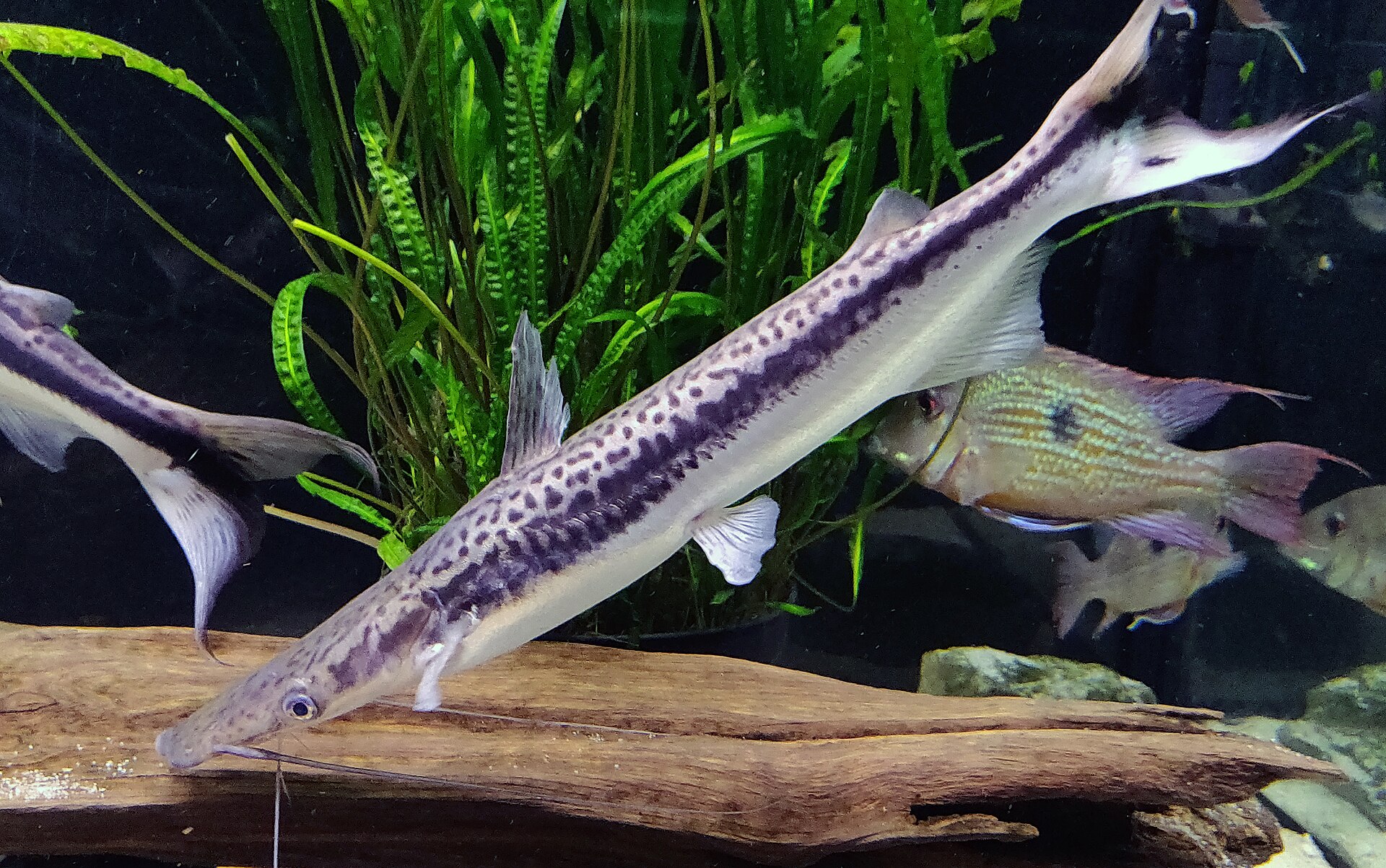
Seen from above, Sorubim lima is a pale stick with a spoon for a face. The duckbill catfish is a pimelodid of South American rivers that lies on sand, waits, and then lunges with a mouth at the end of a flattened snout. Adults commonly reach about 45–55 cm, sometimes more. That is already a large predatory catfish for a private house, even though it is smaller than a barred sorubim or a marbled Leiarius. Juveniles look like ornamental oddities. Adults eat fish. This is a huge river hunter in miniature compared with a tiger shovelnose, and it is still not a community catfish.
Sandbars of the Amazon and the Paraná
Duckbills range through Amazon, Orinoco, and Paraná-Paraguay basins, using sandy shallows, beaches, and the edges of channels. The snout is a tool for a life on the floor of big rivers: sensory skin, a mouth that opens on a sandbar, a body that disappears as a pale bar against quartz. They are not cave bristlenoses. They are not midwater insect schools. They are not leaf-litter tadpoles. They are open-sand pimelodids.
Seasonal floods move the beaches. The fish moves with the food — smaller fishes, crustaceans, anything the spatula can trap. An aquarium that is a planted thicket with no sand runway is the wrong stage. An aquarium that is a 120 litre community is the wrong scale.
Water is tropical, flowing, and large. Copy that, or do not buy the snout.
The spatula, the barred tail, the lying-down hunter
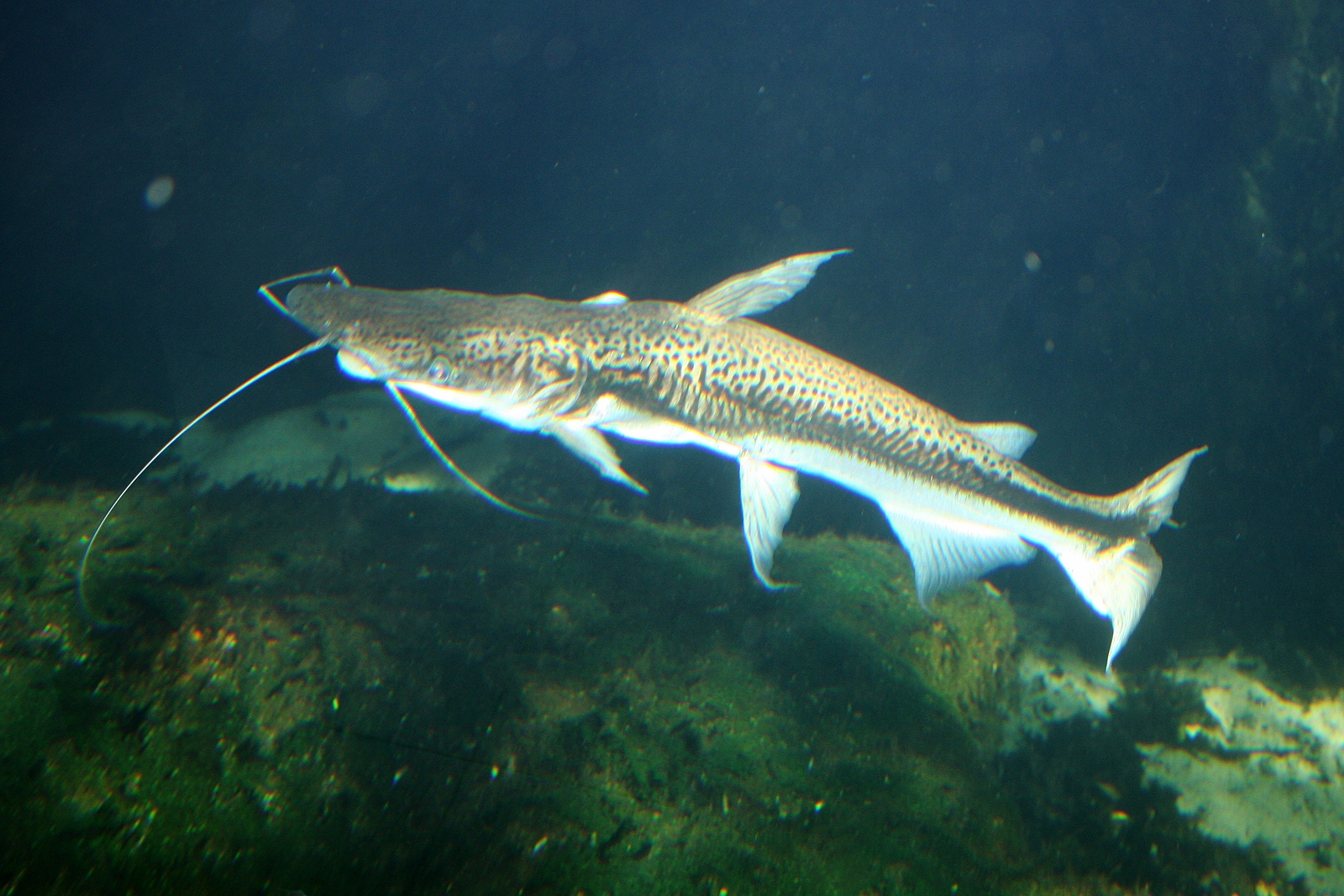 Sorubim lima. Photo: Kambui / Wikimedia Commons (CC BY 2.0)
The head is the identification: long, dorsally flattened, duck-billed, with the eyes on top and the barbels trailing. The body is elongate, often with a dark lateral stripe and a tail that may show contrast. It will rest on the sand for hours, looking like debris, then move like a missile. That hunting style is why small tank mates vanish “mysteriously” at night.
A 12 cm juvenile in a shop is already a specialised predator in outline. In two years it is a half-metre snout with a matching appetite. Do not confuse it with Pseudoplatystoma, which is a much larger, tiger-barred channel catfish, or with Leiarius, which is a marbled, high-dorsal pimelodid. Three different giant-adjacent hunters, three different adult problems. S. lima is the sand-lying spatula.
Healthy duckbills have intact barbels, an undamaged snout edge, and a body that is firm, not concave. Rubbed snouts mean glass panic in a tank that is too short. They need length to lunge.
A runway of sand, not a wood cave as the main idea
Think of a long, low aquarium with a bare sand highway and a few pieces of heavy wood at the back for shade — a beach exhibit, not a pleco log pile. Volume for an adult starts in the many hundreds of litres, with swimming length in metres if you can offer it. Tall tanks waste the hunting axis. Tight lids stop jumps. Filtration is for a piscivore’s waste.
Sharp gravel tears the ventral skin and the barbels. Plants get flattened. This is not a scape contest. It is a predator’s beach.
If you only have a 200 litre tropical community, you do not have a duckbill tank. You have a future eviction.
Big-river warmth and a lot of turnover

Temperature 24–28 °C, pH around 6.0–7.5, river hardness, oxygen high. They are Amazon-Paraná fishes, not cool channel cats of North America and not brackish pemecou. Ammonia from a fish diet is the usual indoor failure. Large water changes are part of owning a pimelodid, not an optional extra.
They are not air-breathing hoplos. If they gulp at the surface, test oxygen and temperature. Do not invent a disease until the gas in the water is right.
Fish-shaped meals for a fish-shaped mouth
Diet is other animals: fish flesh, prawn, earthworms, quality predator pellets that they will take on the sand. They will not live on algae wafers. They will not graze wood. Feeding live “feeders” as a habit is dirty and cruel to the feeders; it also teaches a duckbill that moving fish are food, which they already know.
Feed at dusk on the sand. Watch the lunge. Remove leftovers. A skinny duckbill is not “sleek”; it is underfed or bullied. A bloated one in yellow water is overfed and underfiltered.
Growing juveniles eat often. Adults take substantial meals with rest days. Match the snout, not a community flake ritual.
What disappears on the sandbar
Anything that fits in a 50 cm pimelodid’s mouth will be hunted. That includes most community fishes. Honest companions are other large, robust fishes in a huge river exhibit — and even then, a duckbill may still try. A single-specimen sand tank is the clean ethical choice for a private keeper who insists on the species.
They are not as enormous as a barred sorubim, which is why shops are more reckless with them. Smaller than a tiger shovelnose is not the same as community-safe. It is still a large river predator.
Do not add them as “odd bottom fish” to a tetra display. The tetras will write the ending.
Spawning on a continental sandbar you do not own
Wild Sorubim reproduce in big-river cycles. Home breeding is not a realistic project. Do not buy two duckbills “for breeding.” Buy none, or buy one for a system that already has the length.
How to tell a duckbill from the other big pimelodids in the same aisle
Look down on the head. If it is a long, flat spatula with eyes on top, you are in Sorubim. If the head is a heavy shovel with tiger bars on a thick body, you are in Pseudoplatystoma and the adult is even less keepable. If the fish is marbled with a tall dorsal sail, you are in Leiarius. Three snouts, three growth curves, three reasons not to impulse-buy. The duckbill is the sand-lying specialist of the trio: it needs a runway more than it needs a cave, and it will still eat the community.
When acclimating a juvenile you should not have bought, use a long box so the snout is not mashed on the glass. They bolt forward. Corners cut them.
The snout is the warning label
Sorubim lima is a sand-lying, spatula-faced pimelodid, a large predatory river catfish. If you cannot offer a beach-length tank and a fish diet, you cannot offer a life. See barred sorubim for the still larger tiger, chemistry, cycling.

Explore other topics
Dive into more aquarium guides across the site.