

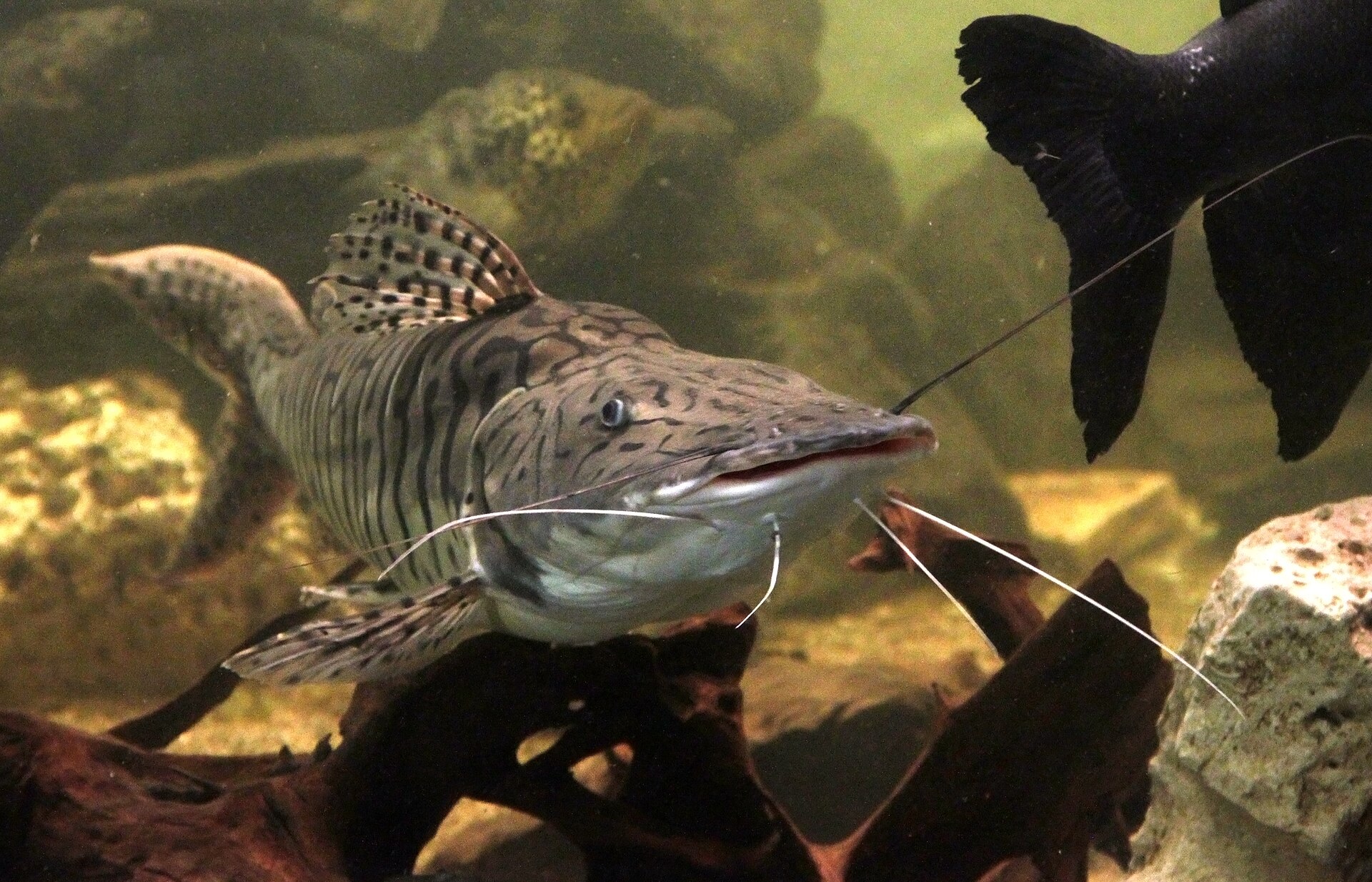
The stripes on a baby barred sorubim are a marketing accident. Pseudoplatystoma fasciatum is a tiger-patterned pimelodid of South American channels that grows into a metre-class hunter — 90 cm is not an exaggeration for a well-fed fish, and wild giants go further. It is an apex river predator. It is not a duckbill with extra bars. It is not a marbled Leiarius with a different paint job. It is not a community catfish. A 15 cm striped juvenile in a shop is a future public-aquarium animal. If your plan is a tank in a house, the plan should end at the shop door.
The barred tiger of the channel, not the spotted one
The genus Pseudoplatystoma is a nest of similar giants. P. fasciatum is the barred form associated with Amazonian and related drainages (taxonomy and trade names wobble; “tiger shovelnose” gets applied loosely). The point for a keeper is not winning a Latin argument. The point is that these fishes patrol main channels as large piscivores, using long barbels and a shovel of a head to find fish in turbid water. They migrate. They grow. They eat things that look like the other fish in your community tank.
Fisheries land them as food. Public aquaria display them as river monsters. The ornamental trade sells the baby because the bars are pretty. Those three facts do not add up to a responsible home pet.
This is a huge predator of big rivers. Write that on the lid of any tank someone proposes for it.
Bars that sell a fish that will not fit
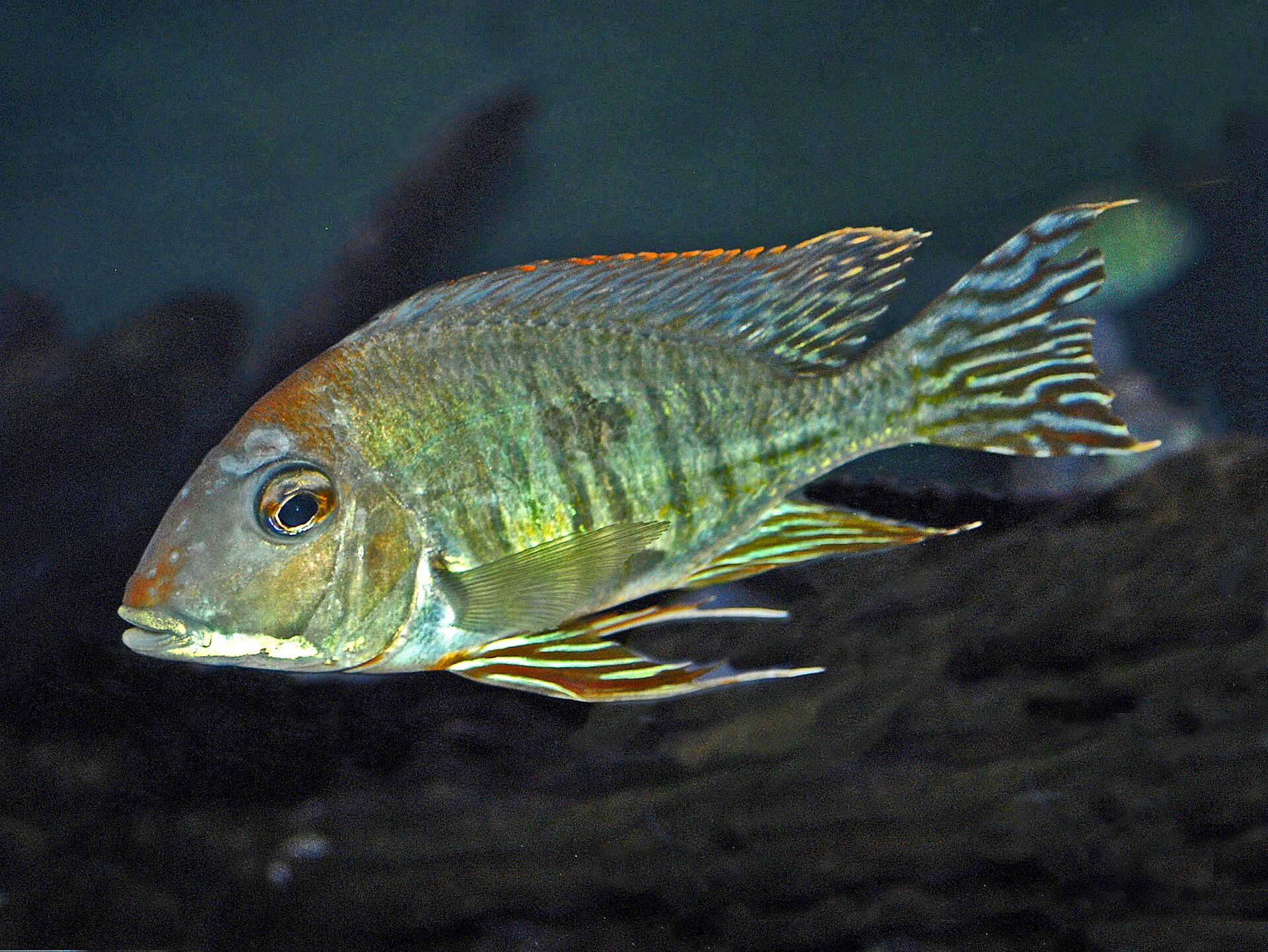
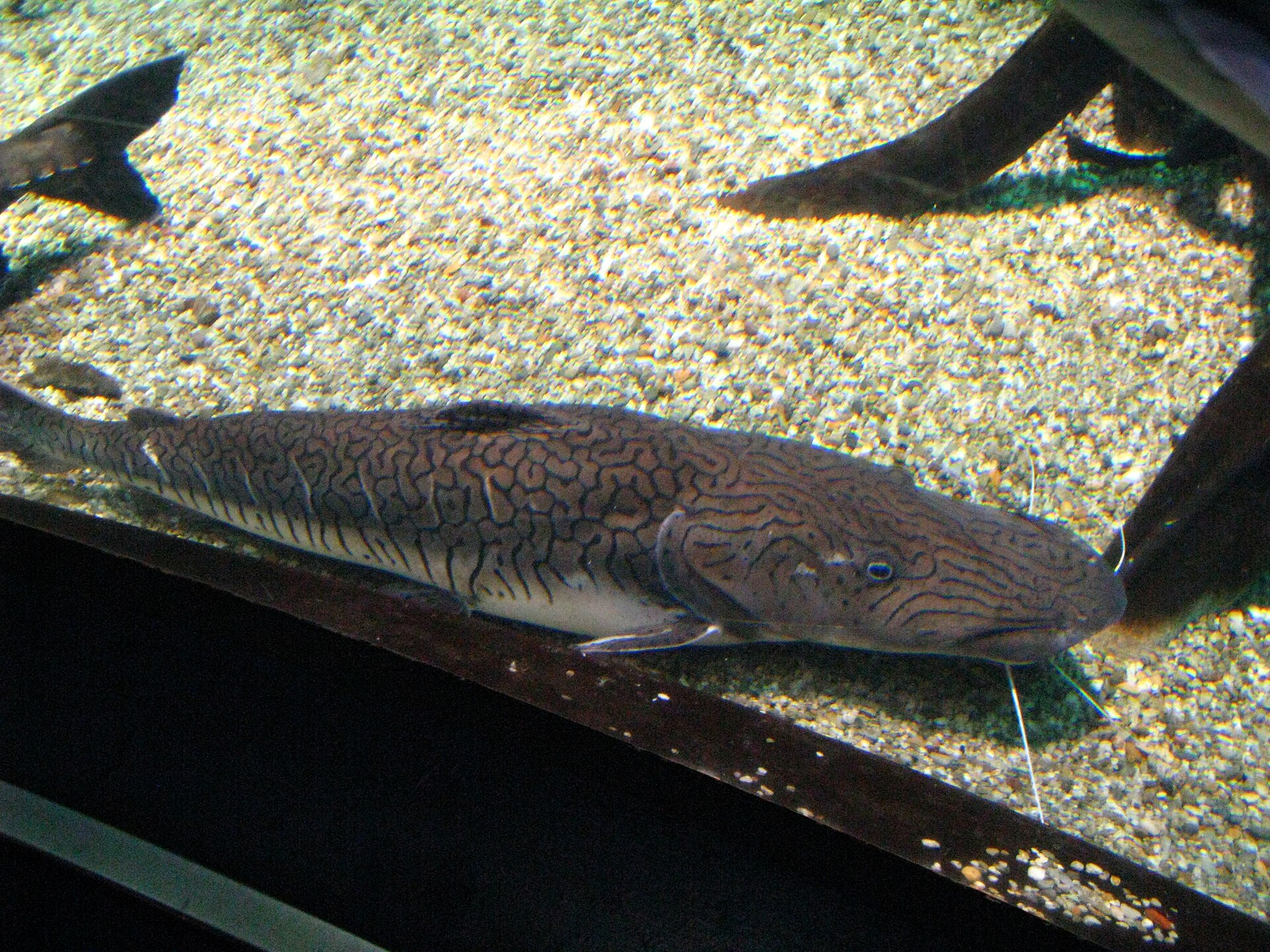 Pseudoplatystoma fasciatum. Photo: KENPEI / Wikimedia Commons (CC BY-SA 3.0)
Juveniles are striking: dark bars and loops on a pale ground, a flattened head, trailing barbels, a body built to accelerate. Adults keep the barred identity (as opposed to some more spotted Pseudoplatystoma forms) but the head becomes a shovel the size of a serving dish and the body a torpedo of muscle. There is no “it might stay small.” There is only “when.”
Compare the outline with Sorubim lima: the duckbill is a lying-down spatula specialist of sandbars, slimmer and shorter. Compare with Leiarius marmoratus: marbled, with a sail-like dorsal, a different pimelodid shape. P. fasciatum is the classic tiger shovelnose of the channel — bars, bulk, and a mouth that ends arguments about stocking.
Shop fish with shredded tails have already been crashing in glass. That is the adult problem arriving early.
A hall of water, or a no
Adult barred sorubim belong in public-aquarium channels: tens of thousands of litres, swimming length measured in many metres, round-the-clock filtration, a lid or deck that can stop a startled missile. Private “large tanks” of 1,000 litres are still jokes at this body size. Indoor ponds designed as river exhibits by people who know engineering can be discussed. Glass boxes in apartments cannot.
Décor must be unbreakable and sparse. They will snap wood that a pleco would ignore. Sand or smooth bottoms save the barbels. There is no planted community version of this exhibit.
If you are pricing a chiller and a sump for a discus tank, you are still in the wrong conversation. This fish needs a building.
Amazon heat, industrial filtration

Temperature 24–28 °C, river pH, crushing bioload management. A tiger shovelnose on a fish diet produces waste like a livestock operation. Home canister filters are not that operation. Institutions use systems designed for large piscivores. Copy them or do not keep the species.
They are freshwater giants of South America, not North American pond cats, not Mekong pangasiids, not brackish ariids. Wrong continent, wrong chemistry, wrong ethics if you mix the care sheets.
A piscivore measured in kilograms of food
Wild barred sorubim eat fish. Captive diets in proper exhibits are formulated large-predator feeds and fish flesh on a schedule, with water quality as the limiting factor. Algae, wood, and leftover flakes are not a menu. A growing juvenile in a hobby tank will eat every companion and then sit in nitrate soup.
Do not use live feeder fish as a personality test. The personality is already “apex channel predator.” Feed dead foods in an institution. Do not feed a living room.
Tank mates are a curator’s problem
In a public river hall, other huge fishes that cannot be swallowed might share water. In a house, nothing should. The barred sorubim is not a “centrepiece” for a community. It is the community’s end. There is no peaceful schooling of tiger shovelnoses in 400 litres. There is no cleaner crew that survives.
Handle with respect: a large pimelodid spine and a thrashing metre of fish can injure a person. This is not a cuddly catfish.
Reproduction belongs to rivers and hatcheries
These fishes spawn in big-river cycles; aquaculture exists in parts of South America for food. Your spare bedroom is not a hatchery. Do not buy a “breeding pair” of 10 cm tigers.
What “tiger shovelnose” hides in a shop bag
Dealers use the English name for more than one Pseudoplatystoma. Some are more spotted, some more barred; all of them become channel monsters. Arguing which Latin name is on a 12 cm fish is less important than refusing the purchase. If you are the person who already owns one that is outgrowing a tank, call a public aquarium or a true large-fish rescue before the animal is injured in glass. Do not dump it. Do not add “just one more tetra” as company. The tetra is a meal size.
Barbels are sensory gear. In a too-short tank they rub raw on silicone. Raw barbels on a tiger shovelnose are a husbandry confession. The confession is: this fish needed a river, and you offered a box.
There is no vitamin, no cave, and no planted scape that converts an apex Amazon piscivore into a community pet. The bars were always a warning. Shops just printed them in a prettier font.
Bars are not a beginner fish
Pseudoplatystoma fasciatum is a huge Amazon channel predator, a barred tiger shovelnose, a public-aquarium species. The juvenile is a lure. Walk past it. See duckbill and marbled catfish for other large pimelodids that are still not community fish, plus chemistry and cycling.
Explore other topics
Dive into more aquarium guides across the site.