

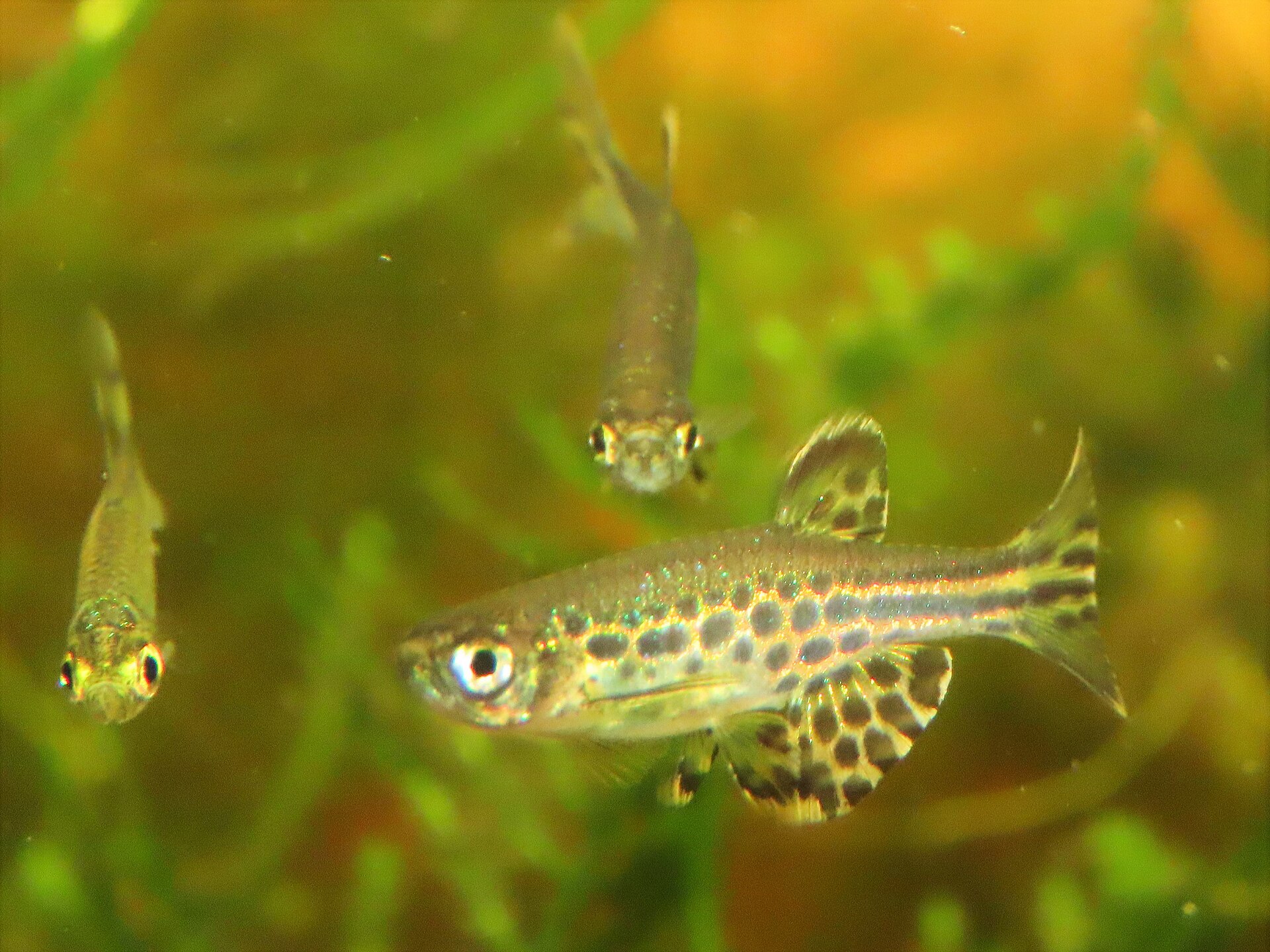
The Hikari danio or gold-ring danio (Danio tinwini) is a small, spotted Myanmar species described in 2009. It does not wear zebra stripes. It wears a dark net or spots on a gold-brown body, and males will spar in a way that looks fierce and is mostly theatre if the tank is long and the school is large. Treat it as a compact stream danio: current, cover, lid, length.
Gold rings on a short fish
Tinwini comes from the upper Irrawaddy basin in Myanmar, in smaller streams than the highways D. kyathit sometimes uses. Adults are only about 3–3.5 cm. That size tempts people to put them in cubes. Cubes lack the horizontal run a danio uses. A 60–80 cm tank with a group of ten is the right shape. Height is almost irrelevant.
Temperature sits a little cooler than “tropical community” marketing: 20–25°C is a sweet spot, with tolerance a bit on either side. pH 6.5–7.5, moderate hardness. They are not peat-swamp fish. They are not Inle Lake fish. They are hill-stream adjacent cyprinids that still need swimming room.
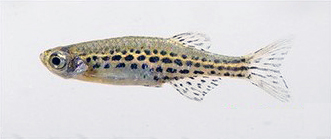 Danio tinwini. Photo: David M. Parichy / Wikimedia Commons (CC BY 4.0)
Spots instead of stripes, sparring instead of a peaceful tetra myth
The pattern is a lattice of dark spots, sometimes looking like gold rings in the right light — hence “Hikari” in some markets. Males are slimmer, more intensely patterned, and will flare and chase. Photographers love two males head-to-head. That behaviour needs a crowd so no single fish is the only target, plus pebbles, plants, or wood to break lines of sight. It is not cichlid warfare. It is danio sport. If fins get shredded, the tank is too short or the group is too small.
They occupy the upper and middle water, always moving. They jump. Seal the lid, including filter cut-outs.
Current without a torrent
A modest powerhead or a filter return along the length is enough. They are smaller than Malabar danios and do not need a river pump. Still water makes them look nervous and listless, which people then “fix” by adding tetras. Add flow and friends of their own species instead.
Oxygen matters. Cooler water holds more, but a warm, still nano will still suffocate a tinwini school. If you heat to 26°C, increase surface agitation and do not overstock.
Micro foods for a micro hunter
Mouths are small. Crushed flake, baby brine, cyclops, powdered foods. They will take food in current, picking pieces as they pass. Large pellets sink past them. They lose feeding contests to kyathit and to zebra danios; mixed Danio tanks tend to produce fat zebras and thin tinwini. Keep Hikari as the primary school, or feed with that bias in mind.

They are not algae eaters. They are not surface-only insectivores like hatchets, though they will take floating crushed flake.
Tankmates at the same scale and speed
Other small stream fish, hillstream loaches if the flow and temperature overlap, shrimp if you accept some predation on young, and plants. Avoid large Devario, avoid slow long-fins, avoid tiny Boraras that will be outpaced. Glowlight danios (D. choprae) are a closer match in size than Malabars.
Do not house them with Mexican tetras. The size and climate gap is silly. Do not house them with splash tetras; the surface circus and the stream sprint are different tanks.
Spawning a 2009 danio
Marbles or a grate, a well-fed pair or group, a water change. Adults eat eggs. Fry need fine foods. Hybridise with other Danio only if you want mystery fish; tinwini is distinct enough that mixing it with rerio in a breeding project is sloppy.
Quarantine. Small spotted danios hide ich in the pattern. Watch behaviour: flashing, hanging in corners, refusing food in the current. They are hardier than wild hatchets and less bombproof than zebra danios from a century of domestication.
If you wanted stripes and orange fins, that is kyathit. If you wanted a tiny spotted Myanmar danio that spars in gold rings, D. tinwini is the one, and the tank is a long, covered stream, not a peat cube and not a tetra community afterthought.
See also glowlight danio for another small Myanmar schooler.
Sparring photographs versus a short tank
The famous images of tinwini males jaw-locked are taken in tanks that still have an escape route. Copy the photo into a 30 cm cube and you copy the lock without the route. Fins shred, spots fade, and keepers decide the species is aggressive. Length and numbers are the behaviour fix. Medication is not.
Cooler rooms suit them. If your house sits at 22°C, you may not need a heater, but you do need to avoid overnight crashes and you do need to watch oxygen if you later add a tight lid and a weak filter. A sealed lid without agitation is a trap for a fish that lives in streams.
Because they are small and spotted, ich is easy to miss. Look at the fins’ clear edges and at whether a fish still joins the current line at feeding. A spotted danio hanging in a back eddy while the rest of the school hunts is the individual to watch, not a generic “all danios have ich after shipping” story — though shipping stress is still the usual trigger, so quarantine the group in a long, covered box, not a vase.
Gold rings and sparring males are the Hikari danio’s whole visual language. Translate that into glass: a long covered box, a modest current, cool water, and enough spotted fish that no pair has to carry the species alone. Short tanks turn the language into shredded fins and a care myth that tinwini is mean.
Count the school after every lid-off maintenance. Tinwini fit through gaps that look too small until you find a dried spotted fish behind the stand. A clip-on cover over the filter slot is not optional hardware; it is how a 3 cm Myanmar danio stays in the river you built for it.
Explore other topics
Dive into more aquarium guides across the site.