

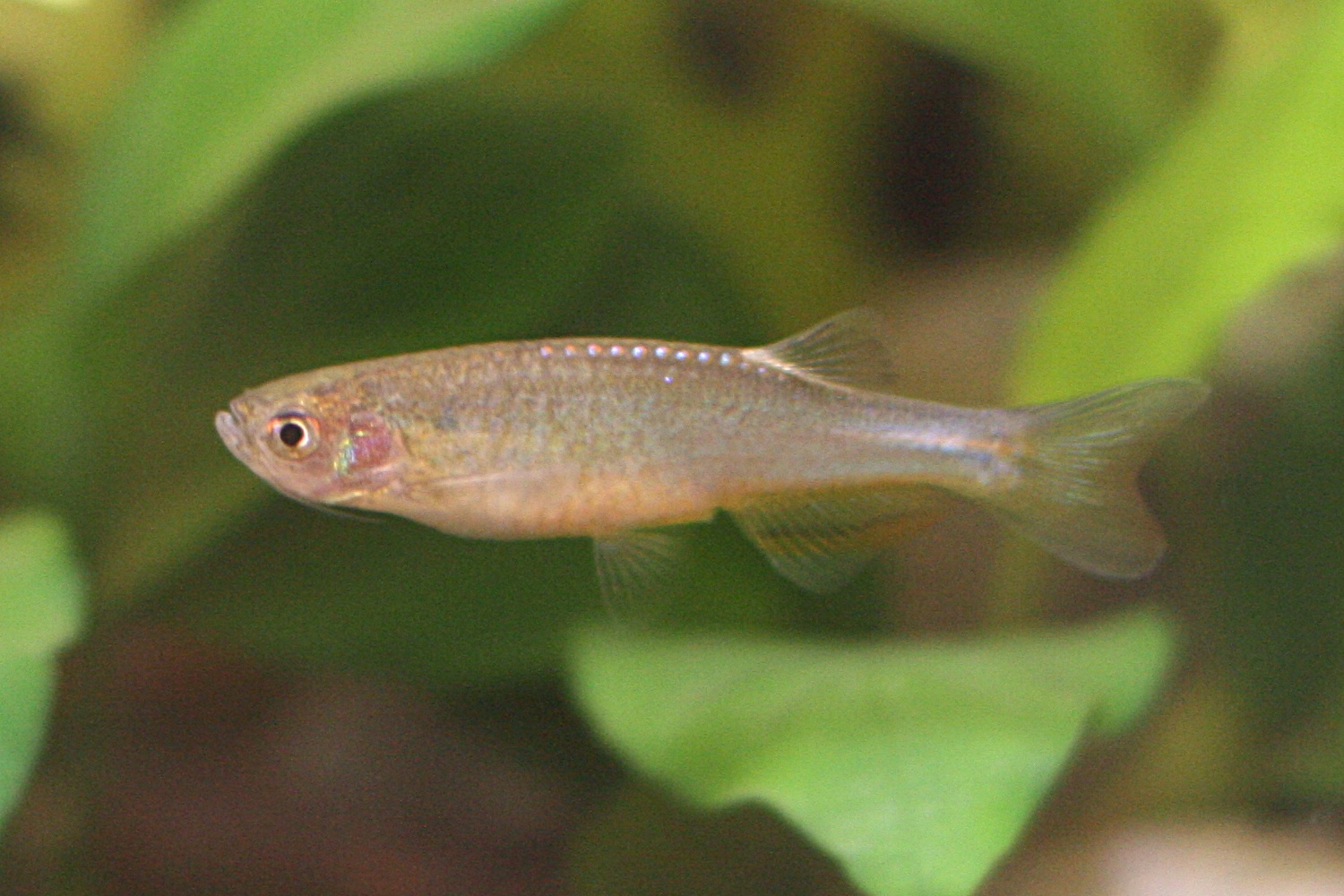
The rose danio (Danio roseus) carries a pink to rose wash over a body with two bluish longitudinal lines. It is a hill-stream fish of northern Thailand, Myanmar, and neighbouring Laos, not a warm still-water tetra and not a giant Devario. Keepers who heat them to 28°C in a short tank get faded, hyper, jumping cyprinids. Keepers who give them length, current, and the low-to-mid twenties get a pink school that actually looks like the name.
Two blue lines and a rose shoulder
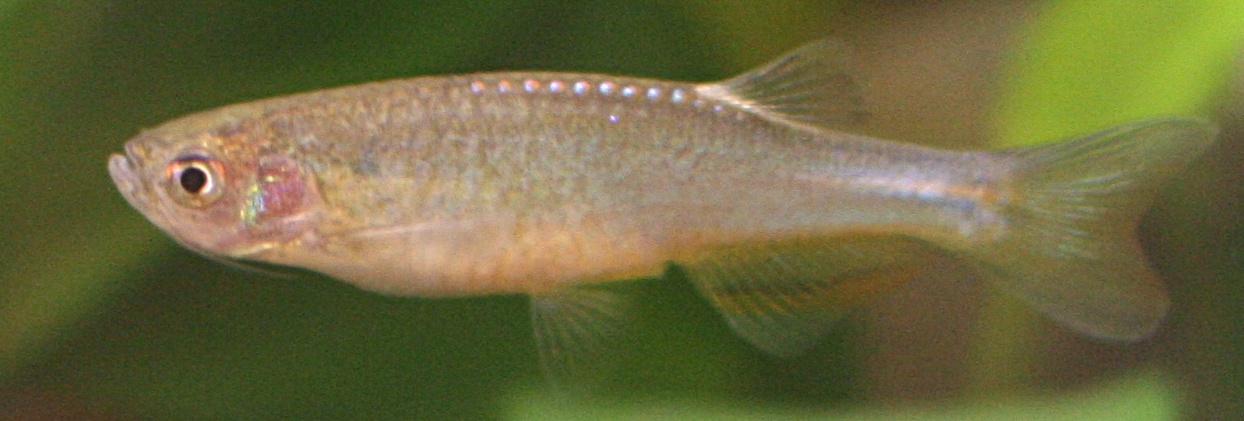
Adults reach about 4–5 cm. The rose colour sits on the flanks and fins in settled, well-fed fish; the blue lines run along the body. Males are slimmer and often pinker; females are plumper. Colour is a mood and a water report. Hard, dirty, hot water turns them into brown minnows. Cool, clean, moving water brings the rose back.
Wild habitats are streams and small rivers with monsoon pulse. They see temperatures that dip below typical Amazon tetra ranges. In the aquarium, 20–26°C is honest. pH 6.5–7.5, moderate hardness. They do not need peat. They do not need salt. They need oxygen.
A river-style layout on a modest budget
Think gravel or sand, a few rounded stones, plants that tolerate flow (Anubias on wood, Vallisneria, hardy stems in the slack water), and a filter return that runs the length. A 90 cm tank for eight or more fish is the shape. They use the top two-thirds, constantly. A nano cube is a treadmill with no length.
Lid. Always. Rose danios are accomplished jumpers, especially at feeding time and when lights snap on. Open-top planted tanks are a common way to lose them.
Schooling in current, not in a tetra huddle
They school loosely while moving, not in the tight midwater ball of a frightened garnet tetra. That is healthy. If they clamp in a corner, the flow is wrong, the group is too small, or a tankmate is hunting them. They are generally peaceful with fish that can keep up. They will nip slow fins. They will eat fry of other species. They will not eat adult Corydoras. They will stress dwarf pencilfish to death by existing in the same current.
Good companions: other small Danio, fast loaches, robust minnows. Poor companions: hatchets (wrong depth and temperament), splash tetras, sun tetras, Boraras, discus.
Surface insects and midwater flakes
In streams they take drifting insects from the upper water. Floating flakes and small live insects are taken eagerly; they also hit midwater frozen foods. Feed against the current. They have a high metabolic rate. One feeding a day of flake produces thin fish with no rose. Two or three small feedings produce colour.
They are not dedicated film-feeders like hatchets. Food that sinks slowly through the upper half is enough. Food that sits on the sand is for someone else.

Breeding without tropical heat
Scatter eggs over marbles or plants. A slight temperature drop and a rain-style water change often trigger spawning better than cranking the heater. Adults eat eggs. Fry raise like other small danios. Do not copy a discus spawning temperature. Do not copy a Copella lid setup. A covered, well-oxygenated breeding tank at 22–24°C is closer to their climate than a 28°C blackwater box.
Pink that is not a dye
Dyed “pink” fish exist in the trade. Rose danios should show even wash that can fade, plus those blue lines. Quarantine. Stream fish pick up skin flukes and ich. Cooler water does not make them immune; it makes some parasites slower, not absent. Watch for flashing and clamped fins. They are tougher than tinwini in some rooms because they are a bit larger, and more temperature-sensitive than zebras that have been farmed for decades.
If you wanted a giant from the Western Ghats, that is the Malabar. If you wanted a vertical-barred Sri Lankan endemic, that is pathirana. If you wanted a pink-washed hill-stream danio of modest size, D. roseus is the one, and the heater is a tool you may barely need, while the lid and the long axis of the tank are not optional.
Compare zebra danio for the domesticated cousin that tolerates a wider mess, and still give roseus the stream it actually comes from.
Pink, blue lines, and a heater you might turn down
Rose danios sold next to neon tetras pick up a 26–28°C reputation they did not earn. If your pink wash never appears, lower the temperature a couple of degrees, raise the flow, and feed more often. The blue lines stay when the rose goes; use them to confirm you still have D. roseus and not a washed-out something else.
Hill-stream scapes with rounded stones look right and give them visual current. Sharp collected rock that forms dead pockets of waste does not. They are not loaches; they will not clean those pockets. Siphon the eddies. Keep the runway open.
Jumping at lights-on is common. Use a dimmer or a plant-shaded dawn, or accept that a snap switch plus an imperfect lid equals fish on the floor. That problem is shared with other Danio and Devario, but roseus is small enough to fit through gaps kyathit might not, so test the lid with a credit card around the rim.
The rose wash is a hill-stream dividend. Turn the heater down, stretch the tank out, seal the lid, and feed drifting food in the current. If the fish stay brown, you still have a rose danio — you just have not given Danio roseus the northern Thai and Myanmar river it paints with.
Feed against the flow at least twice a day, including a small live or frozen offering, or the rose never pays out. These are hill-stream hunters, not leftover-eaters under a tetra flake storm. If Corydoras get fat and the rose danios stay brown, you are feeding the floor of the wrong river.
A dawn dimmer costs less than the rose wash you lose when lights slam on and half the school hits the lid.
Explore other topics
Dive into more aquarium guides across the site.