

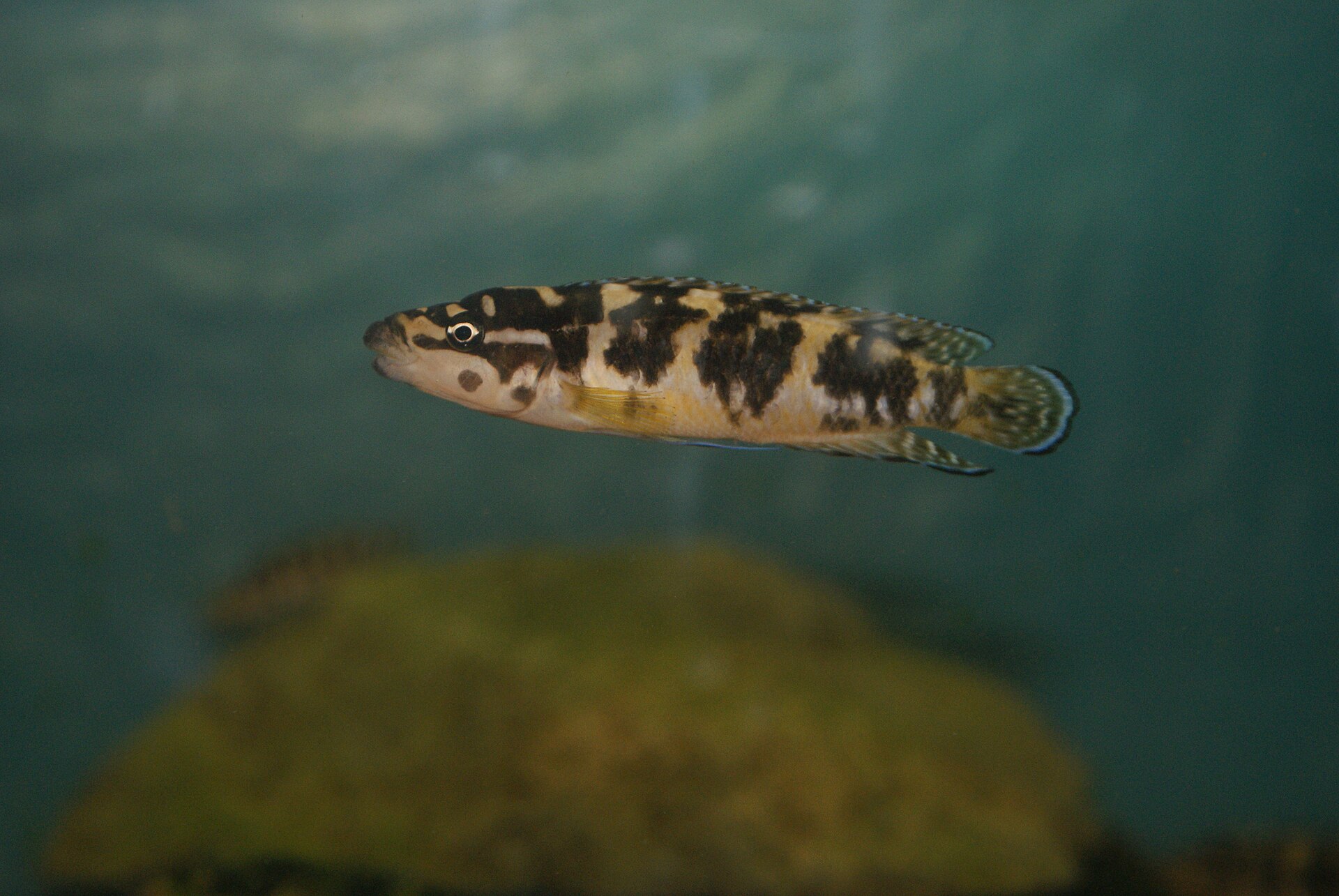
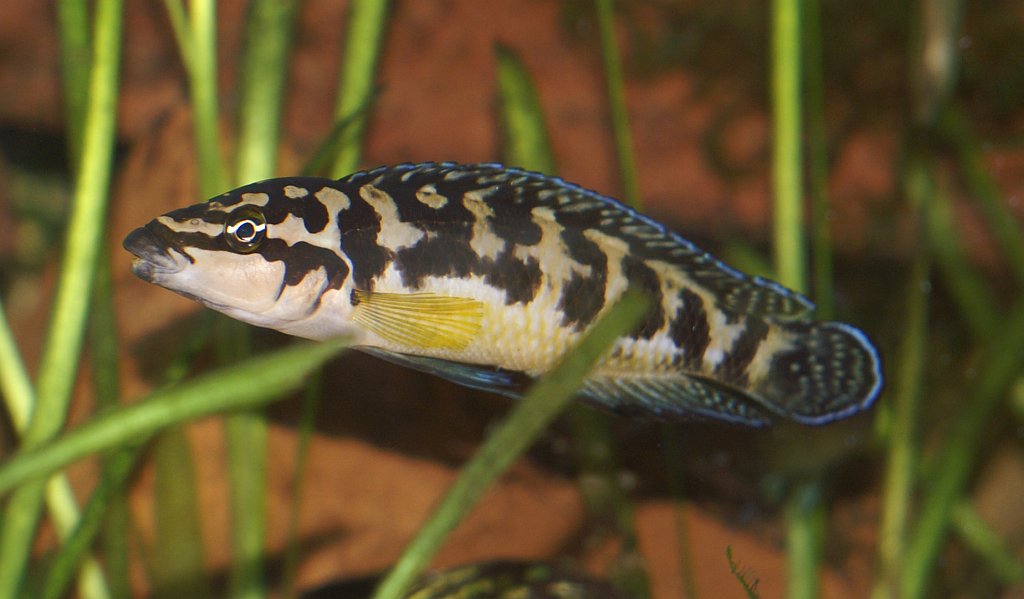
Julies do not patrol like mbuna. They stitch themselves into a crack. Julidochromis transcriptus, a small Tanganyikan from the northwest (Pemba, Bemba and neighbouring rock), wears a black-and-white maze that looks like a circuit board. The body is elongate, the head is stubborn, the pair is a marriage that can last years or end in a murder when the tank is too small for a divorce. They are cave spawners, not mouthbrooders. They do not want a harem on sand. They want a pile of slate with tunnels, hard water, and a neighbour policy that respects the fact that a 7 cm fish can hold a doorway like a guard dog.
The trade mixes julies. J. transcriptus is the compact, high-contrast, almost chequered one compared with the more striped J. marlieri or the slimmer J. ornatus. If your fish is a long yellow worm, you do not have transcriptus. If it is a short, stark, maze-sided julie, you might. Care among Julidochromis is close; the pair-bonding drama is the same play with different costumes.
A maze needs a wall
Eighty to 120 litres can house a pair if the rockwork is the tank, not an afterthought. A 200 litre tank can house a pair plus carefully chosen Tanganyikan neighbours if caves are mapped so that nobody shares a hallway. Stack slate in plates to make crevices. Sit the stack on the glass. Sand in front for the look and for the occasional invert. They will not sand-sift like an Aulonocara. They will back into a slot until only the tail pattern shows, which is how you miss them when you count, and how they like it.
Temperature 24 to 27°C. pH 7.8 to 9.0. High mineral content. Clear water, strong oxygen, moderate flow that does not blast the caves. They are not open-water sardines. They are not Tropheus either; they take more animal food. They still die in a pH 6 Amazon box.
Marriage, caves, and the week it goes wrong
The reliable way to get a pair is to raise a group of juveniles and let them sort it, then remove extras before someone dies. Introducing two random adults is a coin flip. A pair that works is devoted. They spawn on the ceiling of a cave, guard the eggs, and allow several generations of fry to hang around the territory in a layered family that looks almost cooperative. A pair that stops working will kill. Have a divider. Have a second tank at the same chemistry. Watch for a fish that suddenly stays outside the cave while the other claims the door. That is the weather changing.
Sexing is easier once they spawn: the female is often larger in julies, which surprises people who assume cichlid males are always the big ones. Not always here. Behaviour at the cave mouth is a better guide than a shop guess on a 4 cm fish.
Micropredators, not algae cows
Frozen cyclops, mysis, brine shrimp, quality micro-pellets, and crushed granules. They will pick at the rock for small animals. They are not herbivores; a spirulina-only diet is the wrong lake logic copied from Tropheus. They are not piscivores of hap ambition; they will still eat tiny fry of other fishes and they will still eat shrimp that wander into the doorway. Feed small, feed so both pair members get some. A dominant fish at the slot can block a meal.

They appreciate a living rock film because it holds infusoria for fry, not because they are grazers first.
Neighbours, if the doorway allows
Open-water Cyprichromis in a taller, larger tank can occupy a different floor of the building. Shell dwellers can occupy sand if the julie pair does not decide the sand is also theirs. Other julies of the same species are a territorial problem. Other julies of different species are a hybridisation and fighting problem. Mbuna are the wrong lake. Large predatory Altolamprologus may eat julie fry and may be ignored by adults, or may not. Many people keep a species pair in a dedicated rock tank and get the family layers that make julies famous. That is the high-yield path.
They will kill incoming fish that look like rivals. They will tolerate, sometimes, a fish that clearly lives in another neighbourhood of the tank. Layout is diplomacy.
Eggs on the ceiling
Look under a slate with a torch. A neat patch of eggs is a spawn. Parents fan and guard. Fry stay in the territory and may be joined by the next spawn, so you see several sizes at once. That is the julie postcard. It requires that you do not siphon the cave, do not restock with a predator, and do not break the pair with a panic rearrangement. If you want to raise numbers for other keepers, you can catch juveniles from the edges of the territory. If you want a display, leave them. The tank will become a village until it is overfull, and then you will have to harvest.
Water changes should not include a temperature slap or a pH adventure. Tanganyikan caves sit in a stable lake. Copy the stability.
When the maze fades
A washed-out julie is stressed, sick, or losing a fight. Ich shows on dark-and-white fish as white on the black. Treat in alkaline water. Quarantine new julies in a cave-furnished box or they will not eat. A julie that will not go into a provided pipe is a julie that does not believe the pipe. Offer better rock. Plastic decorations with huge open rooms are not caves. Slots that fit the body are caves.
Julidochromis transcriptus is a fish for people who like looking into crevices more than they like a midwater show. The maze pattern is camouflage for a life in cracks, and it only reads as art when the fish is comfortable enough to hang in the doorway. Build the wall, get a real pair, feed the micro-hunters, and keep a spare tank for the day the marriage fails. Most days it will not fail. Those days, the ceiling of the cave is full of eggs and the doorway is full of a pattern that looks like writing. That writing is the species. It is not a mbuna slogan. It is a lease on a crack in Tanganyika.
Explore other topics
Dive into more aquarium guides across the site.