

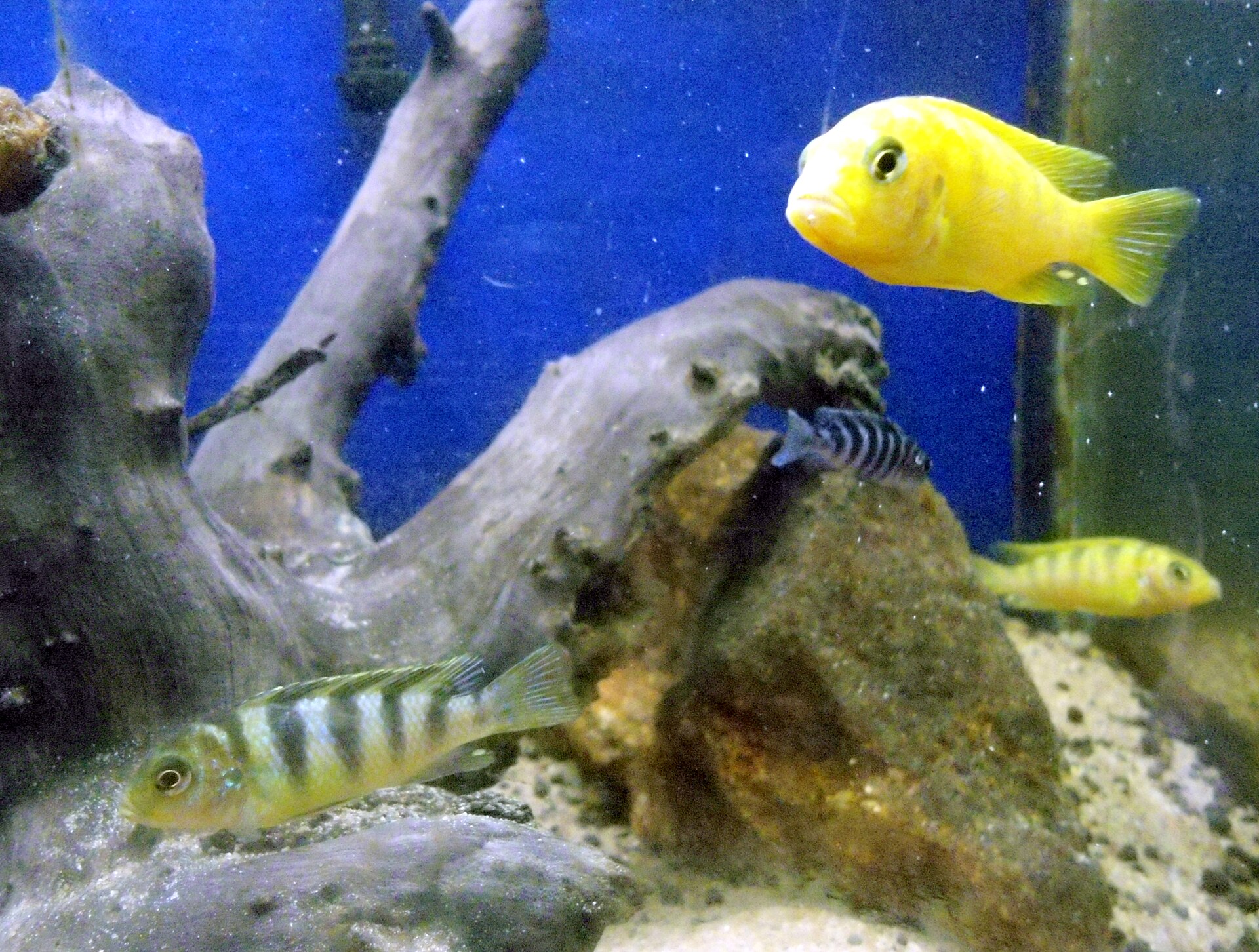
Most Malawi cichlids follow a boring rule: males flashy, females brown. Maylandia lombardoi (still sold as Metriaclima lombardoi, still called Kenyi) tore up the rule and left it on Mbenji Island. Adult males are yellow to orange with faint bars. Females and juveniles are blue with bold black bars. Beginners “sort” them into two species and then cannot understand the fighting. There is one species. The yellow fish is the male. The blue fish are the females you needed more of. The juveniles are blue too, which is how a tank of “all blue Kenyis” becomes a time bomb when half of them turn gold and start a war.
It is a mbuna, a rock-dwelling, algae-grazing, highly territorial Lake Malawi cichlid. It is not a peacock. It is not mild. It is a 12 to 15 cm argument in a cave, and it is popular because the colour split is so complete that a pair looks like a designer’s joke.
Mbenji rocks, and the overstocking that is actually husbandry
In the lake, Kenyi hold small territories on rocky shores around Mbenji. In the tank, a single pair in 150 litres will produce a yellow tyrant and a hiding blue fish. The Malawi trick for mbuna — more fish, more rock, less exclusive real estate — applies hard here. Two hundred litres with a pile of rocks that creates ten caves, a group of one male and four or more females, plus other mbuna of different pattern if you know what you are doing, spreads aggression. A sparse, pretty scape with two Kenyi is a beautiful crime scene.
Temperature 24 to 28°C. pH 7.8 to 8.6. High hardness. Sand in the lanes, rock on the glass. No Amazon botanicals. No pH 6.5 “for the plants.” The plants, if any, should be ones that tolerate alkaline water and mbuna teeth; often there are none.
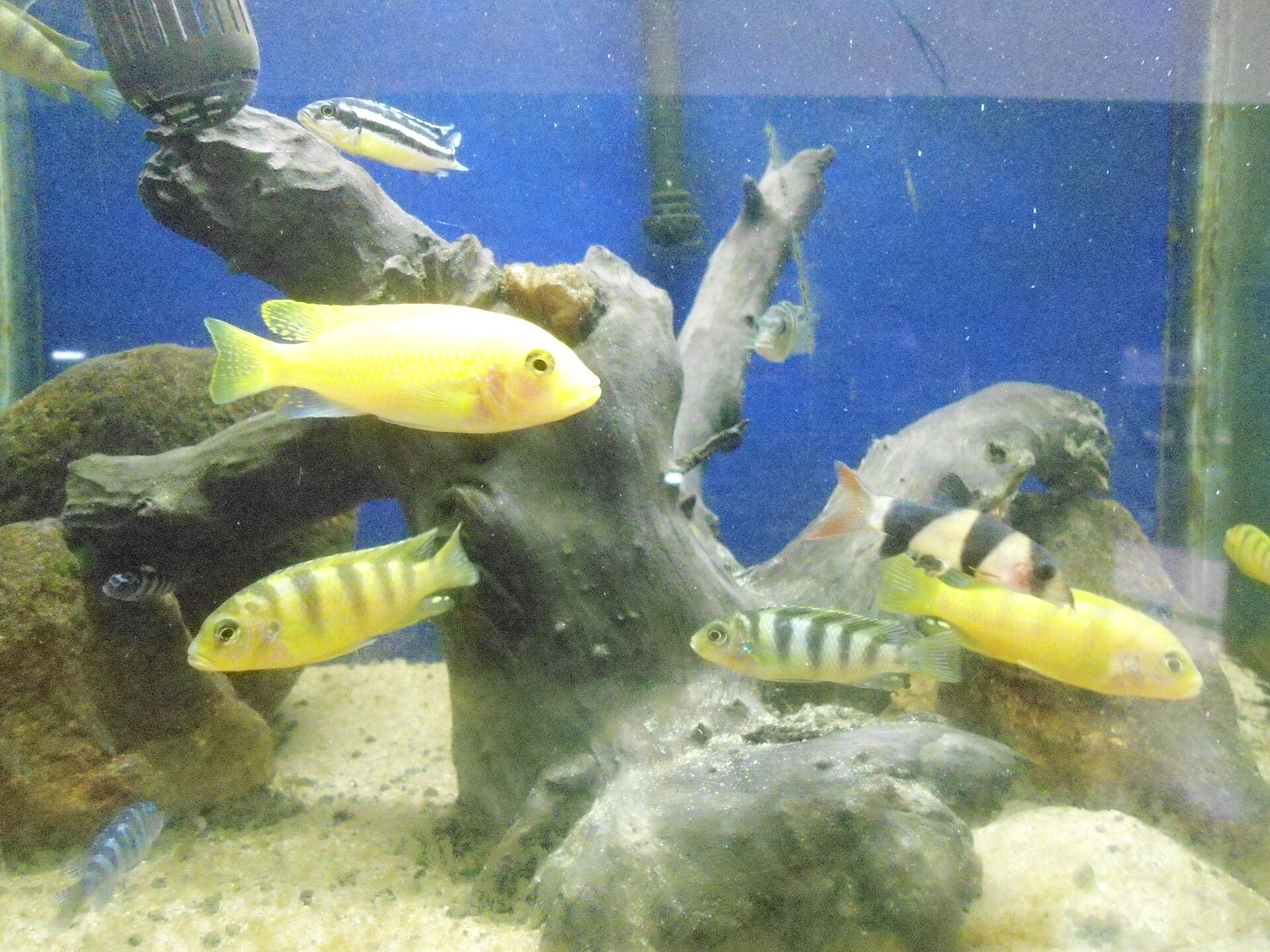
Yellow is not a morph you ordered. Yellow is puberty.
When a blue barred fish begins to show gold in the fins and a wash of yellow on the body, you are watching a male colour up. If you already have a yellow male, you now have a problem. Remove the new male or rebuild the tank with more rock and more fish. Do not wait to “see if they work it out” in a small volume. Mbuna work it out by ending one of them.
Females stay blue-barred. They are not drab. A good female Kenyi is a striking fish and should not be treated as leftover stock. Brooding females need a cave the male cannot trivially evict them from.
Aufwuchs, spirulina, and the bloat you were warned about
Wild Kenyi comb rock for algae and the animals living in it. The tank diet should be mostly vegetable: spirulina flakes, herbivore pellets, blanched greens. Animal foods are a small fraction, not the personality of the menu. Bloodworm-only feeding is how you buy Malawi bloat — swelling, lethargy, refusal to eat, death. High-fibre, lower protein, frequent small feeds, and excellent water are the counter-spell. They will still take a pellet with protein in it. They should not live on krill.

Feed so that even the lowest female gets some. The yellow male will try to monopolise the front glass. Drop food in more than one place, including near rock openings.
Who can survive a yellow landlord
Other mbuna of similar size and different colour pattern, in a large, overstocked rock tank, are the traditional company. Peacocks and mild haps are often harassed. Tiny fishes are harassed or killed. Non-Malawi community fishes in soft water are in the wrong building. Large Synodontis sometimes work as bottom movers. Two male Kenyi is a no in anything but a huge display. Mixing with other yellow mbuna males (there are a few) invites extra war and extra hybridisation.
They will hybridise with other Maylandia / Metriaclima if you let them. If the yellow/blue split is why you bought them, keep the species to itself or with unlike genera that will not spawn with them.
Mouths full of eggs, tanks full of yellow sons
Maternal mouthbrooder, three weeks give or take. The blue female holds. The yellow male keeps displaying at everyone. Fry released in the display are likely food. A nursery tank at the same chemistry is how you get numbers. You will get numbers. Kenyi are fertile. You will also get more males than you want, because every other hobbyist already has a yellow fish and needs blues. Plan the population like a problem, because it is one.
Stripping is optional and skill-dependent. Harassment of holding females is not optional to manage; it is the default. Rocks. Extra females. Maybe a breeder box that still has alkaline water and an air stone, not a tiny isolation cup.
The joke is on the care sheet that said “peaceful mbuna”
There is no peaceful mbuna of this size that looks like a Kenyi. There is a colourful, backwards-sexed, rock-scraping cichlid that rewards a crowded, alkaline, vegetable-fed, rock-dense tank and punishes a pair-in-a-show-tank fantasy. If you like the yellow-and-blue gag, commit to the gag’s habitat. If you wanted a single mild fish on sand, you wanted an Aulonocara and you should not have picked the one that turns into a gold bar and claims every cave.
Maylandia lombardoi from Mbenji is a specific rock. You cannot copy the island. You can copy the rules: hard water, aufwuchs diet, many females, one adult male, stone piled until it looks too much, and the understanding that the blue fish is not a different species. Remember that last part when the first gold appears. It is not a new fish arriving. It is the plot.
Shipping and settling deserve their own sentence because Kenyi colours invite impulse buys. A bag of mixed blue juveniles looks harmless. In quarantine they need the same alkaline water you intend to keep them in, a heap of caves, and vegetable food from the first full day, not a week of bloodworm “to fatten them.” Fat Kenyi on protein are not well Kenyi. They are pre-bloat Kenyi. Drip them onto your pH. Do not pour a pH 7 bag into a pH 8.4 display and call the resulting flashing a mystery. The mystery is chemistry. The yellow that appears later is still not a second species. It is the same fish, finishing the sentence Mbenji started.
Explore other topics
Dive into more aquarium guides across the site.