

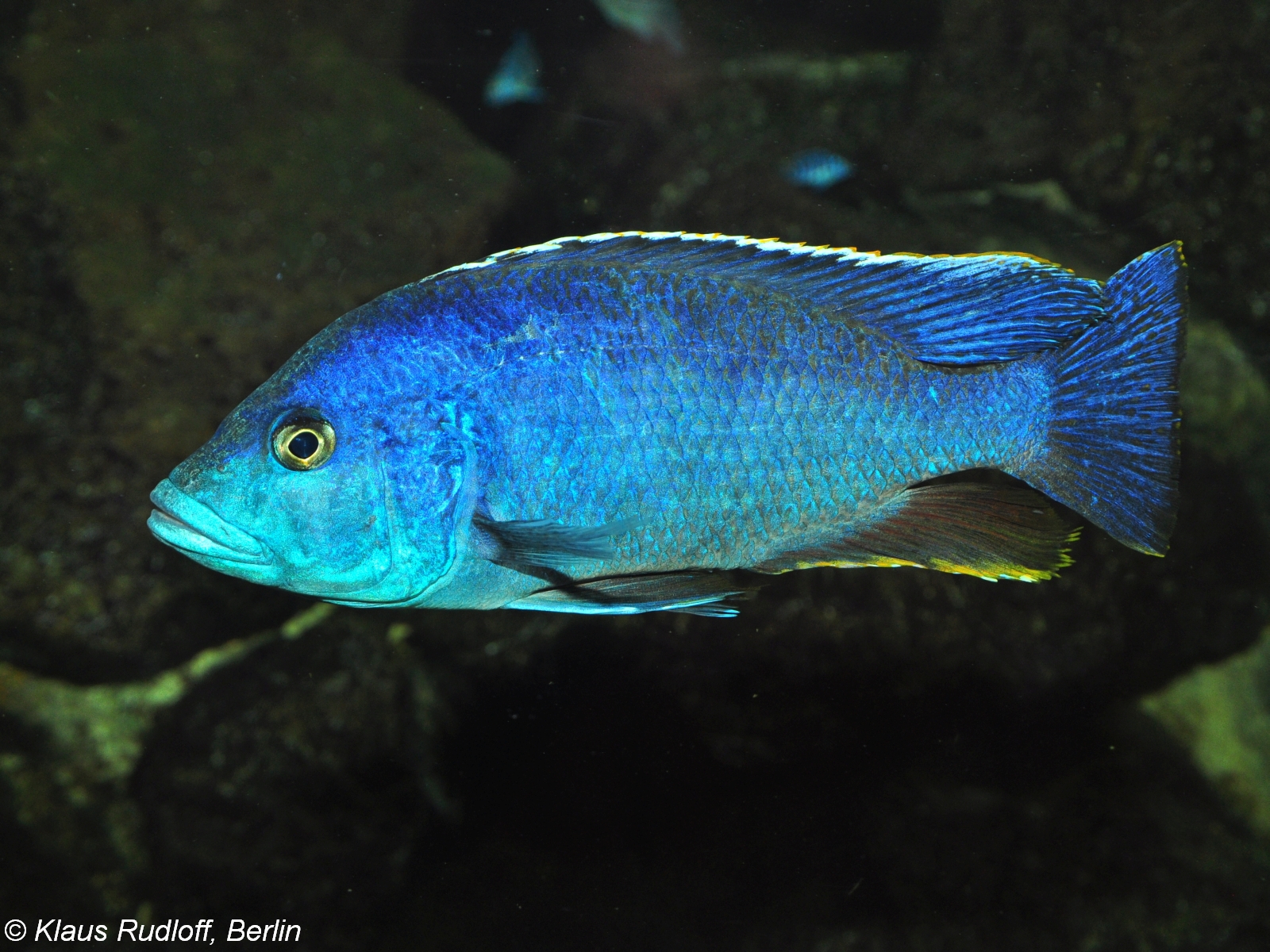
Peacock cichlids hunt by listening to sand. Aulonocara nyassae, the type species of its genus, carries enlarged sensory pits on the head — part of the lateral line turned into a metal detector for invertebrates moving under the lake floor. In Lake Malawi it works the sand-rock interface, hovering, then dipping. In an aquarium with sharp gravel and no sand, that tool has nothing to do. The fish will still eat pellets. It will not be the animal the pits evolved for.
The trade calls a dozen Aulonocara “peacocks.” A. nyassae is a specific fish, associated with southern lake populations (the species name points at Nyassa, the old name for Malawi). Shop fish may be hybrids. Care for true peacocks is still a cluster: milder than mbuna, still alkaline, still a maternal mouthbrooder, still in need of a harem, still destroyed by mixing with hyper-aggressive rock-scrapers that will not let them forage.
Males in costume, females in khaki
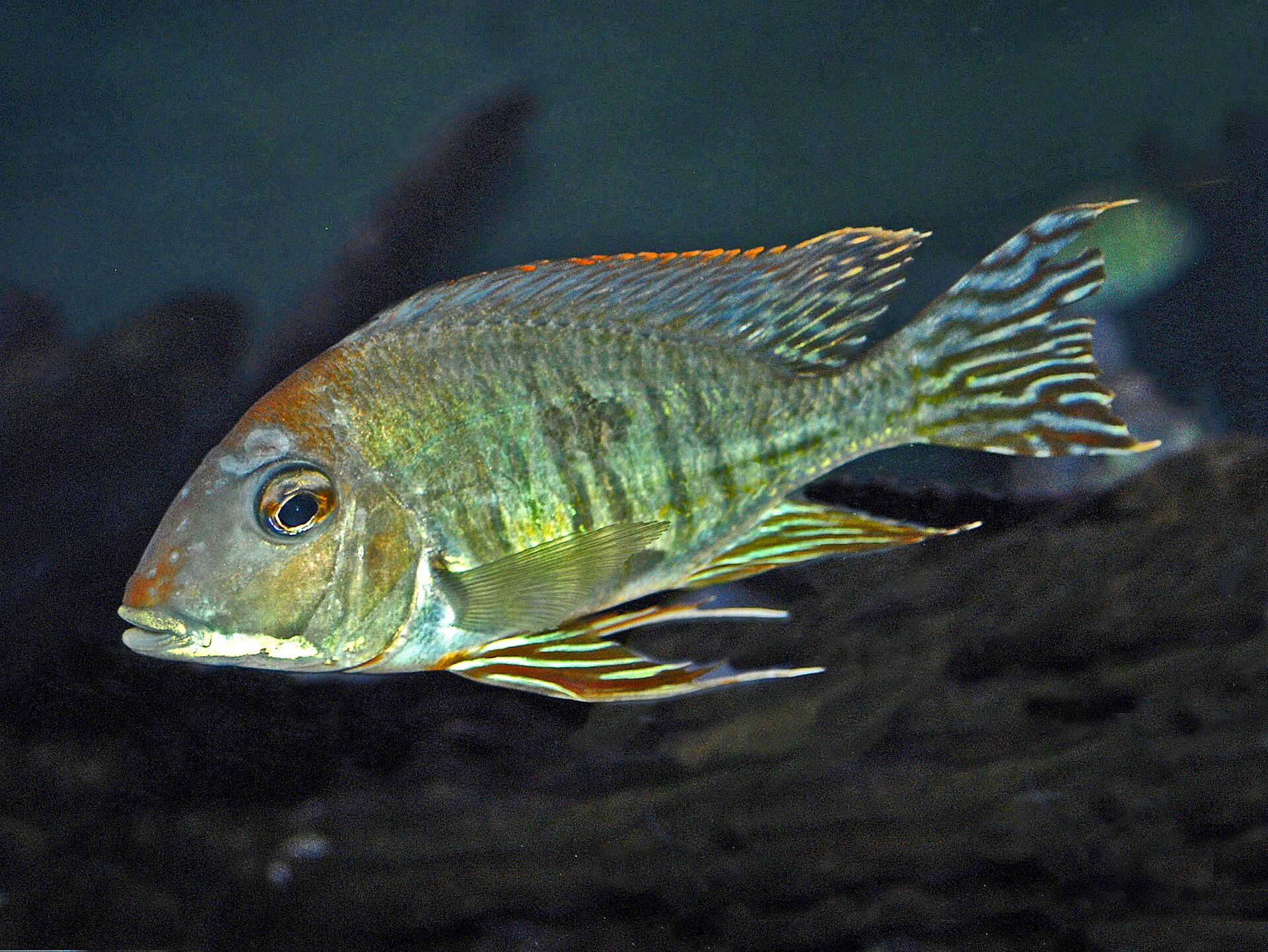
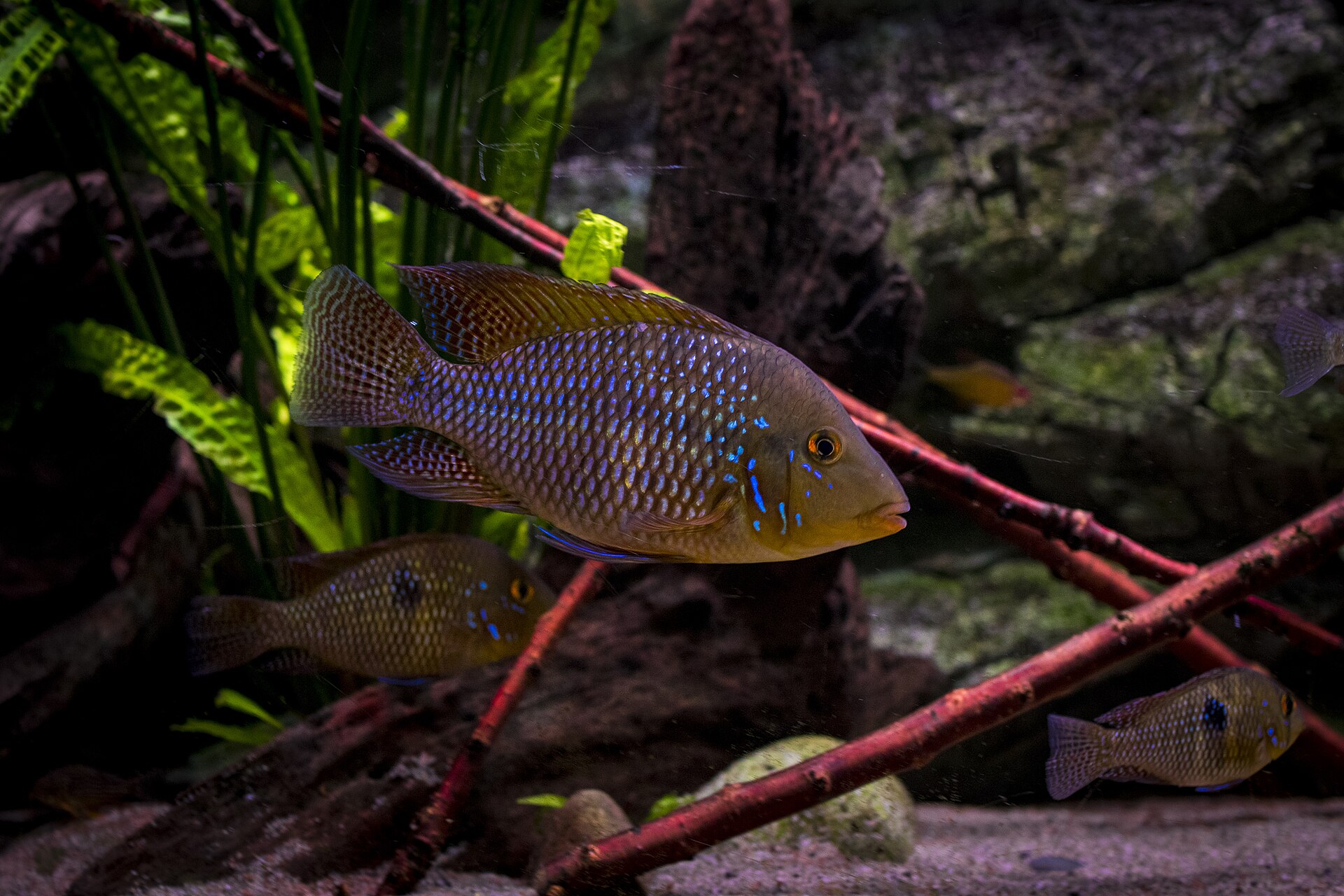
Males reach 12 to 15 cm and put on blues, yellows and a metallic wash that varies by locality and by how much hybrid you actually own. Females are smaller, silver-brown, barred, easy to ignore and essential to own in numbers. A tank of six “peacocks” that are all young males is a future of torn fins and washed-out colour. One male, three or more females, sand, and rock breaks: that is the unit.
A beach at the foot of a reef
One hundred and fifty litres can work for a small harem; 200 to 300 litres is more like it once you add a few compatible peacocks or mild haps. The layout is sand in the open, rocks at the rear and sides, caves for females, no maze so tight that a hap-style swimmer cannot turn. Plants are optional and often eaten or uprooted; hardy Vallisneria sometimes persists. Temperature 24 to 28°C. pH 7.5 to 8.5. High KH. Bright light makes males show; it also grows algae, which peacocks will not farm the way Tropheus will. You are not building an algae wall. You are building a listening beach.
Flow moderate to brisk. Oxygen high. Tannins are the wrong aesthetic. Clear water, mineral, a little current over sand.
Food that can be found in sand, and food that cannot
In nature, insect larvae and crustaceans in the substrate. In the tank, a mix of quality Malawi pellets (not pure high-protein “colour food” every meal), frozen mysis, brine shrimp, daphnia, and occasional krill. They will learn to take food from the sand if you drop small items there; that is using the pits. They will also gorge at the surface if you only ever feed floating sticks. Do both. Do not feed a mbuna herbivore diet as the only diet, and do not feed a piscivore hap diet as the only diet. Peacocks sit in the middle: invertebrate hunters, not algae cows, not fish chasers of electric-blue-hap ambition.
Malawi bloat still happens if you hammer them with bloodworm and never change water. Moderation is not a personality. It is a gut.

Peaceful, for Malawi, which is a warning inside a compliment
Peacocks can live with other peacocks of different pattern if you have space and one male per colour form, or with milder haps. They should not live with Maylandia, Melanochromis, or Pseudotropheus that will occupy every rock and charge everything gold and blue. They should not live with tiny non-Malawi schoolers that need soft water. They should not live with a predator hap that considers females a snack. Large Synodontis and similar bottom fishes in Rift chemistry can work. Your stocking list should read like a Malawi book, not like a random peaceful-community poster.
Males will quarrel with other colourful males that look like rivals. Too many males is the most common peacock mistake after mixing in mbuna.
Holding females are not sick
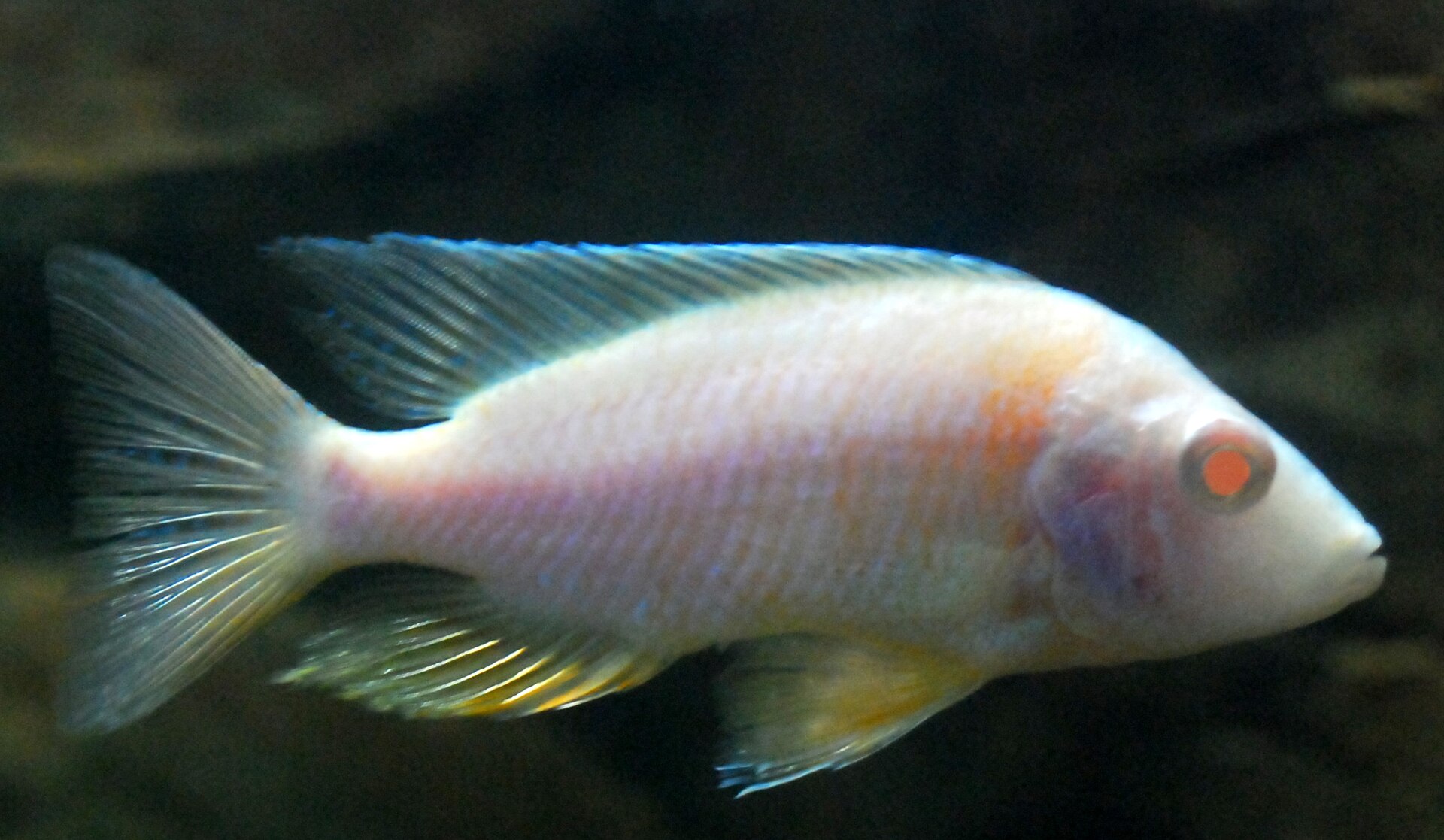
A female with a full mouth is brooding. She will not eat much for about three weeks. Do not force-feed her. Do not strip her unless you know the technique. Give her a quiet cave away from the male. When she releases, the fry are tiny, immediately independent, and immediately edible. A nursery or a lot of rock is how any survive. You will get fry if the harem is happy. You will get mixed-looking fry if your male was a hybrid. That is the peacock trade in one sentence.
Pits, gravel, and why the substrate is the method
Sharp gravel can irritate the mouth and does not transmit invertebrate movement the way sand does. Fine sand is the correct floor. If you insist on gravel, you still have a peacock, just a slightly unemployed one. Keep the sand clean with a gentle siphon that does not vacuum every grain every week; you want a living film, not a septic bed.
Quarantine. Malawi fishes arrive with a cocktail of issues. A peacock that clamps and scrapes needs a diagnosis, not more colour flakes. Watch for Malawi bloat: refusal to eat, swelling, white faeces. Act early. Watch for a male that stays pale: check rivals, pH crash, or nitrate.
The peacock that is actually nyassae
If you can source fish closer to type — a documented line rather than a “mixed peacock” box — do it. If you cannot, keep what you have as a hybrid swarm with dignity: still sand, still a harem, still hard water, still no mbuna circus. Aulonocara nyassae in the narrow sense is a sand-listening Malawi cichlid of moderate size and spectacular male colour. The pits on the head are the clue you are supposed to follow. Follow them to sand. Everything else — pH 8, one male, several females, no rock tyrants — is how you let a peacock be a peacock instead of a battered extra in a mbuna tank that was already full.
When a male hovers over sand, tilts, and picks, you are seeing the genus do its job. That moment is worth more than a fluorescent hybrid name on a bag. Build the beach. The colour is the receipt.
Explore other topics
Dive into more aquarium guides across the site.