

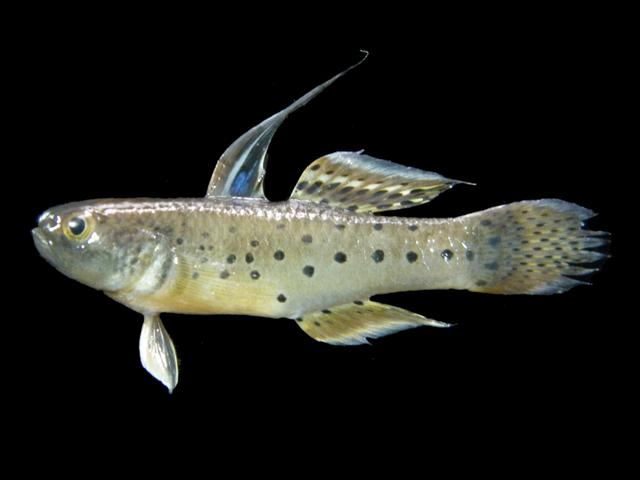
The knight on the body is a pattern of dark spots, not a personality. Knight gobies (Stigmatogobius sadanundio) are estuarine fish from South and Southeast Asia that the freshwater trade sells into planted tanks. Some individuals live for years in hard freshwater. Many do better with a little salt. All of them are territorial bottom fish with a big mouth for their size and a habit of sitting on a leaf or a rock as if they were posing for a postage stamp.
If you wanted a peaceful sand-sifting cory, this is the wrong goby. If you wanted a brackish-capable, spotted sentry that eats meat and owns a corner, keep reading — and keep the conductivity in mind before you drip them into a tank of rummynoses.
Estuaries that forget to stay fresh
Stigmatogobius sadanundio occurs from the Indian subcontinent through parts of Southeast Asia in rivers, mangroves, and lagoons. Salinity swings. The fish is built for that. Freshwater shops still list it because it will often adapt to hard, alkaline freshwater, especially tank-raised stock. Wild-caught fish may fade, sit, and pick up ich if you force a sudden drop to soft RO. Ask what they were kept in. Match it, then decide whether your display can match that.
In nature they sit on mud, sand, and structure, darting after small animals. They are not midwater schoolers. An aquarium that is all stem plants and no floor space wastes them.
Spots, a stout body, a stare
Adults reach about 8 cm, sometimes a bit more. The body is pale to grey with dark spots that suggest a chessboard or a constellation, depending on the fish and the light. The eyes are high. The mouth is terminal and capable. Fins are rounded. Males can be slimmer with longer dorsal elements; females rounder when full of eggs. Sexing is easier when you have a pair in front of you than when you have one fish in a cup.
They look bigger than they measure because they sit in the open and do not flee like a tetra. That boldness is why people like them and why small tank mates disappear.
A floor with a throne
Eighty litres for a single adult or a pair is a practical starting point; more length if you want two males, which you probably should not. Sand or fine gravel, rocks, a piece of wood, perhaps a broad leaf of Anubias they can perch on. They appreciate a cave. They will also perch in the open. Current can be moderate; they are not hillstream gobies, but they are not still-water bettas either. Brackish setups often use fewer plants; freshwater setups can be planted with species that tolerate harder water.
A lid matters. Gobies jump. Heaters need guards because a territorial fish will slam what reflects.
If you run brackish, use marine salt and a hydrometer or refractometer, not table salt, and keep the specific gravity modest (many keepers sit around 1.005–1.010). If you run freshwater, keep it hard and stable. Flip-flopping weekly between the two is how you kill them with kindness.
Hard water is the freshwater compromise

Temperature 22–28°C. pH 7.0–8.5 in freshwater; similar or a bit higher in brackish. Soft acid water is a mismatch. They are not Amazon gobies (and most “freshwater gobies” in the Amazon are not this fish). Ammonia is still lethal. They tolerate a range of salinity better than a range of neglect.
Filtration should be solid. They eat meat and produce waste accordingly. In brackish, live rock is not required at this specific gravity; a sponge plus a hang-on or canister is enough if you change water. Match salinity of new water exactly.
Meat, and then more meat
Knight gobies are carnivores. Frozen mysis, chopped prawn, bloodworm, brine shrimp, live blackworms if you trust the source. Some take sinking pellets. Many ignore flake. They will eat small fish and shrimp. Feed once or twice a day what they can finish on the bottom. Target-feed if you have faster tank mates. A fat goby sitting on a rock is a success. A thin goby that only appears at night is losing the food race.
One sentry per corner
They are territorial toward their own kind and toward other bottom fish of similar size. A pair can work. Two males in a small tank will not. Possible companions in a large, hard-water or brackish tank are fish that stay up: some mollies, larger hard-water rasboras, perhaps an archers in a true brackish community — always matching salinity. Do not add them to a tank of small tetras and dwarf shrimp and act shocked. Do not add them to a Malawi tank; the chemistry might be hard enough, the neighbours will not be kind, and the goby will still try to own a rock the mbuna also want.
They are not a cleanup crew. They are a predator with a perch.
Breeding that asks for brackish fry water
Spawning in aquaria is uncommon compared to kribs, but they are reported as cave or hole spawners with eggs tended by the male, in the goby pattern. Fry of estuarine fishes often need infusoria and, in many gobies, a period of higher salinity or planktonic food that home aquarists are not set up for. If you are not prepared for that, enjoy the adult. Do not buy a pair “to breed knight gobies” as a first project. If they spawn on you, you can try a separate tank and live microfoods; success is a bonus, not a promise in this article.
Acclimation is the real skill
The death rate in this species is highest in the first two weeks, when someone moves them from brackish shop water to a soft planted tank overnight. Drip. Match temperature. Match conductivity as closely as you can. Quarantine with a perch and a cave, in the water type you will keep them in. Ich is common after salinity and temperature shock; treat in the quarantine salinity you have chosen, because some ich meds and plants conflict, and because you should not medicate a display full of invertebrates.
A knight goby that has been drip-acclimated into hard water or honest brackish, fed meat on the sand, and given a rock to sit on is a durable, watchable fish. The spots were never the hard part. The estuary was.
Explore other topics
Dive into more aquarium guides across the site.