

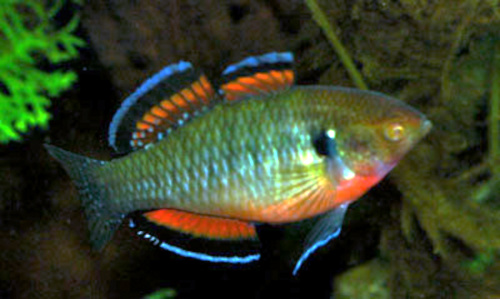
Australian streams produce a sleeper goby that, in male breeding colour, looks like someone spilled enamel paint on a grey fish. The empire gudgeon, Hypseleotris compressa, is a eleotrid — a gudgeon, not a true goby — from coastal drainages of northern and eastern Australia and parts of New Guinea. Males colour up with red, orange, and iridescence that photographs still flatten. Females stay plainer. Both are predators of small animals, territorial on the bottom, and large enough at 10–12 cm that a “nano goby tank” is the wrong idea.
They are sometimes sold as oddballs next to bichirs. They are not tropical Amazon fish. They can take a temperature range that surprises people who only keep discus, and they can take a hint of brackish in some populations. What they cannot take is a diet of flake and a tank mate they can swallow.
Coastal rivers with a wet season
Hypseleotris compressa lives in rivers, creeks, and lagoons, often with a connection to estuaries. Juveniles may use different habitats than adults. The water is typically fresh, sometimes slightly brackish near the coast, with structure: wood, vegetation, uneven bottom. They sit, then lunge. That sit-and-wait hunting is the behaviour you will see in the aquarium if you give them a vantage point.
Australian native-fish keepers often run them cooler than a South American tropical tank. In a Canadian or European home, room-temperature water in the low to mid twenties is usually fine; 22–28°C is a working band. Pushing 30°C because “all tropical fish like it hot” is not doing this species a favour.
When the male turns the lights on
Males in colour are the reason the fish has a common name that sounds like a medal. The body compresses (the Latin is honest), the fins carry pigment, and the head can look almost metallic. Females are silvery to brown with a more modest pattern and a rounder belly. Adult length 10–12 cm is typical; some males look heavier than the tape because of the depth of the body. Juveniles are forgettable. Buy them for what they will become, or buy a coloured male and a female and accept the price.
They are not rainbowfish. They will not school in the upper third. If you wanted Melanotaenia, that is a different article.
A long tank with a viewing rock
A hundred litres is a minimum for a pair; more is better, especially in length. Sand or fine gravel, snags, a rock they can sit on, plants if your temperature and hardness allow — Vallisneria and hardy stems in fresh water. They will eat small shrimp and tiny fish, so a planted community of ember tetras is a snack bar. Current moderate. They can hold in flow but they are not hillstream loaches.
A lid: yes. Gudgeons jump. Filtration: oversized for a meat-eating fish that sits in one place and defecates in one place. Siphon that place.
Some keepers add a little salt for coastal forms. If your fish came from a freshwater dealer tank and are eating, you can keep them freshwater with moderate hardness. Do not oscillate.
Not a blackwater fish, not a rift-lake fish

pH 6.5–7.8, moderate hardness, clean water. They are adaptable within that band. Soft, tannin-heavy Amazon water is a poor default. Malawi mix is the other wrong default. If your tap is decent, use it. Change water because nitrate and a meat diet demand it, not because the species is fragile in the discus sense.
Oxygen matters. A still, warm tank in summer will stress a fish from flowing Australian creeks. Surface movement, not a whirlpool.
They eat what fits
Frozen mysis, prawn, earthworm, bloodworm, sinking carnivore pellets. Live fish will be eaten if they fit in the mouth — and the mouth is wider than hobbyists expect. Feed sinking food at the sit-rock. They can be trained to take pellets dropped in front of them. They will not compete well with frantic surface feeders if you only throw flake at the top.
A fat, coloured male is a fed male. A grey log that never moves except at lights-out is underfed or frightened. Look at the belly, not the marketing.
Males need a border
One male, one or more females, in a tank with visual breaks. Two coloured males in a metre-long tank will display and fight. Tank mates must be too large to eat and uninterested in the same sit-rock: perhaps larger rainbowfish in a very big Australian-biotope tank, or other robust natives if you are going down that route. Community tropicals of 3 cm are food. Corydoras may be left alone or may not; I would not risk small cories. Shrimp are food.
They are not vicious in the jewel-cichlid-with-fry sense every day. They are opportunistic and territorial. That is enough.
Spawning without a fairy tale
Empire gudgeons have been bred in aquaria. Eggs are typically deposited on a surface and guarded, in eleotrid fashion, often by the male. Fry are small and may need infusoria and, in some accounts, careful attention to water from the parents’ habitat type. This is not a krib. Do not expect a cloud of fry to follow mum around the tank as a default spectacle. If you want to try, a separate tank, a spawning site, and a plan for microscopic food come first. Many keepers never breed them and still keep them well.
Oddball, not throwaway
Quarantine with a perch, a cave, and meaty food. They can be shy at first, then boldly sit in the front once they decide the tank is theirs. Ich after shipping is common in gobioids; treat in quarantine. Inspect the mouth for damage. Do not combine them with aggressive cichlids that want the same rock.
An empire gudgeon in a long, clean, moderately hard Australian-style tank, fed on the bottom, with a female to display to, will colour in a way that makes “oddball” sound like an insult. It is a coastal river fish with a male that earns the name. Give it the river’s footprint, not a leftover corner of a community you already stocked.
Explore other topics
Dive into more aquarium guides across the site.