

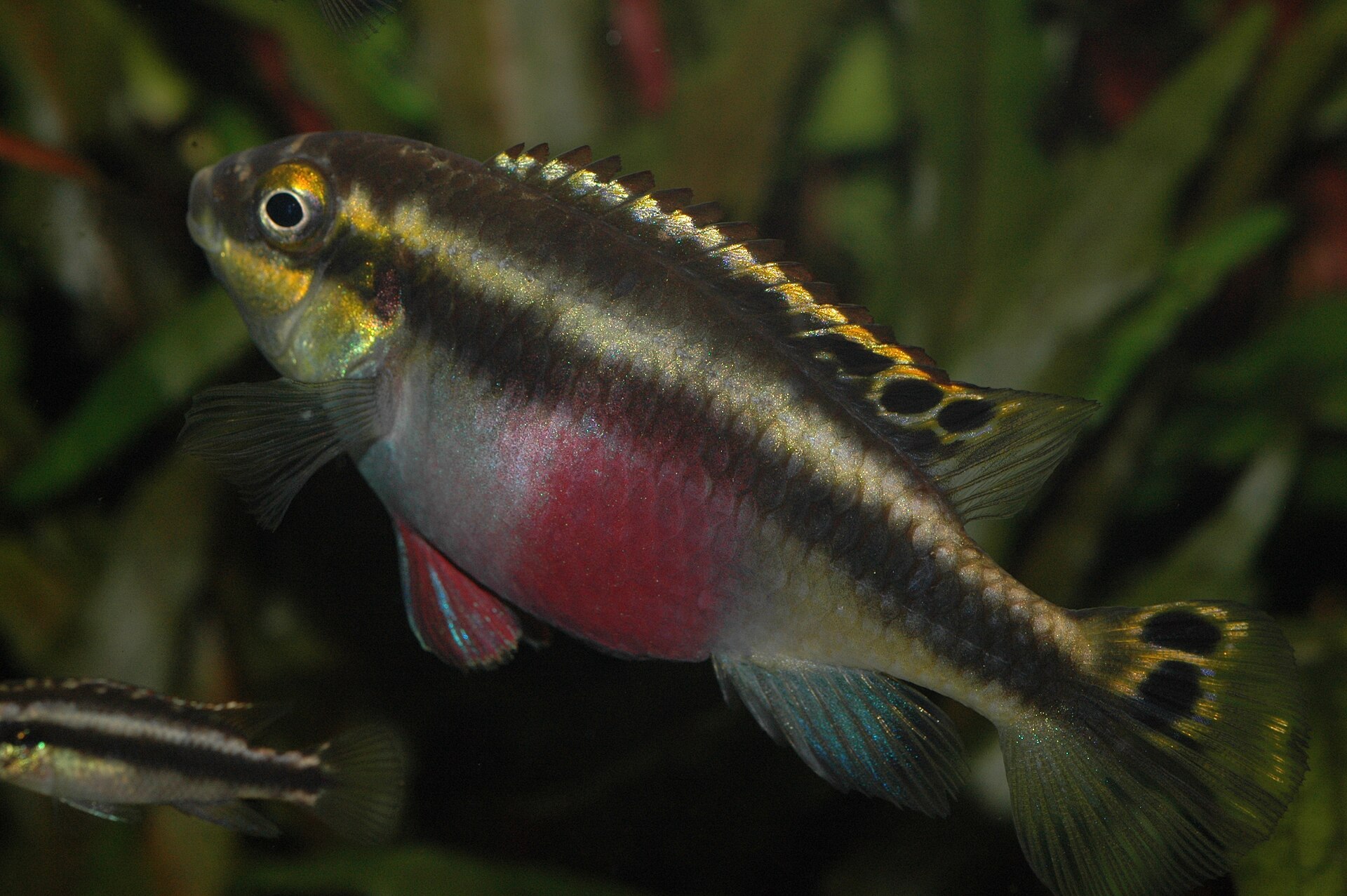
If African dwarf cichlids have a household name, it is the kribensis. Pelvicachromis pulcher from the coastal streams of Nigeria and Cameroon is the cave fish that actually gets kept: colourful without rift-lake chemistry, small without being fragile, and willing to spawn in a tank that also holds a few dither fish. That reputation has a cost. People treat kribs like tetras with a pink belly, skip the cave, and then complain that the pair “turned mean.” They did not turn mean. They started breeding, which is what this species does when it is comfortable.
A female in colour is the postcard — round, rose to violet on the belly, a dark spot on the dorsal, gold in the flanks. The male is longer, often 8–10 cm, with a more pointed caudal and less of that belly neon until you look twice. Sexing is easy in adults and annoying in young fish. Buy a known pair if you can. Six unsexed juveniles in 80 litres will produce extra males you will have to move.
Coastal water that is not a swamp cliché
Wild P. pulcher lives in forested streams and slower sections near the West African coast. Water is typically soft to moderately soft, warm, and structured with roots, overhangs, and cavities. Some populations see a hint of brackish influence near estuaries, which has led to old book advice about adding salt. You do not need a brackish tank. You need stable freshwater in the mid-twenties, a cave, and a pair that chose each other.
They are not Tanganyika fish. They are not Amazon apistos. The tank can be planted. The water can sit near pH 7 if it is stable. What they will not accept is a bare glass box with a powerhead and a random Oscar for a roommate.
Let them pick each other
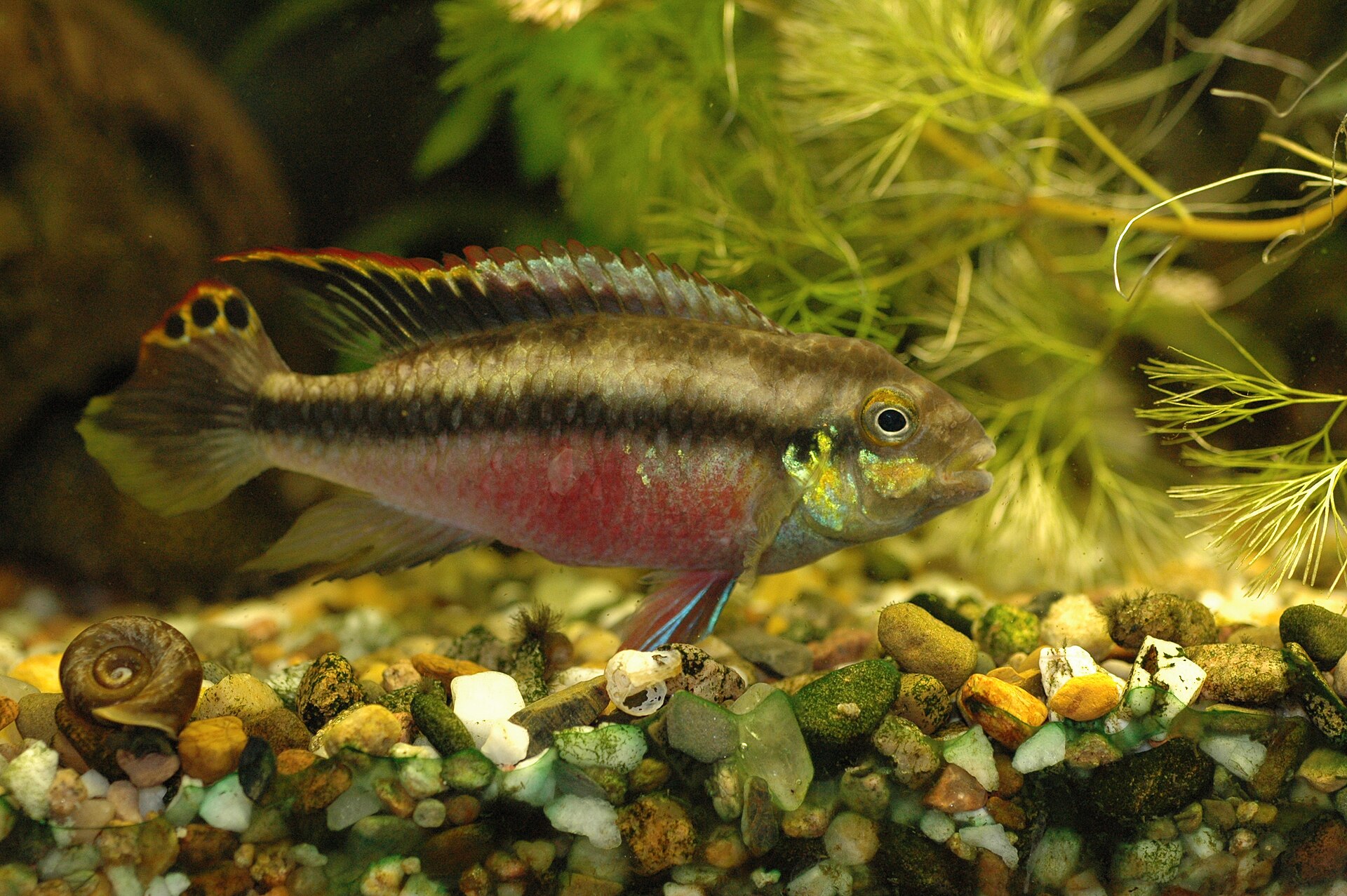
Kribs pair. A forced pairing — any male stuffed in with any female — sometimes works and sometimes produces a fish hiding in a corner with torn fins. If you grow a group of juveniles, you will usually see a pair bond form: they swim together, flare at others, and start inspecting holes. Remove the extras. That is kinder than a “colony” in a four-foot tank that is actually three pairs and a war.
The pair needs a cave they both approve of. Flowerpots, coconut shells, and rock caves all get used. Put more than one option in; they will ignore the expensive ornament and spawn in the ugly pot. Face the entrance toward the back or the side so they feel enclosed. Sand or fine gravel is fine; they will fan a pit at the entrance. Plants can go around the territory. They may nibble a little. They are not going to eat a mature Amazon sword overnight.
A layout for a bonded couple
Eighty to a hundred litres is a sensible home for one pair with a little midwater company. Smaller tanks work for a pair alone if you are ready for the entire volume to become a territory when eggs appear. Length helps more than height. Wood and rock break the line of sight so the krib does not have to defend every square centimetre against a tetra that wandered past. A sponge filter or a gentle canister outlet keeps the water moving at the surface and still at the cave.
They will jump when frightened. Cover the tank. They will also rearrange sand. That is behaviour, not a filter problem. If the heater is exposed, sleeve it or hide it; a pairing krib will ram what it mistakes for a rival’s eye.
Numbers they forgive, swings they do not

Temperature 24–28°C, pH roughly 5.5–7.5, soft to moderately hard water. They are more tolerant of hardness than many apistos, which is why they survived decades of mixed community tanks. Tolerance is not indifference. Chronic pH 8.2 and high GH is a poor match for West African stream fish and often shows up as poor spawn survival. Ammonia and nitrite stay at zero. They are messy enough when breeding that weekly water changes are part of the hobby, not an extra.
If you use RO, remineralise. Pure RO with a krib pair is a way to crash pH when the botanicals finally overwhelm a tank with no buffering. Test. Write the numbers down. The pair does not care about your memory of last month’s tap.
Food that is ordinary on purpose
Kribs are omnivores. A decent cichlid granule, frozen brine shrimp, daphnia, and the occasional bloodworm is a complete working diet. They will take flake. They will graze a little aufwuchs. They do not need a specialist menu. What they need is enough food that the female stays round and the male does not go hollow while he is busy displaying. Feed two modest meals. Breeding pairs get a third small offering of frozen food. Uneaten bloodworm in the sand is how you get a nitrite blip the day after you “conditioned” them.
The day the cave is closed
Outside of spawning, a krib pair is one of the more peaceful dwarf cichlids you can keep with similarly sized, non-aggressive fish: small tetras, rasboras, Corydoras, a bristlenose. When they spawn, the radius around the cave becomes a no-fly zone. Tetras that panic and dive get bitten. Corydoras that blunder into the entrance get chased. This is temporary and predictable. Either the tank is large enough that the rest of the fish have a safe end, or you net out the companions for a few weeks, or you accept some nipped fins. What you should not do is add the pair to a tank of slow, long-finned fish and act surprised.
Do not house them with other cave spawners in a small tank. Two krib pairs is a bad idea unless the aquarium is huge and heavily broken up. Pelvicachromis taeniatus looks similar and will not share a pot peacefully. Large Central American cichlids will eat them.
Fry that stay with the parents
They spawn on the cave wall or ceiling. Both parents guard, which is part of the charm and part of the management problem. Eggs hatch in a few days; the parents move wrigglers, then a swarm of fry appears at the entrance. The cloud follows the female. The male does perimeter work. You can raise fry in the display if there are no predators and you feed baby brine shrimp. You can move the pot to a rearing tank. The parents will spawn again soon if they are well fed, so a production plan needs more than one tank or a willingness to rehome.
Sex the young when the bellies and fin shapes diverge. Keep one pair. The rest are how the hobby stays supplied with kribs that did not travel from West Africa last week.
Five years in the same tank
A krib that eats, colours, and patrols a small area is healthy. One that hides all day in a community of barbs is not “nocturnal.” Ich after a chill is common in cheap imports; quarantine new fish. Hole-in-the-head type erosion is uncommon if you keep water clean and skip the mystery medications, but poor diet and hard, dirty water still cause head and lateral line problems in cichlids generally. Watch the female’s belly. A chronically thin female is not getting food or is being harassed by a male who was never a partner.
Quarantine is a plastic tank, a sponge, a heater, a pot, and two weeks of watching them eat. It is not optional because the species is “easy.” Easy is what they are after they have recovered from the bag. Once they are in the display, the work is ordinary: match the water, keep the cave, feed them, and when the pink belly appears, decide whether the rest of the tank is allowed near that pot. That decision, not a special light, is kribensis keeping.
Explore other topics
Dive into more aquarium guides across the site.