

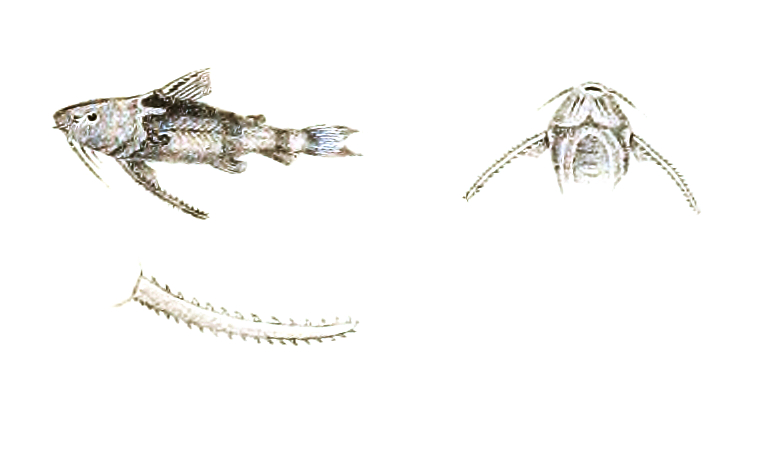
The Asian Stone Catfish, Hara jerdoni, is a miniature freshwater catfish known for its unusual flattened body, broad pectoral fins and mottled brown camouflage. It is sometimes called the Dwarf Anchor Catfish because its extended fin spines create an anchor-like outline. This is a quiet fish that suits peaceful planted aquariums but is easily overlooked at feeding time.
Native Range and Natural Habitat
Hara jerdoni is native to parts of South Asia, where it occurs in slow-moving streams, rivers and related habitats with sandy or silty bottoms. It spends much of its time close to the substrate among leaves, stones and submerged debris.
Size and Tank Requirements
Adults remain very small, reaching roughly 3–4 cm. A compact aquarium can house a small group, but stable water is far more important than minimum volume. A mature tank with a sand or fine gravel substrate, leaf litter, smooth stones, wood and shaded hiding places is ideal.
Because the fish is sluggish and spends much of the day resting, avoid a bare layout. Our guide to aquarium-safe woods can help when creating natural cover.
Water Conditions
This species prefers clean, oxygenated freshwater without a strong current. A temperature around 20–26°C and a pH of roughly 6.0–7.5 are suitable for most captive specimens. Moderate hardness is usually tolerated if conditions remain stable.
Use gentle filtration and avoid sudden changes. Ammonia and nitrite should always remain at zero in a cycled aquarium. If you need a refresher on establishing biological filtration, see our guide to cycling an aquarium.
Diet and Feeding
Asian Stone Catfish are small carnivorous or omnivorous bottom feeders that respond especially well to frozen and live foods. Offer bloodworms, daphnia, cyclops, chopped tubifex, small sinking pellets and other appropriately sized foods. Their slow feeding style means they can lose out to fast midwater fish.
Feed after the main aquarium lights dim if necessary and make sure food reaches the bottom. Observe individuals closely because a thin fish may simply be failing to compete rather than refusing food.
Sexing Asian Stone Catfish

Sexing is not always obvious. Mature females may appear fuller through the abdomen, especially when carrying eggs, while males can remain slimmer. Differences are subtle compared with many colourful community fish.
Breeding
Breeding reports in home aquariums are limited compared with popular catfish such as Corydoras. A mature, well-fed group in a calm species tank offers the best chance of natural spawning. Fine cover, leaf litter and stable water should be provided so eggs or newly hatched fry have somewhere to avoid adults.
If fry appear, offer microscopic foods at first and keep water changes small and regular. Avoid strong suction around filter intakes.
Community Tank Compatibility
This is a peaceful species, but it is not ideal with large or aggressive fish. Choose tiny rasboras, peaceful tetras, small loaches or other calm species that will not harass it. Avoid very competitive bottom feeders in a small tank because the catfish can be pushed away from food.
Ease of Care
Care is moderate rather than beginner-proof. Water requirements are not extreme, but the fish can be shy, inactive during daylight and easy to underfeed. Aquarists who enjoy observing subtle behaviour will often appreciate it more than those wanting a highly visible display fish.
Species Variations and Albino Forms
Hara jerdoni is normally sold in its natural mottled brown form. Several related small Asian catfish can look similar, so correct identification matters. Established albino aquarium strains are not commonly available.
Final Thoughts
The Asian Stone Catfish is a fascinating specialist for a quiet aquarium. Give it fine substrate, shaded cover, gentle tank mates and food that reaches the bottom, and its unusual appearance becomes a rewarding part of a natural-style setup.
Explore other topics
Dive into more aquarium guides across the site.