

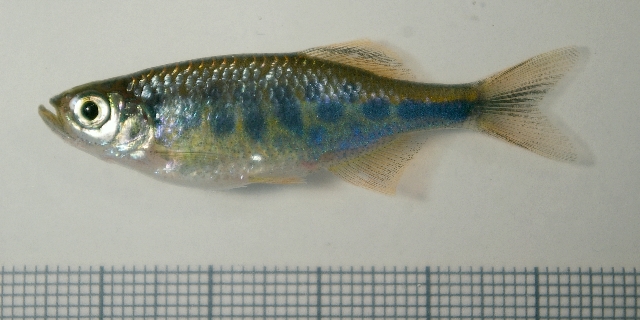
Devario pathirana is a Sri Lankan endemic with vertical bars — unusual in a group better known for horizontal sheen. The barred danio is restricted in the wild to the Nilwala River basin. Habitat loss has made captive-bred fish the only ethical source. If a shop implies wild Sri Lankan stock as a selling point, walk away. Keep the ones already in the hobby, and keep them as a flowing, oxygenated school, not as a novelty tetra.
Bars on a threatened island fish
Adults reach about 6–8 cm. The body shows distinct dark vertical bars on a gold-green ground, more like a small Distichodus silhouette than a zebra danio. Males are slimmer and often more sharply barred; females fill out. Colour intensifies in current and in a group. Isolated fish in still water look like faded diagrams.
Water: 22–27°C, pH around 6.5–7.5, moderate hardness, high oxygen. They are tropical island stream fish, a bit warmer than Malabars from higher Ghats streams, still not a 28°C Amazon box. They need length — a 90–120 cm tank for a school of six to eight — and a lid, because Devario jump.
The Nilwala drainage and why your tank is now a refuge
Wild range is tiny by continental standards. Forestry, agriculture, and pollution hit that range. Aquarium keeping does not fix a river, but buying wild-caught fish as décor makes it worse. Ask for tank-bred. If the seller cannot say, assume the worst. Once you have a school, consider that a spawn is conservation-adjacent, not just a hobby trick.
The tank should look like a forested stream: current, rounded stones, hardy plants in slack water, wood. It should not look like a peat swamp for Phoenix rasboras and it should not look like a Tanganyikan shell bed.
Flow, oxygen, and a long footprint
Point filtration along the tank. They will use the current line as a highway and the edges as rest. A cube filter in a corner produces a dead end and a crowded corner of bars. They school more tightly than Malabars when nervous and more loosely when settled. Either way they need the run.
They are more modest in temperament than Malabars of equal age, but they will still eat small nano fish and they will still outcompete still-water tetras. Stock robust, similar-sized companions or keep a species tank. Fire-bar danios are smaller and from Thailand; mixing Devario species is possible in a huge tank and messy in a small one.
Diet and the bar pattern
Omnivore. Quality flakes, frozen invertebrates, some vegetable. Feed in the flow. Bars look sharp on well-fed, unstressed fish and muddy on skinny, still-water fish. They are not as greedy as adult Malabars, so they can lose food to larger Devario. If you mix sizes, feed in two places.
They take food midwater and at the surface. They are not hatchets. Do not rely on floating-only diets.

Breeding a thin-range schooler
Egg scatterer. Condition with live foods, offer a grate or fine plants, change water to mimic rain. Remove adults. Raising fry is a contribution if you can place them with keepers who will not dump them into goldfish vats. Hybridising with other Devario wrecks the barred identity that makes pathirana worth keeping. Do not toss them in a community breeding free-for-all with maetaengensis or malabaricus.
This is not a jumping aerial spawn. This is not a cave spawn. This is a stream cyprinid scatter.
Health in a fish that should not be rare in tanks
Quarantine new arrivals. Stream endemics can carry parasites. Ich, skinny disease, and fin damage from short tanks are the usual issues. They are hardier than sun tetras, more specialised than zebra danios, less physically overwhelming than Malabars. Gasping means oxygen or temperature, not “normal surface behaviour.”
If you wanted horizontal gold-blue bands on a giant, that is Malabar. If you wanted small red bars from the Mae Taeng, that is D. maetaengensis. If you wanted vertical bars on a Sri Lankan Devario whose river is smaller than your county, keep Devario pathirana as captive-bred stream fish in a long, covered, moving tank — and treat every spawn as more valuable than a bag of farmed neons.
See Malabar danio for the larger cousin, and do not copy its 15 cm space requirements down to a 60 litre because both are “barred or banded danios.”
Captive-bred bars as a closed loop
If you spawn pathirana, keep records of which fish you use and do not mix in fire bars because “both have vertical marks.” The Sri Lankan endemic’s value in the hobby is that pattern on that lineage. A pretty hybrid helps neither Nilwala conservation talking points nor the next keeper who wants true pathirana.
Sri Lankan hill streams can run warm compared with Himalayan dangila water, but they still run. A barred danio in a still, tannin-heavy Amazon tank is a fish in the wrong story. Give them current and a long axis. Give them a lid. Give them a school so the bars read as a moving fence, which is how the pattern works in a group.
When you see a listing that brags about wild Nilwala collection, treat it as a warning. The ethical care path starts with farmed fish and a tank that could, if needed, hold a breeding group without dumping extras into a goldfish pond. That is a different moral load than keeping zebra danios, which exist in the millions, and you should feel that difference when you stock and when you spawn.
Vertical bars on a Devario are easy to market and easy to wreck. Keep the current honest, keep the lineage unmixed, and keep the tank long enough that a 7 cm Sri Lankan endemic can run without bouncing off glass. That is the whole conservation-adjacent hobby in one footprint: captive-bred fish in a river you actually built.
Oxygen meters are optional; gasping at a sealed lid in warm still water is not a mystery. Open surface agitation along a long tank, keep the school together, and treat every extra Devario species as a hybridization risk rather than as décor. The barred danio’s vertical fence only means something if the next generation still shows it.
Explore other topics
Dive into more aquarium guides across the site.