

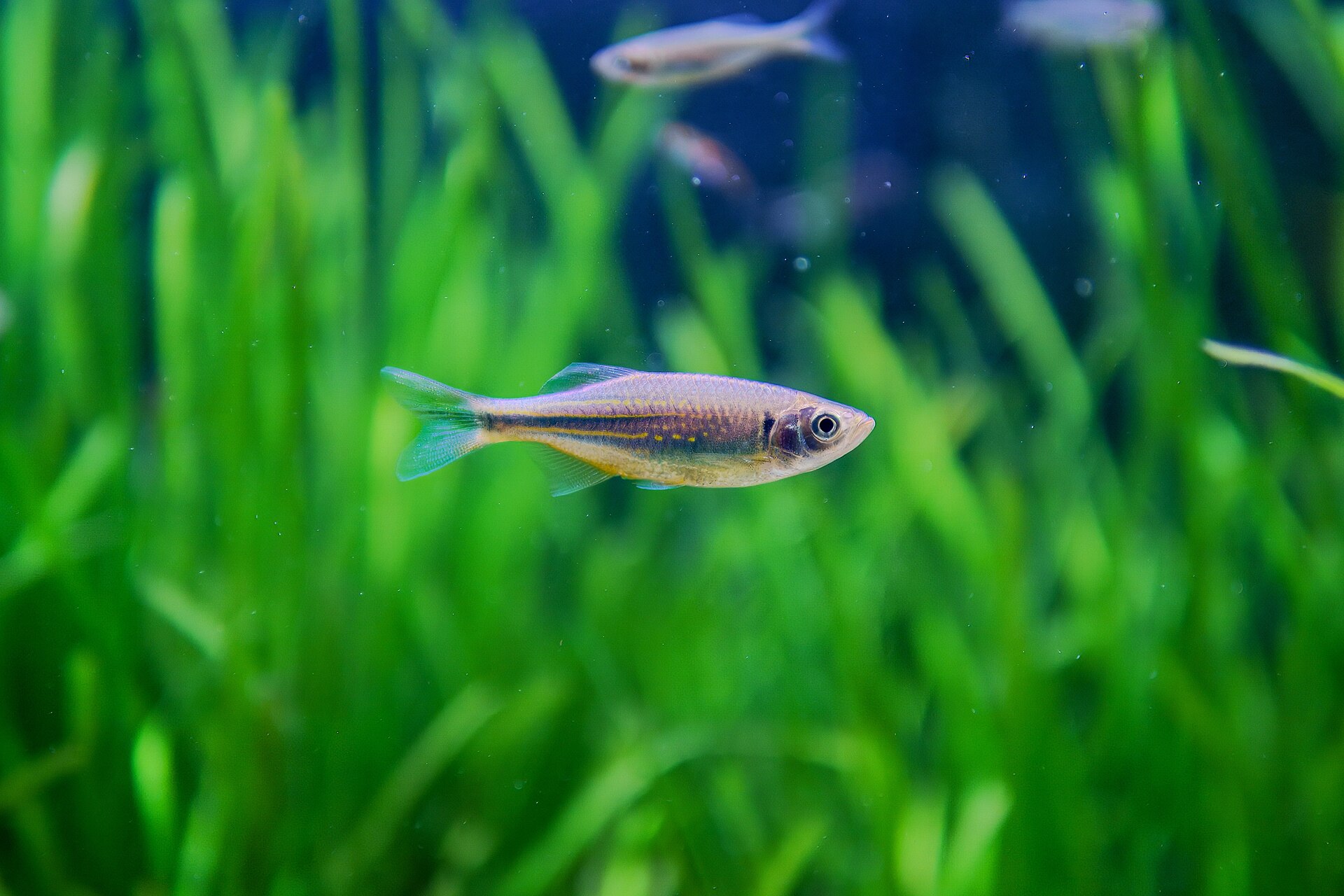
The Malabar danio is a Western Ghats and Sri Lankan river fish that outgrows the word danio in most keepers’ heads. Devario malabaricus (often confused with the giant danio Devario aequipinnatus) reaches 10–15 cm in the aquarium. It is a powerful, cool-water, high-flow schooler. A 60 litre “danio tank” is a cruelty, not a starter home. If you cannot offer a tank around 120 cm long and 200 litres or more for a group, buy a smaller Danio species instead.
Devario, not Danio, and not a tetra
Devario are deeper-bodied, larger, and generally more riverine than the slim Danio rerio group. Malabar danios wear gold, blue, and yellow bands that shimmer in current. Males are slimmer and more colourful; females are heavier. They come from well-oxygenated streams of the Western Ghats of India and from Sri Lanka, with seasonal monsoon flow. Temperature in the wild includes water in the high teens and low twenties. In captivity, 18–25°C is the working band. A heater locked at 28°C is a common way to shorten their lives and wreck their oxygen balance.
pH can sit around 6.5–8.0; they are not peat specialists. Hardness is moderate. What they cannot compromise is length, current, and a lid. They jump like the rest of the family, only heavier.
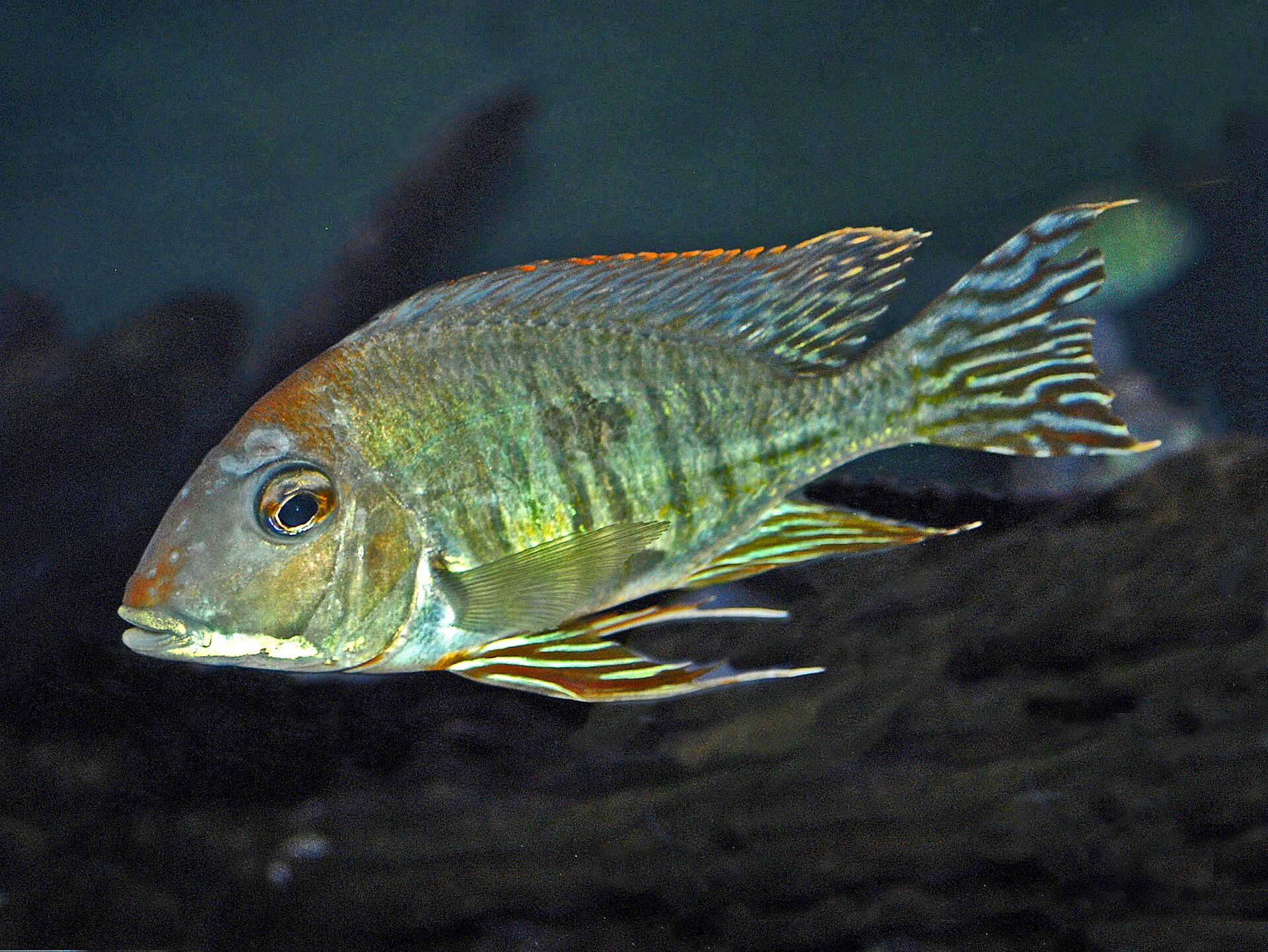
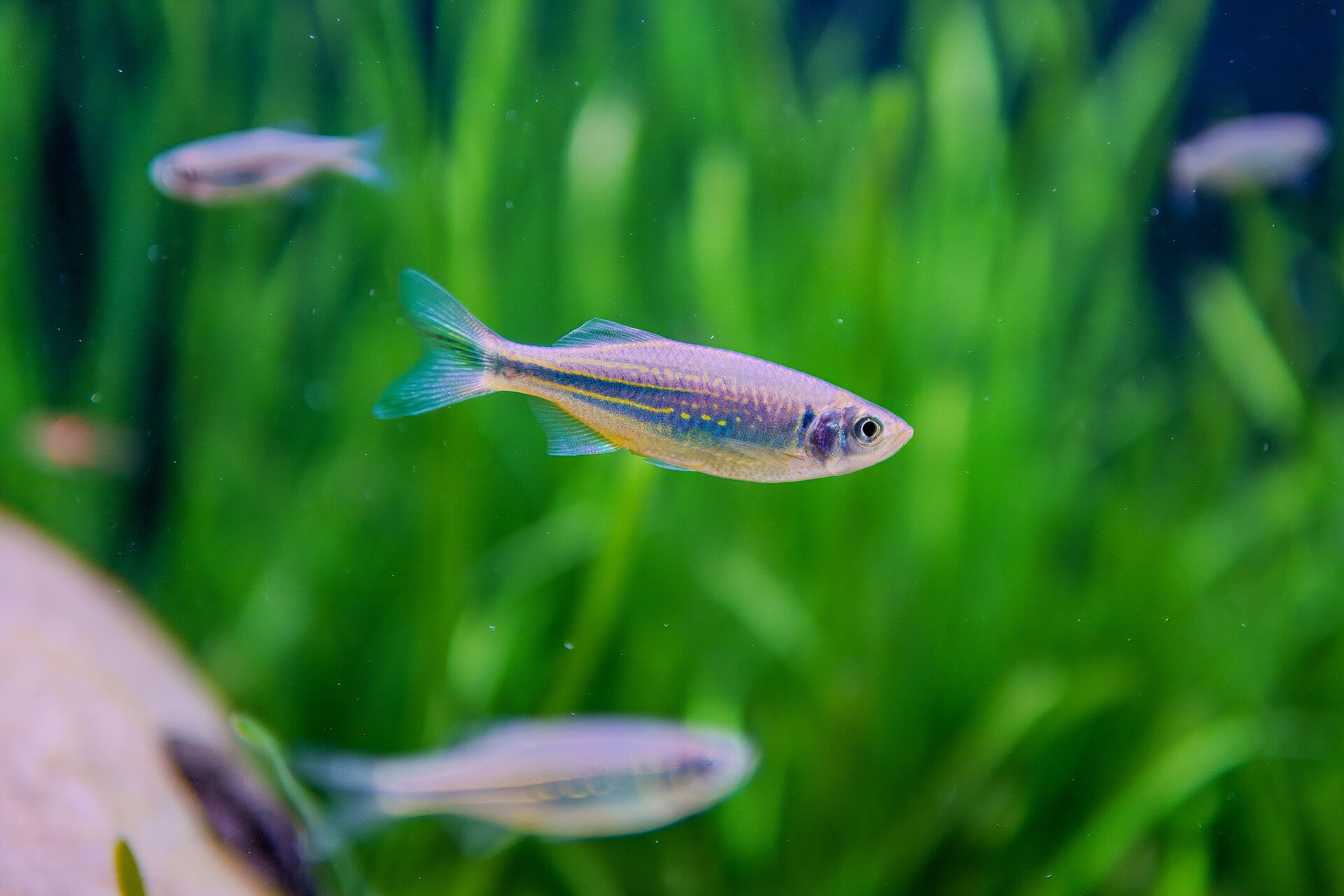 Devario malabaricus. Photo: Shifu Tanks / Wikimedia Commons (CC BY-SA 4.0)
Why 120 cm of glass is the real filter
They patrol. A short tank produces head-banging, nipped companions, and a fish that never settles into a school line. Point a strong filter or a powerhead along the length, leaving a slack zone with plants for rest. This is a river display, not a Dutch still garden, though tough plants on wood can survive in the quieter corners.
They produce significant waste. Filter for a foot-long school of active cyprinids, not for a neon tetra stocking chart. Water changes are part of the current, not an afterthought.
Boisterous is the temperament, not a moral failing
A school of six to eight Malabars will chase each other, hit the surface at feeding, and steamroll slow fish. They are not malicious cichlids. They are large, fast, hungry. Tankmates must be similarly robust: other large Devario if the tank is huge, large barbs, fast loaches, bigger rainbowfish that like cooler water. They will eat anything that fits in the mouth, including small tetras, rasboras, and shrimp. Hatchets at the surface look like snacks. Pencilfish are food. Sun tetras are food.
Do not use them as dither fish for large aggressive cichlids; the cichlids will be slower but meaner, and the danios will still need the whole length. Do not mix them with Mexican tetras in a modest tank; both are active, and the climate overlap is only partial.
Appetite of a ten-centimetre cyprinid

They eat flakes, pellets, frozen foods, insects, and vegetable matter. Feed twice a day what they consume in a minute, in the current. They will beg like goldfish. Do not obligate. Fat Devario look dull and strain the filter. Fasted Devario in a planted tank will still find fry and small tankmates.
They take food at all depths, unlike hatchets. That makes feeding easy and makes them dangerous to nano fish.
Monsoon cues, not a moss cave
They scatter large numbers of eggs, often after big water changes that mimic monsoon influx. A huge breeding tank or a grate, then removal of adults. Fry grow fast and need space quickly. This is not a nano spawn. This is not an aerial Copella spawn. If you lack a second large tank, enjoy the display school and do not expect to raise a hundred giants.
Shop fish are often young. Record the adult size on the label in your head before you pay. A 4 cm Malabar is a juvenile of a fish that will want a four-foot tank.
Cool water, high oxygen, no excuses
Ich still happens. So does ammonia in an undersized filter. Quarantine in a covered, long tub if you can; a tall bucket is a poor hospital for a sprinter. They are hardy compared with wild Carnegiella, not hardy compared with neglect. Gasping at the surface in warm water is oxygen debt, not “hatchet behaviour.”
If you wanted a 5 cm orange-finned stream fish, buy kyathit. If you wanted a Western Ghats powerhouse with gold-blue bands, Devario malabaricus is the honest giant of this set, and the purchase starts with a tape measure along the stand, not with a cute bag at the shop.
Further reading: zebra danio if you need a smaller lid-and-length lesson, and cycling an aquarium before you add a bioload this size.
Shop juveniles and the four-foot promise
A bag of 5 cm Malabars looks like a large zebra school. In twelve months it looks like a pack of small trout in a tank that cannot turn. Write the adult length on the stand before you buy, not after the fish outgrow the filter. If the stand cannot hold a 120 cm tank, this is the wrong Devario. Fire bars and rose danios exist for smaller rooms.
Western Ghats streams are monsoon engines. In a home, you imitate that with water movement and coolness, not with a heater and a peat bag. They will live in slightly warmer water than dangila sometimes, but “tropical community heat” still strips oxygen and manners. Gasping Malabars at 28°C are telling you physics, not asking for a surface-feeder diet.
They will eat expensive nano fish the same day you add them. If you want shrimp, use a separate tank. If you want tetras, use a separate tank. The Malabar display is a river school, and honesty about predation is part of the care, not a temperament footnote copied from a peaceful garnet tetra article.
Measure the stand. If it cannot take a 120 cm tank, the Malabar danio is not your Devario. Cool flow, a lid that can take a hit, and a menu that admits they eat small fish are the adult reality hiding in that cute 5 cm shop bag.
Explore other topics
Dive into more aquarium guides across the site.