

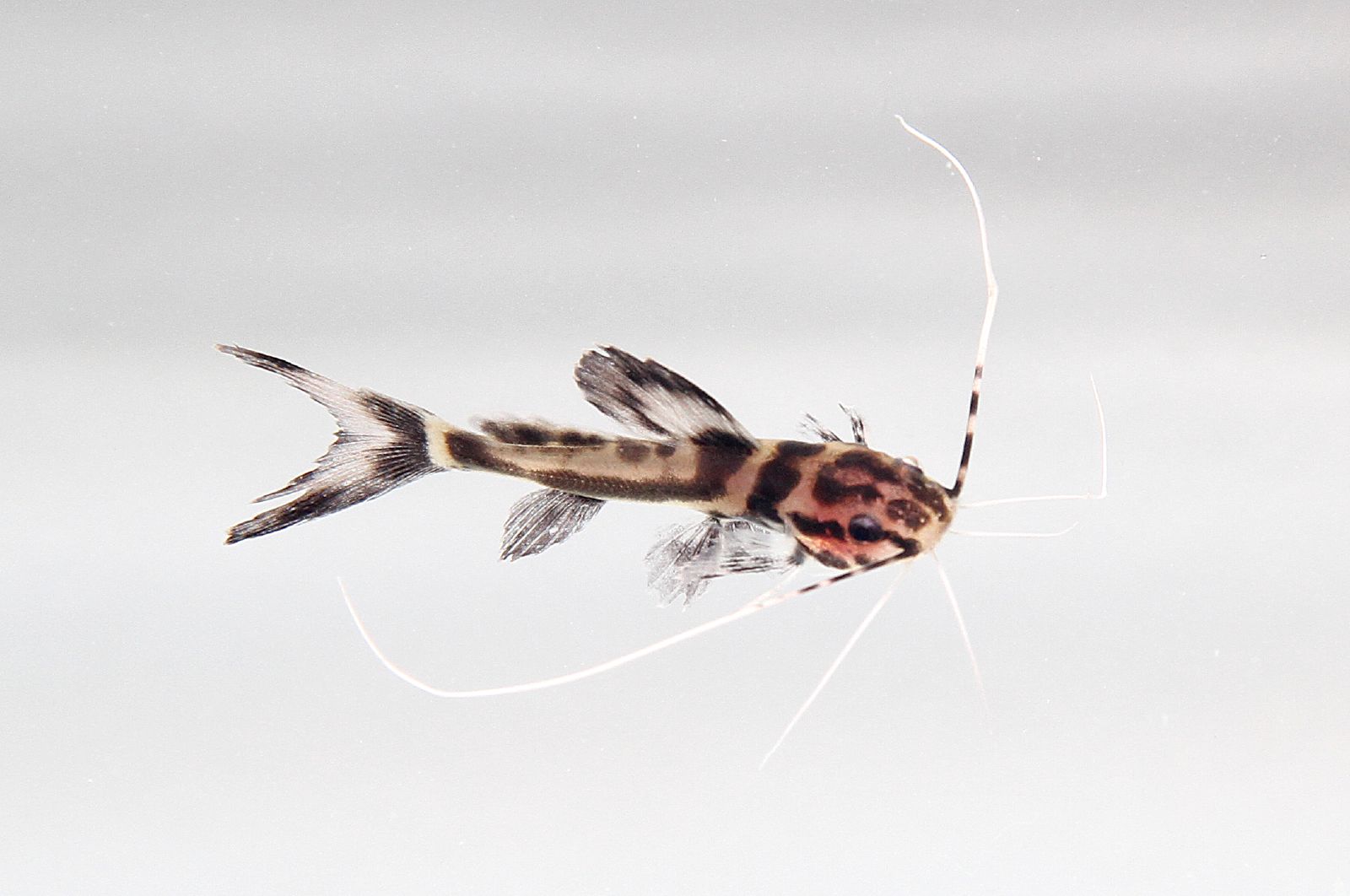
The marble is the giveaway, and the dorsal fin is the silhouette. Leiarius marmoratus, sold as marbled catfish or marbled pimelodus, is a large Amazonian pimelodid with a blotched, map-like pattern and a sail of a dorsal that juveniles show off in shop tanks. Adults push past 60 cm and can approach a metre in big water. It is a huge river predator. It is not Pseudoplatystoma fasciatum (barred tiger shovelnose of the open channel). It is not Sorubim lima (sand-lying duckbill). It is not a “pretty catfish for the community.” It is a sail-finned hunter that shops move because the baby looks like a koi-coloured curiosity.
Amazon wood and channels, a different pimelodid job
L. marmoratus inhabits Amazonian drainages, using structured water — wood, shade, the edges of current — as a large nocturnal predator. The high dorsal is part of a different outline from the shovel-headed tigers. In nature it takes fish and other animal prey in a warm, large, oxygenated river. There is no nano version of that niche.
People who have kept them into adulthood describe a fish that becomes bulky, territorial about space, and incompatible with anything swallowable. That is not a temperament surprise. That is a pimelodid growing into its Latin name.
Fisheries and local markets know these fishes as food. The ornamental path is the juvenile. Those paths should not meet in a 200 litre tank.
Marbled maps and a sail, not tiger bars
Juveniles are the trap: irregular dark marble on a gold, cream, or grey ground, a tall dorsal, long barbels, a lively swimming habit in a small vat. Adults keep the marbling but the body becomes a heavy pimelodid with a mouth to match. The sail looks proportionally less cartoonish as the fish fills in, but the dorsal remains a Leiarius flag, not a Pterygoplichthys pleco sail and not a Myxocyprinus carp sail. Different families, different climates, different ethics.
Do not identify this fish as a barred sorubim. Bars versus marble, shovel versus sailfin pimelodid — if you cannot see the difference, you should not be buying either giant. Do not identify it as a duckbill; there is no spatula snout.
Healthy juveniles still become impossible adults. Condition in the shop is not a size guarantee. Pinched bellies and ripped fins mean a bad start on a fish that needed a good start in a huge system you probably do not have.
A river exhibit with a sail, still not a house pet
Adult marbled catfish need swimming volume in the public-aquarium class: long, deep, heavily filtered water, a lid, sparse heavy décor, a sand or smooth floor. A “very large home aquarium” is almost always still too small. If you cannot commit to a hall-like system, you cannot commit to L. marmoratus.
They will smash light wood. They will eat tank mates. They will foul water on a predator diet. Engineering comes first. Aesthetics come last.
Night is when they own the tank. Daytime hiding does not mean they are a shy dwarf. It means you have a large nocturnal hunter.
Warm Amazon water at livestock scale
Temperature 24–28 °C, typical river chemistry, oxygen and turnover as if you were keeping a food-fish operation — because in biomass you nearly are. They are not cool Ictalurus. They are not brackish Sciades. They are not xylophagous panaques. Mixing those care models is how giants die in the wrong climate while the keeper follows a template.
Water changes are large and frequent. Filters are redundant on purpose. Power failures are emergencies for a fish this size.

A hunter’s diet, a hunter’s waste
Feed fish flesh, prawn, and proper predator diets in amounts the fish finishes. Do not feed the marble pattern; feed the mouth. Do not leave seafood to rot behind a rock. Do not use living companions as the pantry.
Juveniles in shops often take pellets. That does not freeze their growth. It just means they will eat pellets and then everything else.
Fasting an adult one day a week in a clean system is more sensible than constant banquet in a small box.
Marble does not mean gentle
Stocking is: this fish, or this fish plus other true giants in an institutional river, or nothing. Community fishes are food. Medium fishes become food later. There is no cleaner crew. There is no algae argument. There is no “it grew up with them.” A huge predator does not sign a peace treaty with childhood tank mates.
They may quarrel with other large catfishes over space. A single specimen in a vast exhibit is the least bad private idea, and it is still a bad idea for most homes.
No garage hatchery
Big-river pimelodid spawning is not a home project. Do not buy two marbled juveniles to breed. The marble is not a pair-bond. It is camouflage for a predator that has not grown up yet.
Juvenile swim, adult bulk
A young marbled catfish often swims more in the open than a duckbill plastered to sand. That activity is charming in a shop vat. It is also a clue that the species wants water volume, not a cave to disappear into forever. As the marble fills with muscle, the same fish becomes a bulky nocturnal hunter that still needs length. People who built a “tall display” for the sail discover the adult wants a corridor. Length first. The dorsal fin will find the water column on its own.
If you already own a juvenile, stop adding swallowable fishes now. Every month of growth closes the mouth-size loophole you were pretending existed. Rehome while the fish is still movable. A 70 cm Leiarius is a logistics problem with spines.
Night feeding on the sand or in midwater — wherever this individual hunts — should be watched once so you know the marble is eating pellets or flesh you offered, not the last remaining neighbour.
The sail is not a size cap
Leiarius marmoratus is a marbled, high-dorsal Amazon predator, a huge river catfish. If you wanted stripes, that was the tiger shovelnose, and that fish is even less suitable. If you wanted a spatula, that was the duckbill, still a predator. If you wanted a community, you wanted a different family. See barred sorubim, duckbill catfish, chemistry, cycling.
Explore other topics
Dive into more aquarium guides across the site.