

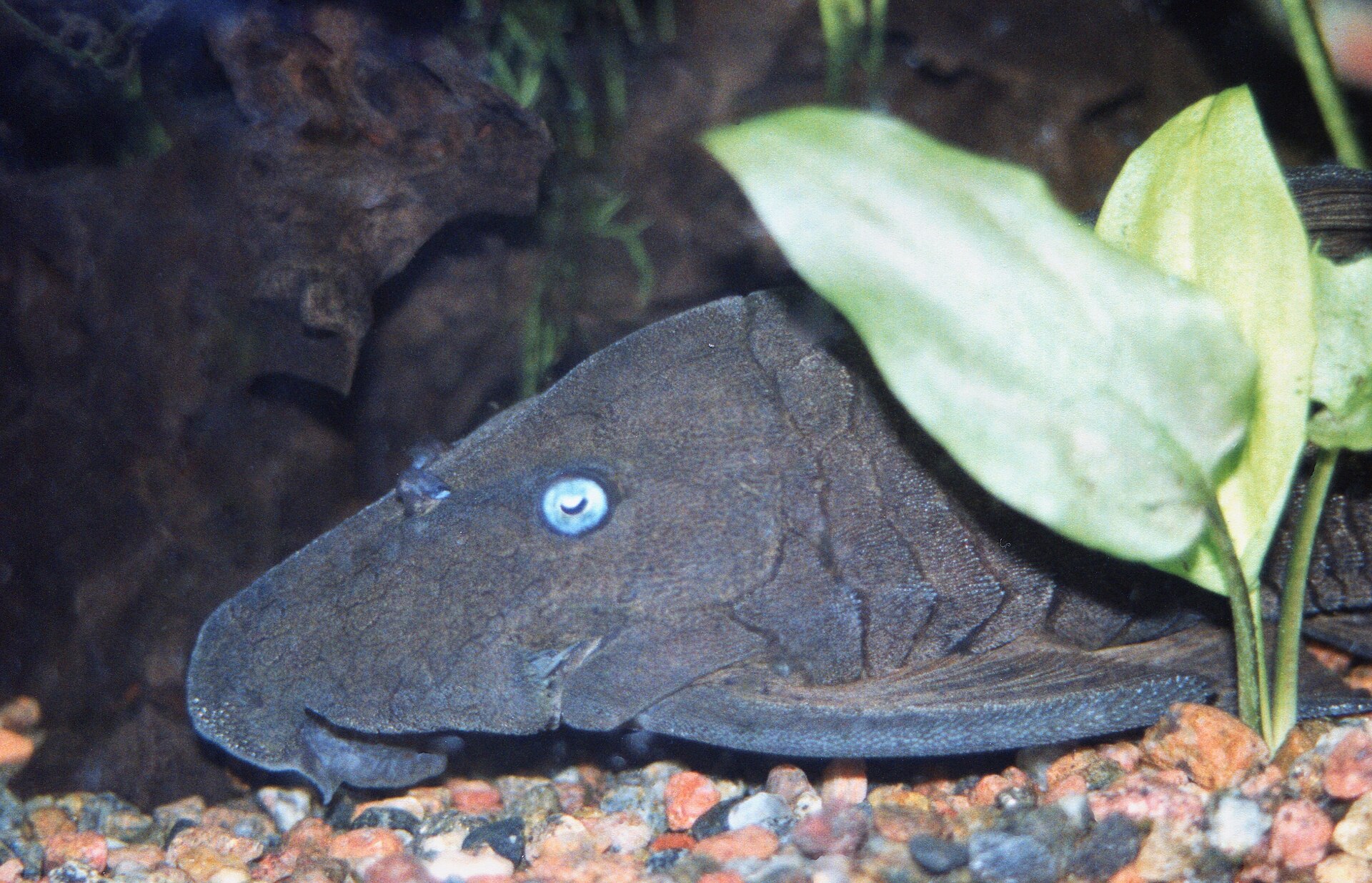
The first thing you notice, if the fish is in decent water, is the eye. Panaque cochliodon, the blue-eyed panaque or blue-eyed pleco, carries a pale, almost turquoise iris on a body that is usually olive, grey-brown, or muddy gold rather than pinstriped. It is a Colombian Magdalena specialist, a true Panaque with wood-gouging teeth, and an adult that still reaches the 30–40 cm class. It is not P. nigrolineatus with the stripes photoshopped off. It is not an algae oto. It is not a bristlenose. It is a range-restricted xylophage whose eyes sell juveniles into tanks that cannot hold the adult or the waste.
The Magdalena is not the Orinoco royal’s river
P. cochliodon belongs to the Magdalena basin of Colombia, a Pacific-slope-adjacent Caribbean drainage with its own fauna, its own conservation problems, and its own water. Royals of the nigrolineatus complex are Orinoco-Amazon fish. Mixing the two in one “panaque care” paragraph erases a Colombian endemic. Wild habitat is tropical river with heavy woody debris, current, and oxygen. Security and habitat change in the Magdalena drainage have made locality fish a serious subject, not a casual import.
If you keep this species, you are keeping a Magdalena wood-eater. Copy warm, moving, well-filtered water and a constant supply of appropriate wood. Do not copy a cool Andean cobble tank. Do not copy a still blackwater nano.
Captive-bred blue-eyes appear less often than farmed bristlenoses. Treat wild-caught adults as animals that need impeccable water after a long trip, and treat the species as one you should only buy if the adult system already exists.
Olive armour, a bull sucker, and that iris
The body is a hefty panaque shape: broad head, armoured plates, a powerful sucker with spoon teeth. Colour is typically drab until the eye hits the light — then the blue or pale ring is obvious. Some individuals show faint mottling. They will never be mistaken for a royal if you look at the flanks instead of the price tag.
Juveniles already show the iris. That is why they sell. The body will thicken for years. A 8 cm blue-eye is not a finished fish. Plan for the bull adult.
Health is a belly, a mouth that is not torn, and an interest in gouging wood. A blue-eye sitting on glass in a bare shop tank, ignoring a wafer, may simply be a xylophage without wood. Ask what they have been eating. If the answer is “algae,” walk away.
Males can show more odontodes. Cave politics are real. Sexing shop juveniles is guesswork.
A Colombian woodpile in a large tank
Adult housing is in the same league as a royal: a large, long aquarium, replaceable hardwood, sand, heavy décor, a lid, and filtration that expects constant faeces. One adult is a sensible stocking. Two males and one log is a fight. Flow should be respectable; Magdalena rivers move. Temperature stays tropical.
They will rearrange light wood. Bolt it or use pieces too heavy to skate. Plants are optional casualties.
A bristlenose cave is too small. A royal’s log is the right scale. Do not keep a blue-eye in an 80 litre “pleco tank.”
Tropical, oxygenated, and filtered like a xylophage
Temperature 25–29 °C, pH roughly 6.5–7.8, high oxygen, zero ammonia. They are not cool-water rubberlips. They are not brackish ariids. Large water changes are routine. Filters clog with wood waste; clean them.

Colombian river chemistry is not a licence for hard, alkaline rift-lake water, nor for empty RO. Aim for stable, mineral-reasonable tropical river water.
Wood first, because the teeth say so
Same law as other true panaques: wood is a food. Vegetables and specialised sinking foods support; they do not replace logs. Protein is modest. Algae is a side graze. If you keep a blue-eye next to a royal, you still have two large xylophages and twice the waste, plus possible territorial overlap. Most home tanks should not keep both.
Replace eaten wood. Watch faeces. Feed greens on a clip so you can see whether the fish left the log to eat them.
A blue-eye on a flake-and-algae diet is a slow veterinary case.
One log, one tyrant
Keep the fish with robust, large companions in a huge system, or keep it as a single specimen display. Small fish are not a community around a 35 cm panaque. Other cave loricariids will contest wood. Giant pimelodids are a different, predatory problem; do not mix a wood-eater in as “the cleaner” for a shovelnose.
Quarantine with wood. Observe the eye (cloudiness is a water-quality alarm) and the appetite for lignin.
Breeding remains a big-fish problem
Cavity spawning is likely the mode, as in other panaques. Documented home breeding of P. cochliodon is not a beginner project. Do not buy a “pair” of blue-eyes for a community. Conservation of Magdalena fauna is better served by not impulse-buying wild adults you cannot house.
Why Colombian locality should slow your wallet
The Magdalena fauna has been hit by habitat change, security limits on field work, and the usual export pressure on anything with a pretty eye. A blue-eyed panaque is not a mass-farmed bristlenose. If the price is suspiciously low, ask whether the fish is correctly named, wild-caught, or simply a dull royal. Look at the flanks. No pinstripes. Olive to gold-brown. Then look at your tank length. Then look at your filter. Only then look at the iris again.
After import, give the fish a dim, wood-filled box of its own until it gouges a log and produces the famous faecal stream. That stream is how you know a xylophage has started work. No stream and a hollow belly means the teeth have nothing to do. Do not medicate for “lethargy” until wood is present.
Long term, the blue eye can cloud in poor water. Treat cloudiness as a cue to test ammonia and nitrate, not as a new colour morph.
The eye is not the species
The iris is how you recognise Panaque cochliodon in a shop. The wood diet and the adult size are how you decide whether it goes home. A Colombian xylophage is not a royal clone and not a community algae eater. See royal panaque, chemistry, cycling.
Explore other topics
Dive into more aquarium guides across the site.