

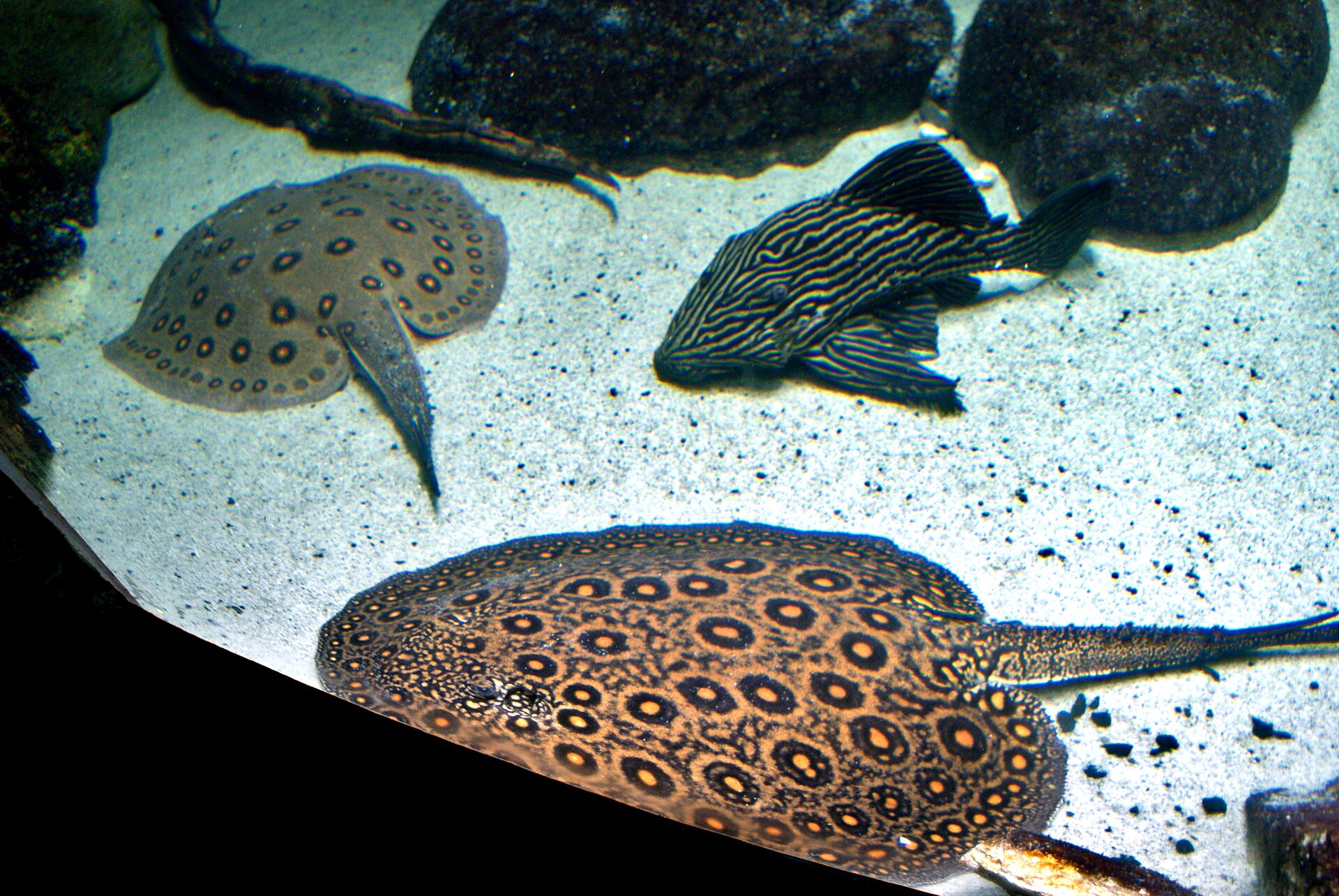
The royal panaque is a wood-eater. That sentence should sit above every care sheet. Panaque nigrolineatus has spoon-shaped teeth for gouging submerged wood, a striped royal pattern, and an adult size in the 35–43 cm class, sometimes more. It is an Orinoco and Amazon loricariid, a specialist xylophage, not an algae janitor, not a 12 cm bristlenose, and not a spotted sailfin that merely rasps décor. People buy a 10 cm striped juvenile because it looks like a living ornament. They inherit a large, territorial, cellulose-digesting catfish whose main products are shredded wood and a lot of faeces. If you cannot feed wood as food and filter the result, you cannot keep a royal.
Striped water of the Orinoco and Amazon
P. nigrolineatus is the classic royal with dark stripes on a pale ground, associated with the Orinoco and Amazon basins, among large woody snags in tropical rivers. Locality variants and related L-numbers (the “royal” complex) confuse shops. The care theme stays: big river, big wood, warm water, oxygen, and a diet that includes lignin. These fish live where trees fall in. An aquarium without substantial, replaceable wood is a starving royal in a pretty box.
Current in those rivers is real but not a mountain torrent. They are not Chaetostoma. They wedge into logs and gouge. Floods bring new wood. In a tank you must restock wood as they eat it.
Conservation of big river specialists is not helped by dumping adults. These fish live a long time. The purchase is a decade-scale wood contract.
Pinstripes, a bull head, and spoon teeth
Juveniles show the fine black-on-cream striping that sells. Adults keep the royal look but the head becomes massive, the body deep, and the eyes relatively small. The teeth are the identification of the job: spatulate, for excavating wood, visible if you look at the sucker. That is the difference from Hypostomus and from Pterygoplichthys, which rasp mixed aufwuchs. It is also the difference from Peckoltia vittata, which is smaller and more omnivorous than xylophagous.
The blue-eyed panaque (P. cochliodon) is a different, usually plainer, Magdalena fish with a striking iris. Do not write one care sheet for both just because both eat wood. Striping versus olive-brown, Orinoco-Amazon versus Magdalena, still two species.
Healthy royals have intact fins, a heavy but not bloated body, and obvious interest in wood. Hollow-bellied striped juveniles on a wafer-only diet are already in trouble.
Wood as furniture and as groceries
An adult needs a large, long tank — 400 litres and upward is the conversation, with more length than height, a canopy, and wood that can be replaced. Several thick pieces of aquarium-safe hardwood (the kinds known to be used with panaques) should be in the tank at all times. When a log is honeycombed, add another. Sand substrate. Rock can be used as structure but rock is not food.
Filtration must be brutal. Xylophage faeces are a famous problem: long, plentiful, constantly produced. Canister filters, sumps, and large water changes are the hobby. A sponge filter is not enough. Flow should keep waste moving toward intake without turning the tank into a hillstream.
They are territorial about logs. One adult per large woodpile is saner than a pair of males in a 200 litre tank.
Warm river water and a waste budget
Temperature 25–29 °C, pH 6.5–7.5 as a working band, oxygen high. They are tropical. Cool Yangtze water is wrong. Brackish water is wrong. Ammonia from wood waste plus leftover vegetables will spike if you are lazy. Test. Change water. Clean filters before they clog with panaque output.
Nitrate control is part of keeping a royal, not an extra. A striped fish in yellow water is a filtration failure.
Cellulose, vegetables, and a little protein
The staple is wood. Support it with sinking vegetarian foods, sweet potato, courgette, and similar items, plus modest protein. Specialised panaque diets exist for a reason. Algae wafers alone are a misunderstanding of the teeth. The fish will rasp glass; that is not a royal’s calorie source.
Do not pull all the wood out for a “clean scape” photoshoot. You removed the pantry. Do not assume a driftwood ornament from a craft shop is safe or nutritious. Use woods the specialist community actually uses, and replace them.
Watch the faecal stream. It is gross and it is information: a working xylophage produces a lot of it. None of it should rot in a cave.
A log tyrant, not a school
Keep one royal, or a huge exhibit with visual breaks and multiple logs. Small fish may be ignored or may be rasped at night. Flattened tank mates suffer. Other large, robust fish in a vast Amazon display can work; a tetra community cannot. This is not a giant pimelodid predator, but it is a huge, territorial, wood-eating loricariid. Neighbours must be chosen for size and toughness, not for “cleaning crew” logic.
Incoming royals need wood in quarantine too. A bare box with wafers is the wrong hospital.
Spawning is a specialist’s rumour
Cave spawning is the loricariid pattern, but home breeding of full-size P. nigrolineatus is rare because of adult size and territoriality. Do not buy two juveniles as a breeding pair for a community tank. Enjoy the adult you can actually house.
Which woods belong in a royal’s tank
Specialist keepers use dense, aquarium-proven hardwoods and replace them as they become honeycombed. Soft, resinous, or unknown craft-shop branches can leach, rot the wrong way, or simply fail as food. Do not add wood that still smells of varnish. Do not add wood so light the fish can skate it into the heater. A royal is a bull. The log must survive the bull until the bull eats it, which is a different mechanical problem from decorating a tetra tank.
Budget for wood the way you budget for food. If that sounds expensive, the fish is expensive. The stripes were never a discount.
Stripes do not make it small
A royal panaque is a wood-eating river loricariid that belongs in a large, filtered, log-filled system. If you wanted algae, buy otos or a bristlenose. If you wanted a medium striped cave fish, look at Peckoltia. If you wanted this look, budget for wood and waste. See blue-eyed panaque, Peckoltia vittata, chemistry, cycling.
Explore other topics
Dive into more aquarium guides across the site.