

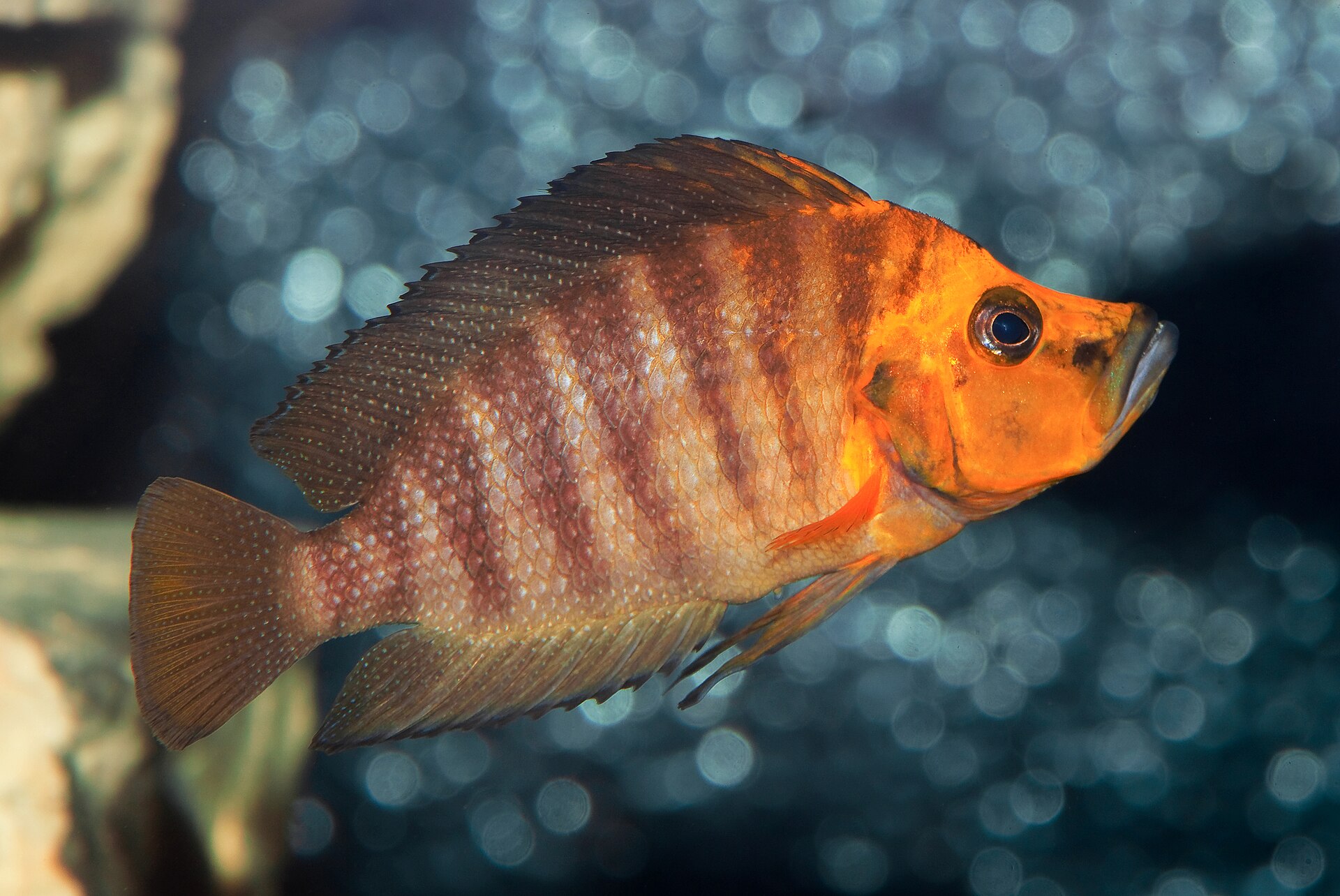
Compressed Altolamprologus looks like someone pinched a cichlid sideways and taught it patience. Altolamprologus compressiceps reaches 12–15 cm, presents a high, thin body made for vertical rock seams, and hunts by hovering, peering, and picking — snails, shrimps, and other fishes’ fry in the lake. It is not a Julie that lives in a horizontal crack as a pair. It is not a shell-dweller. It is not a gentle apisto. If you wanted a “small Tanganyika cichlid” for a community, this is the wrong small.
The sister species A. calvus is even more extreme in the head-down, ultra-compressed look. Compressiceps is the deeper-bodied hunter of the two, still a specialist of rock fissures, still alkaline, still a predator you stock with intent.
Vertical seams on a Tanganyika wall
Rocky Lake Tanganyika: the fish orients to cracks that run up the rock, not to shells on sand. Water is the usual lake recipe — hard, alkaline, stable, 24–27°C. They share the habitat conceptually with Julies but use the geometry differently. A Julie threads a tube. Compressiceps presents that knife-edge body to a slot and waits.
Your rockwork should include upright slabs and narrow vertical gaps, not only a jumble of round cobbles, and not a field of apple-snail shells. Sand at the base is acceptable. A planted soft-water layout is a different planet.
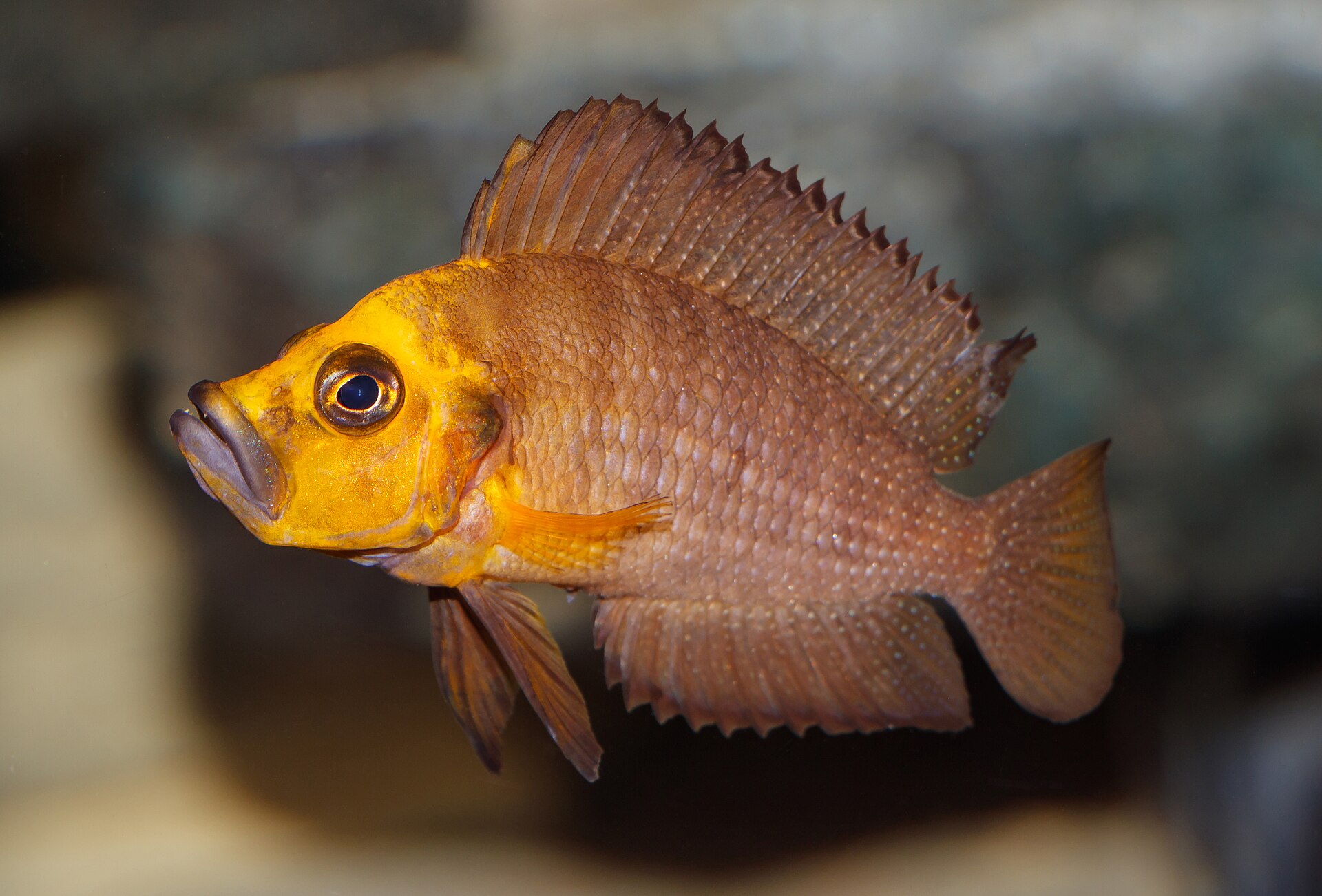
A knife with a gold eye
Colour varies by population: gold, brown, barred, sometimes a dark eye-ring that reads as a stare. The diagnostic is the compression — from the front the fish is a blade. That blade is why they can enter places a cylindricus cannot. Sexing is not trivial; males may be larger. They are slow until they are not. Watching one hunt along a seam is the reason to keep the species. Watching one eat your Neolamprologus fry is the reason to think about stocking.
Do not confuse them with compact mbuna. Mbuna are Malawi, usually more herbivorous, and politically louder in a different way. Compressiceps is a Tanganyika predator aesthetic.
One hundred fifty litres of hunting ground
The hunting ground should be 150 litres or more. A pair or a carefully chosen harem needs broken rock and swimming space in front of the wall. They are not a school. They are not a shell colony of twenty. Overcrowding produces wrecked subordinates. Build rock that cannot fall. Include some shells only if you also keep shell-dwellers in a large partitioned-by-scenery tank and accept predation risk — most keepers should not.
Filtration: strong, because rock and a 15 cm cichlid make mess. Flow along the wall. No peat. No oak leaves. Lid optional compared with rasboras, still wise.
Alkaline water, predator metabolism
Temperature 24–27°C. pH 7.8–9.0. High minerals. They are less forgiving of soft water than a convict cichlid and far less forgiving than a pearl cichlid from coastal Brazil. Cycle the tank. Keep nitrate in check without stripping KH. Chemistry, cycling.
This is the same chemical neighbourhood as Julies and ocellatus, which is why people try to mix all three. Mixing is an advanced lake layout, not a default. Compressiceps will eat things that fit in the mouth. Shell-dweller fry fit.

Snails on the menu, pellets as backup
In nature they eat invertebrates including snails. In the tank they take frozen mysis, krill, chopped prawn, quality pellets, and — if you offer them — small snails. They do not need a lettuce diet. They do not need powdered rasbora food. Feed sinking or slow-sinking items near the rock. They may ignore surface flakes.
A well-fed compressiceps still hunts. Do not stock “feeders” as décor. Do not stock expensive shrimp and act surprised.
Stocking is a predation map
A species tank or a pair in a rock tank is clean. Possible companions in a large Tanganyika setup: fish too big to eat that use open water, or robust rock fish that can stay out of the seams. Bad: anything 4 cm that lives in a crack, most shell-dwellers, all South American dwarfs, all rasboras, all tetras, Corydoras.
Calvus and compressiceps together is a specialist choice, not a beginner mix. Julies occupy overlapping real estate. Fairy cichlids occupy overlapping real estate. Draw a map of the rock before you add a second genus.
Spawning in a slot you will barely see
They spawn in a cavity or tight space in the rock. The female is often more involved with the clutch in the typical lamprologine way; details vary with the pair. Fry are at risk from other cichlids and from the parents’ tankmates. This is not a mouthbrooder like Paracyprichromis. It is not a sand-sifting mouthbrooder like some Satanoperca. It is a rock cavity spawn in alkaline water.
If you want to raise fry, a separate tank or a very large, lightly stocked rockwork is the path. Do not expect a peaceful colony like multifasciatus shells.
Lethargy versus stalking
A compressiceps that hangs motionless in a seam is often behaving. A compressiceps that hangs at the surface, clamped, is not. Imports can be thin; feed well in quarantine with rock and correct water. Avoid mixing medications and high organic loads. Watch for injuries from rock and from tankmates.
Related reading that actually belongs: Altolamprologus calvus for the more extreme knife, ornate Julie for a different crack lifestyle, fairy cichlid if you wanted a social rock cichlid that is not a snail hawk. Amazon tetras have no place in this chemistry.
Watching a hunt without stocking victims
The pleasure of compressiceps is the hover and the peek. You can have that with pellets and frozen mysis along a well-built seam. You do not need live snail cultures unless you want them, and you do not need a tank of dwarf shrimp advertised as “cleanup.” If you do offer snails, use species you accept as food, in a tank that is already alkaline, not mystery snails you wanted for algae in a planted community you no longer have.
Imports arrive thin because the blade body shows every rib. Feed daily at first, small amounts, at the rock. A fat compressiceps is still a hunter; a thin one is a medical watch. Do not confuse the natural motionless hang with lethargy: gill rate, appetite, and whether it still orients to seams tell you which is which. If it orients to the heater and the surface, you have a water problem, not a hunting problem.
Explore other topics
Dive into more aquarium guides across the site.