

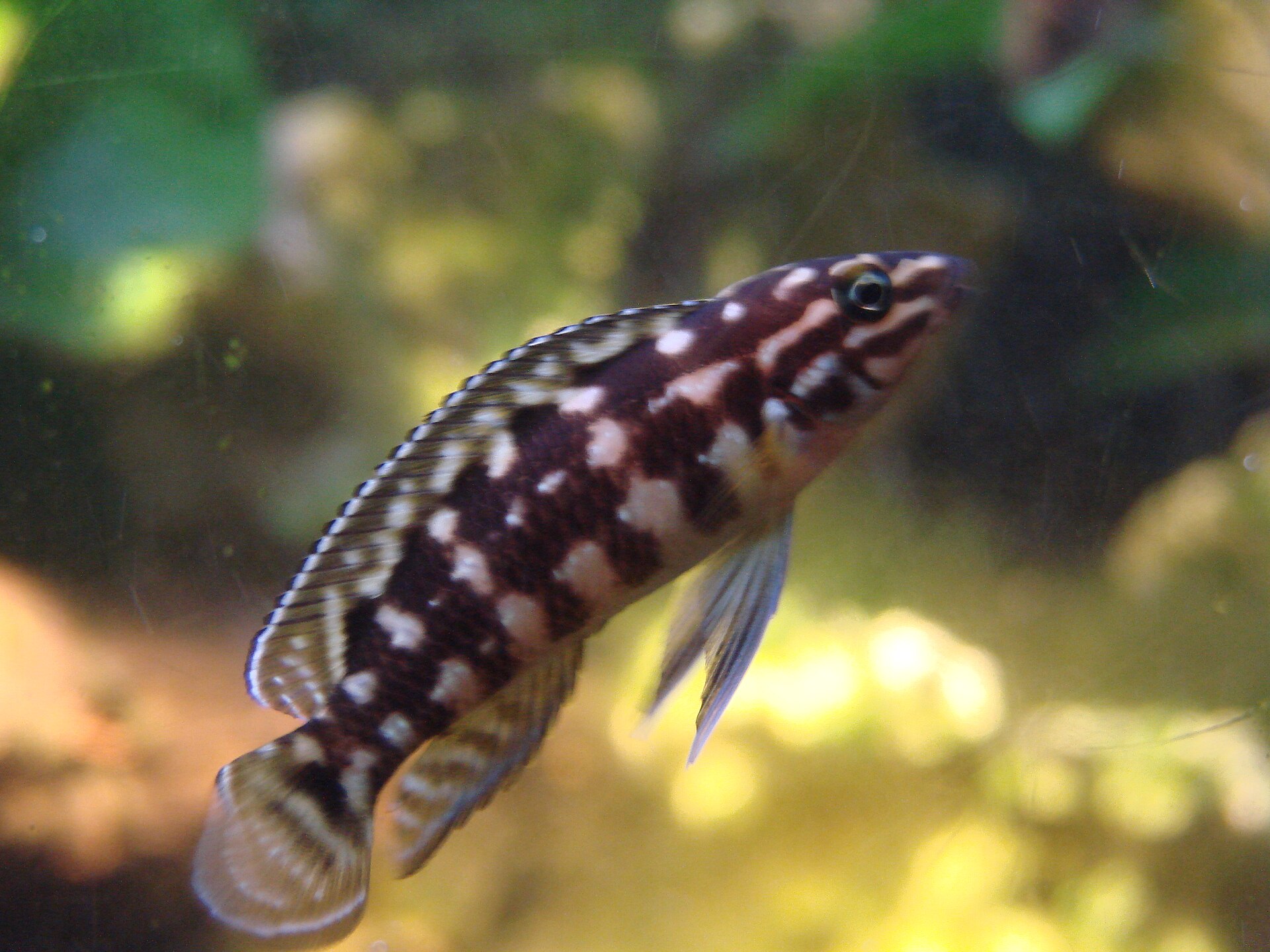
Marlier’s Julie is the Julie people buy when they wanted more bulk and more maze-like barring. Julidochromis marlieri grows around 8–10 cm, wears a dark lattice or checker on a lighter ground, and occupies rocky coasts of Lake Tanganyika like a muscular version of the ornate Julie. It is still a slit fish. It is still a pair fish. It is still a hard-water fish. It is not a sand-flat shell-dweller, and it is not a “bigger ornatus” you can drop into the same 100 litre rock pile without redrawing territories.
If J. ornatus is a needle in a crack, J. marlieri is a finger in a crack. The husbandry overlap is real; the space requirement and the punch in a quarrel are not identical. Treat this article as the large-Julie manual, not a copy-paste of the ornate file.
Rock faces with more fish-length behind them
The species is native to rocky coasts of Lake Tanganyika. Habitat is jumbled limestone and cobble, alkaline water, high mineral content, temperatures in the mid-twenties Celsius. They work the rock/water interface, slipping into gaps that look too small until you see the body compress. Sandy patches may exist nearby; the fish does not organise its life around empty snail shells.
A biotope photograph would show stone, stone, and a Julie’s head in a gap. It would not show a planted Dutch scape. It would not show a peat swamp. It would not show a Geophagus sand bed.
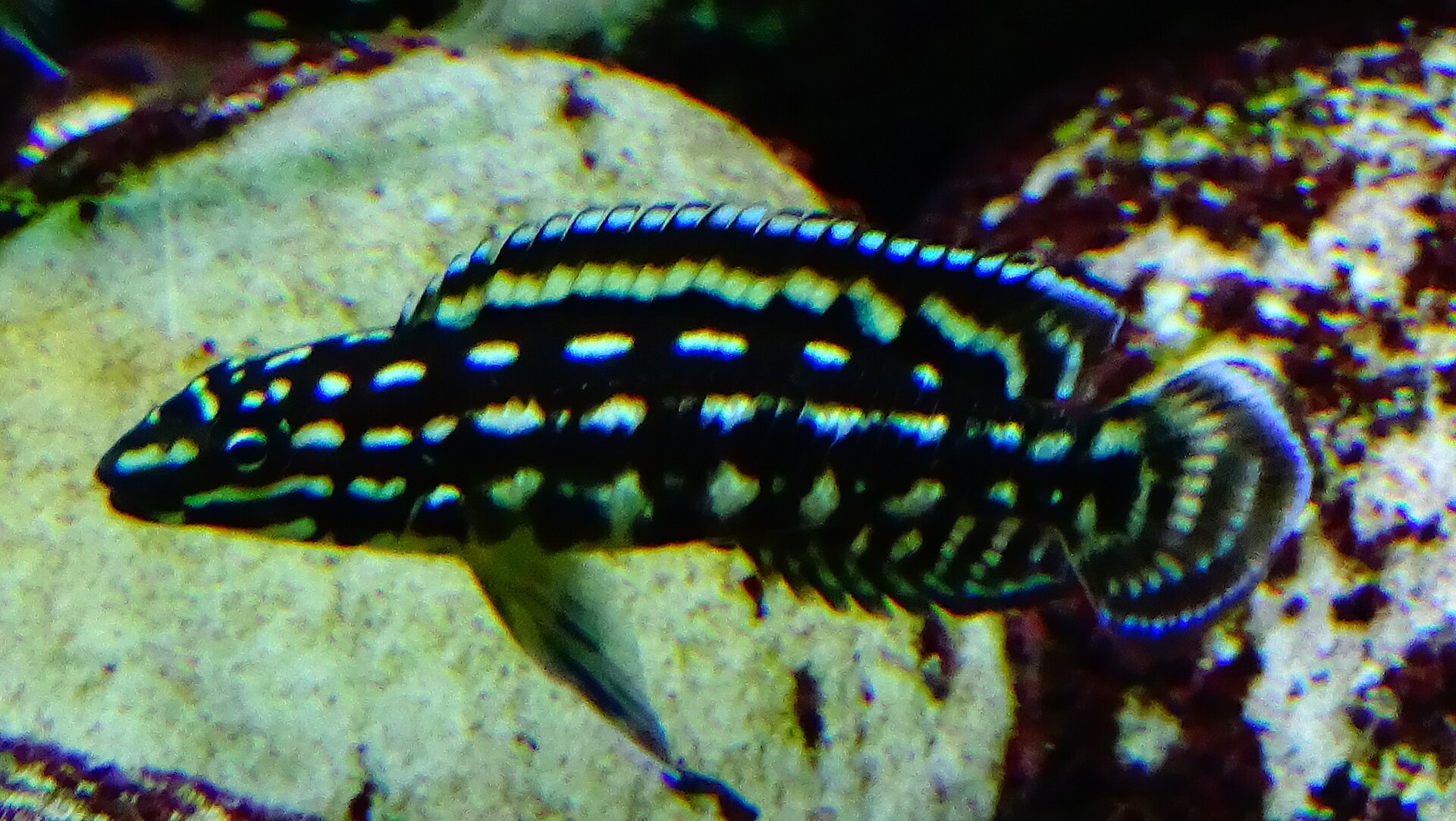
Lattice, not four clean stripes
Marlier’s Julie is famous for a more reticulated, checkerboard pattern — dark lines crossing rather than only running as neat longitudinal stripes. Mood darkens or lightens the contrast. The body is more robust than J. ornatus. That extra mass is why they need a larger footprint and why a “Julie community” of several species is a bad idea. Sexing remains a pain; pairs form, spawn, and defend. Six unsexed adults in 120 litres is a clinic visit.
Julidochromis transcriptus is another barred Julie; do not mix Julies to complete a set. They do not complete sets. They complete grudges.
One hundred twenty litres of stable stone
Give Marlier’s Julie 120 litres or more. Stack rock so slits exist at multiple levels. Anchor everything. Fine sand on the floor catches waste and lets them forage, but the rock is the tank. Compared with an ocellatus layout, you should see almost no open sand prairie. Compared with an ornate Julie tank, you should see more volume and more broken sightlines, because marlieri pairs project a wider “this is our wall” attitude.
Filtration needs to handle detritus in rock. Powerheads along the back glass can keep film off stone. Do not point a cannon at the pair’s home crack. Lid is sensible; they are not famous jumpers like scissortails, but a startled cichlid can still come out.
Plants: mostly skip. Hard-water anubias on rock is a maybe. Vallisneria in Tanganyika water is a maybe. A jungle of Amazon swords is a no.
Lake water, not forest water
Temperature 24–27°C. pH 7.8–9.0. High GH/KH. Soft acidic water from an apisto tank will wreck their slime coat and osmoregulation. If you keep both types of cichlid in the house, they need separate systems. Cycle with rock in place. Change water that matches alkalinity. Guides: chemistry, cycling.

Do not add driftwood to lower pH on purpose. Tannins are for Dicrossus, not for Marlier’s Julie.
Food along the cliff
Sinking foods, frozen invertebrates, quality cichlid micro pellets. They will come out of the slit to eat. They will not compete well at the surface with danios you should not have added. They are not herbivorous mbuna; do not fill them with spirulina-only wafers and call it a biotope. Variety prevents the washed-out, thin look.
Feed the pair, then look for fry in the dark. If you have fry, add crushed food that actually reaches the crack.
Roommates are a luxury
A pair is the stocking. In a large Tanganyika tank you might add open-water cyprichromines that stay off the rock, or a distant shell field that the Julies cannot easily dominate. Altolamprologus also use rock and will conflict. Variabilichromis will conflict. Fairy cichlids will conflict. Anything South American will die of chemistry or teeth.
South American catfish, rasboras, and tetras fail here: the water is wrong, and the Julie will treat small fish as intruders or food.
Rock spawn, serious parenting
Eggs on stone in a hidden slit. Both adults guard. Fry stay in the territory. Pull juveniles before the next spawn if the tank is small, or watch the pair thin their own numbers. This is classic Tanganyika substrate spawning on rock. It is not mouthbrooding like a Paracyprichromis male holding eggs. It is not a shell full of ocellatus fry.
Damage reports
Split fins on the smaller fish: the pair is not a pair, or the tank is a box of rivals. Fish hanging at the surface: oxygen, temperature, or a collapsed cave trapping waste. Ich on imports: quarantine in the correct water, with rock, not in a barren hospital that panics a slit specialist.
Read the ornate Julie article if you have less space and want the slimmer species. Read Altolamprologus compressiceps if you wanted a compressed snail-hunter on the same rocks rather than a striped crack-liver. Same lake. Different job.
Building rock that does not kill the fish in the night
Marlier’s Julie likes tight lattice. Tight lattice collapses if you stack slate on sand without a base plate. A 10 cm fish pinned under a stone is a dead fish you will smell, not a shy fish. Dry-stack on the glass, use a foam or egg-crate base if you need to, and wedge keystones. Then add sand. Then add the pair. The order matters. Digging shell-dwellers undermine rock; Julies do less of that, but sand still creeps. Recheck the pile after the first month.
When you siphon, you are siphoning a cliff, not a river. Reach the back corners with a tube; do not dismantle the home crack weekly. If mulm pours out of a slit as black soup, you have waited too long. A turkey baster aimed at the porch, not at the nest, is the weekly tool. Save the heroic teardown for when you are moving house, not for a Saturday scape itch.
Explore other topics
Dive into more aquarium guides across the site.