

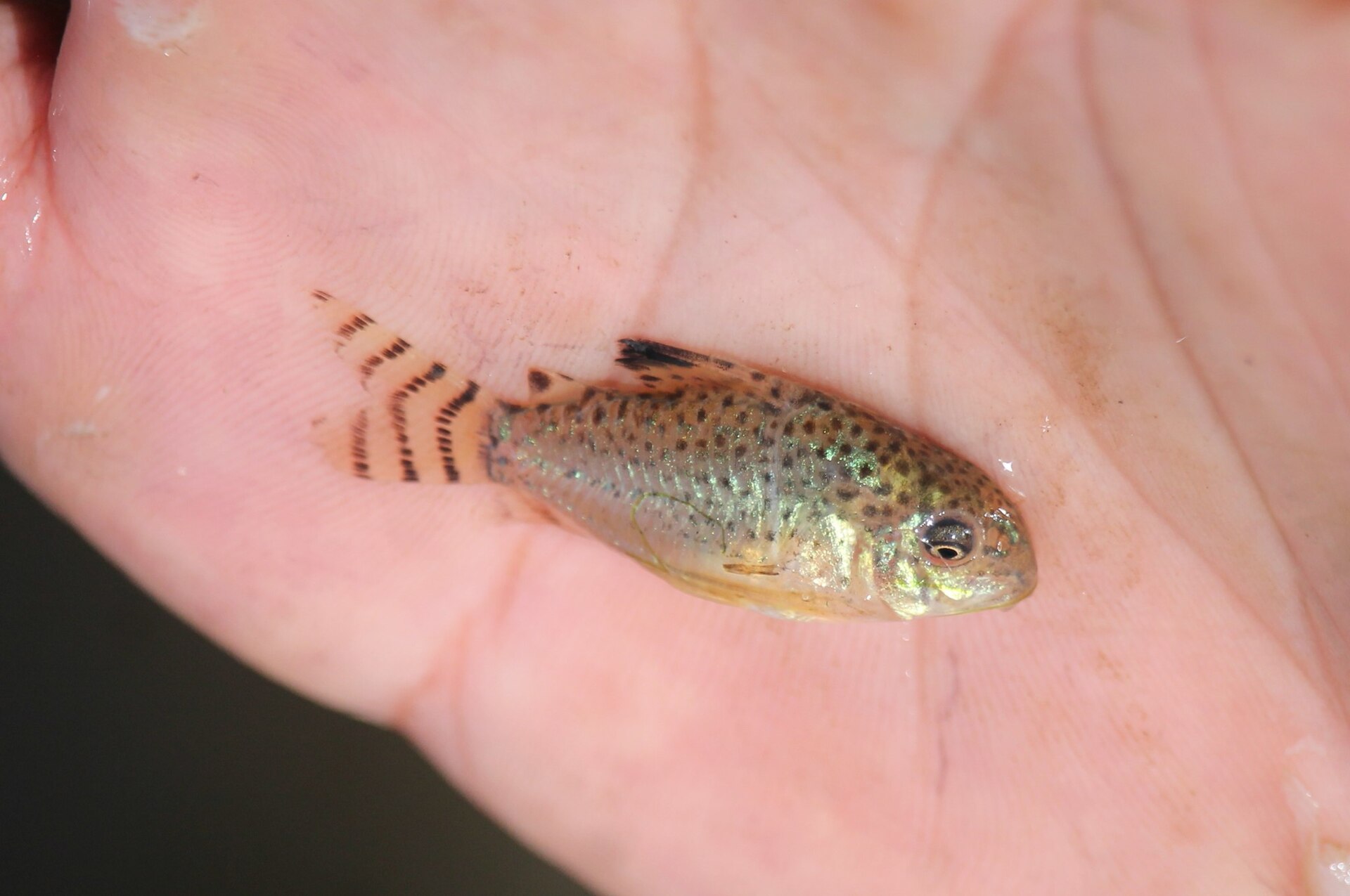
Before it had a scientific name, this fish was C012. Cruz's Corydoras (Corydoras cruziensis, now often Hoplisoma cruziense in revision papers) is a short-snouted Bolivian cory from the Santa Cruz and Beni departments of the Madeira basin. It is a mosaic-stippled, golden-bodied sand fish, not a Negro blaze, not a Mamoré orange-spine, and not “Bolivian ram” just because the map says Bolivia.
Named for Santa Cruz, not for a person named Cruz
Joachim Knaack described it in 2002 from Guarayos, Santa Cruz Department, Bolivia. The specific name refers to that department. Adults are small: roughly 4–4.5 cm standard length, a bit more in total length, with females the heavier fish. The look is a warm golden to tan body with regular dark stippling that can read as a broken mosaic or dashed lines along the flanks. It is short-snouted (the punctatus / Hoplisoma lineage of “round-nosed” corys). It resembles Hoplisoma copei from Peru closely enough that sloppy ID happens. If your fish is a Bolivian import with mosaic stipple and a short face, cruziensis is the working name in the hobby.
It is not a Brochis. It is not pantanalensis (Pantanal wetland, different pattern and usually a more reticulated gold net on a larger fish). It is not sterbai.
Madeira-basin Bolivia
Range: Madeira River basin in Santa Cruz and Beni, Bolivia — lowland streams, sandy creeks, forest and savanna edges, floodplain influence. Water is tropical, not Andean cold. Substrates are sand. Vegetation along banks is normal. This is closer to Madeira-world similis geographically than to Negro adolfoi, but cruziensis is its own Bolivian stipple, not a caudal-smudge similis.
Captive-bred groups exist because wild Bolivian exports are sporadic. Prefer farmed fish when you can; the species is still uncommon enough that a dead group is a real loss.
A small mosaic needs a small-kind floor
Despite the modest adult size, they still want a group and sand. A 60–80 litre long tank can hold six to eight if you do not overload the midwater. Fine, edgeless sand. Wood for shade. Plants welcome. They are not cave specialists. Covered intakes — 4 cm fish vanish into filters. Lid on.
Open sand lanes matter because the mosaic only reads when they are out. A cluttered scape of sharp rock is how C012 becomes a hospital case.
Water for a Bolivian lowland cory
Temperature 23–27°C is a comfortable band; they are not seussi-level heat addicts and not nattereri cool. pH 6.0–7.5. Soft to moderate. They are often described as less fussy than blackwater specialists. “Less fussy” still means cycled water and zero ammonia. Madeira-basin chemistry is not an excuse for a gravel starter kit.
Stipple in numbers
Six to ten. A pair of C012 looks like two beige stones. The mosaic shoal is the display. They forage as short-snouted corys do: barbels in sand, occasional dash to the surface for air. Mixed with copei they will confuse you forever. Mixed with common bronzes they will be out-competed in a small tank.
What a 4 cm mosaic eats

Small sinking foods, frozen bloodworm, flake crumbs, granules. Tiny mouths, modest size — do not feed as if they were leopardus. Evening feeding if tetras are present. Omnivore. Not an algae solution.
Neighbours for C012
Small tetras, rasboras, peaceful dwarfs. Bolivian rams can work thermally and geographically if the tank is large and the rams do not claim the entire floor. No large cichlids. No predatory catfish. Other small Hoplisoma-type corys in a big tank, each in a group if you care about seeing cruziensis-typical milling.
Spawning C012
Hobby reports follow the standard cory script: condition, cooler large water change, eggs on glass and leaves, no parental care. Because the species is still uncommon, every successful spawn is useful. Do not hybridise with lookalike short-snouts. Raise fry on infusoria then baby brine. Label them cruziensis / C012 / Hoplisoma cruziense honestly so the next buyer is not guessing.
Barbels in Bolivian lowland water
Small corys crash faster when barbels fail because they cannot forage as efficiently. Keep the sand clean. Watch for thin fish after import. Quarantine. Ich is still ich. Do not medicate a mosaic catfish with a guess copied from a koi forum.
C012 in the trade, Knaack on the paper
DATZ C-numbers were a way to talk about fish before the description caught up. C012 became Corydoras cruziensis in 2002, and lineage papers now park it in Hoplisoma with a spelling tweak to cruziense. Your search bar can use any of those strings; your tank only needs one actual species. What you should not do is treat every short-snouted Bolivian stipple as C012. Hoplisoma copei is the Peruvian lookalike people mention in the same breath. If your fish came with a Santa Cruz / Guarayos locality, cruziensis is the honest label. If it came as “Bolivian cory, maybe,” you own a maybe.
Because exports from those departments are irregular, the sustainable path is a captive-bred group. Breeders who still print C012 on the bag are not being old-fashioned; they are being searchable. Ask whether the parents were mosaic-stippled short-snouts from a closed line, not a mixed Hoplisoma soup.
Living with a 4 cm mosaic
At this size, everything in the tank is huge. A gentle ram is a giant. A sponge filter is a landmark. A gravel vacuum on full blast is a hurricane. Move slowly when you approach the glass or the troop will plaster themselves against the back pane and look “never active” in every photo you take. Feed in two sandy corners so the smallest female still gets crumbs. If you keep plants, leave a runway; crypts are better than a carpet that turns the floor into a maze they will not cross.
Record weight with your eyes: from above, cruziensis should look like little golden almonds after a meal, not like matchsticks with fins. A Madeira-basin dwarf that arrives thin needs days of micro-food in a quiet box, not an immediate drop into a display full of rummynose tetras. When they finally mill as a stippled ribbon over pale sand, you will understand why someone bothered to describe a fish from Guarayos instead of filing it under “small yellow cory.”
A Bolivian name worth learning
Keep Corydoras cruziensis because you want the Santa Cruz mosaic cory, a small golden stipple from Bolivian Madeira drainages, on sand, in a group. Skip it if you wanted Pantanal reticulation, Sterbai polka dots, or a generic bronze. The department on the map is the etymology. The stipple is the look. C012 was a placeholder; the fish is not. Learn the short snout, the mosaic dash, and the modest centimetres, and you will stop confusing it with every other beige catfish from west of Brazil.
Explore other topics
Dive into more aquarium guides across the site.