

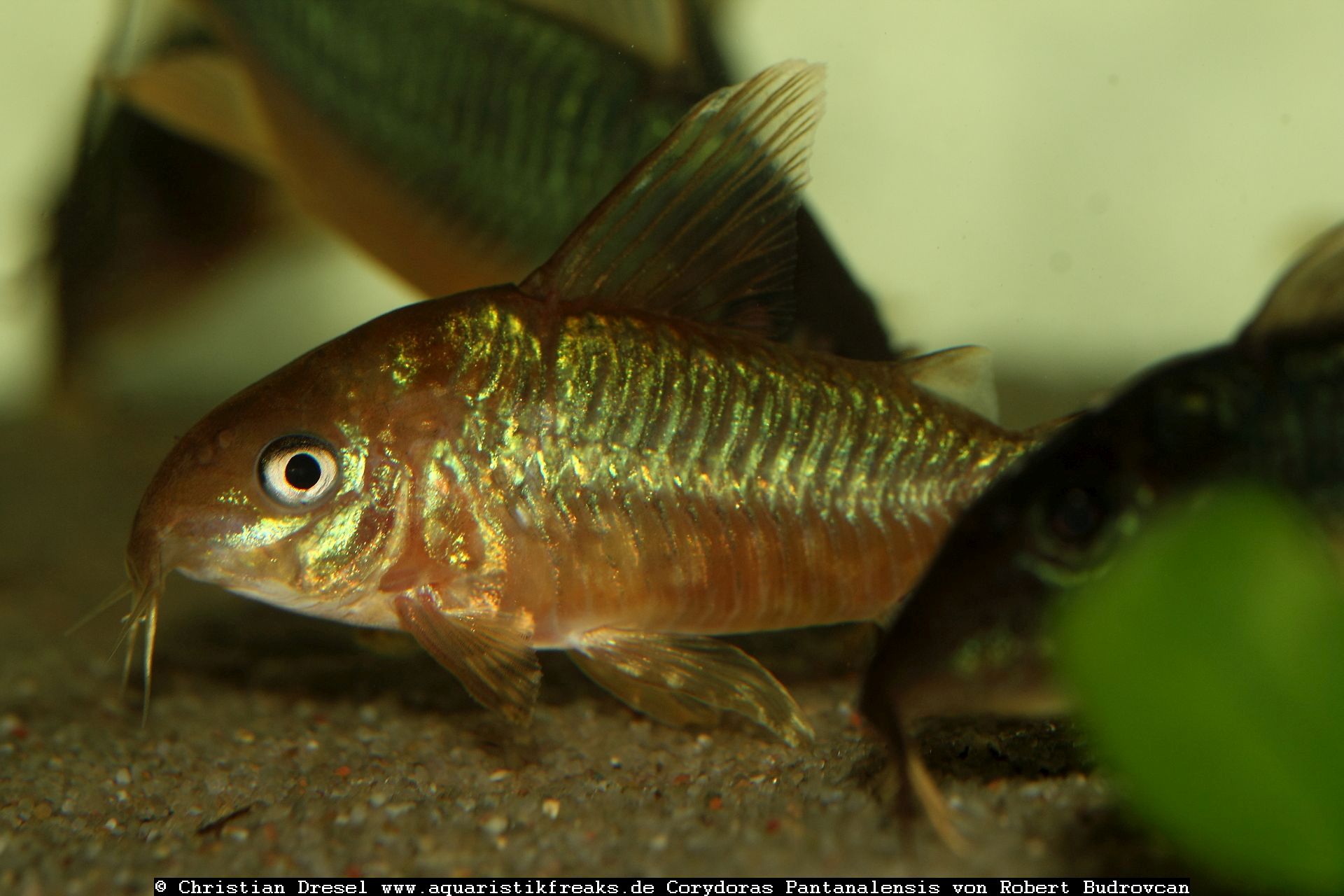
The Pantanal is not the Amazon. Pantanal Corydoras (Corydoras pantanalensis, often listed as Brochis pantanalensis after recent reshuffles) is a wetland fish from the world’s largest tropical swamp, with clear, plant-filled water and seasonal floods — not tea-stained igapó, not a bare sand creek in São Gabriel. If you build it a Negro tank, you have the wrong postcard.
A gold net from a sea of grass
The species was named for the Pantanal. Hobby and field accounts place it in Bolivian and Brazilian wetland drainages including the Cussis and Las Petas systems. Adults are a solid medium cory, often quoted around 6–8 cm, a bit more presence than cruziensis. The pattern is a brilliant reticulation, a golden net over a light body, especially crisp on mature males. It can look superficially like other “network” corys until you remember the geography and the vegetated, clear-water habitat. The snout is the typical cory shovel, not a Farlowella blade.
C005 was the old code. It is not reticulatus from the Ucayali (different country, different mesh story). It is not paleatus from further south, though both can handle water that is not extreme blackwater. It is not a Brochis splendens emerald tank-buster, even when the genus name Brochis gets reused in papers.
Clear water, plants, floods
The Pantanal covers a staggering area of seasonal wetland. Biotopes are often crystal-clear compared with Amazon blackwater, with abundant aquatic plants, soft sand or mud, gentle current, and high oxygen from vegetation. Temperatures run warm. Chemistry is commonly near neutral rather than pH 4. Floods expand the world; dry seasons concentrate fish. In the aquarium you cannot flood a room, but you can plant the tank, keep the water clear, and avoid turning it into a tannin cave unless you like hiding a gold net in brown soup.
A planted sand prairie
This is one of the corys that actually matches the “planted community” people already own. Fine sand, Amazon swords, vallis, cabomba-type stems if you can grow them, open lanes for a group to sift. A 90–120 cm tank is more honest than a 40 litre cube, because pantanalensis is not tiny and because plants plus a shoal need footprint. Gentle flow. Strong lighting for plants is fine if there is shade from the plants themselves. Lid on. Do not use gravel “for the plant roots” in the foraging zone; use sand and put nutrients underneath.
Water for a wetland, not a bog
Temperature 22–28°C; they handle the warm end better than nattereri. pH 6.0–7.5. Soft to moderately hard (something like 5–12 dGH is a published hobby range). Clarity matters because the habitat is clear: you should see the net. That means filtration and plant uptake, not bleach. Zero ammonia. The Pantanal filters pollutants with plants; your glass box does not, unless you do water changes.
A wetland troop
Six or more. They are social, active, sometimes up in the lower water more than a glued-to-the-spot panda. A gold net in a group is the reason to own them. Singles hide in the swords and you will forget you paid for a uncommon cory. Other corys can share a large planted tank; keep pantanalensis in number so the species still exists as a shoal.
Feeding in a planted box

Sinking foods get lost in plant litter. Feed in open sand patches. Frozen bloodworm, granules, crushed flake, occasional vegetable matter. Omnivore. Plants will not feed them. Snails may compete for wafers. Watch one feeding. If you cannot see them eat, you are growing plants and starving catfish.
Neighbours from a vegetated swamp
Peaceful tetras, livebearers that accept similar warmth (the basin is not a livebearer factory, but community overlap happens in tanks), dwarf cichlids, other small characins. Skip large predatory fish. Skip mbuna. A planted Pantanal-style tank with rams and a pantanalensis group is a coherent picture. A discus-blackwater tank is a different picture; they might survive it, but you will not see the net.
Spawning after a flood you fake
Seasonal flood pulse: heavier feeding, then larger water changes. Eggs on plants and glass, no care. Plant cover helps fry survive in the display. Dedicated tanks help more. Do not cross with Ucayali reticulatus because both are “netty.” Geography is not a suggestion.
Health in clear water
You will see problems earlier because the water is clear and the fish is gold. Use that. Barbels still fail on sharp sand. Warm planted tanks still get ich. New C005 should eat in quarantine. Do not dose plant fertilisers in a way that spikes ammonia or metals onto barbels; follow planted-tank sense.
Keep the wetland, not the Amazon cliché
Keep Corydoras pantanalensis because you want a gold-net cory from clear, planted Pantanal water, on sand, in a group. Skip it if you only have a dark botanicals tank you refuse to plant, or if you wanted the Ucayali mesh of reticulatus. The wetland is the habitat. The net is the look. The flood is the breeding hint. That is a different continent of husbandry from Adolfoi, even though both are “corys.”
Clear water is a husbandry choice
Pantanal photographs are green and bright. Recreate that: plants, sand, gentle flow, and filtration that keeps the net visible. Tannin caves hide a gold reticulation you paid for. You can keep a few leaves for foraging texture; you should still see the fish. Warm wetland water grows algae and plants — use that. Swords and vallis are closer to the postcard than a bare sand desert with one stick. When the flood-pulse spawn happens after a big water change, eggs on plant leaves are easier to miss than eggs on glass, so look. A vegetated swamp cory is allowed to use vegetation.
Feed in the open lanes you left on purpose. A gold net lost in the stems is a feeding problem. They will forage as a troop if the troop exists. Six-plus, planted, clear, sandy: that is pantanalensis, not a Negro specialist in a tea-stained box with the wrong name on the lid.
Explore other topics
Dive into more aquarium guides across the site.