

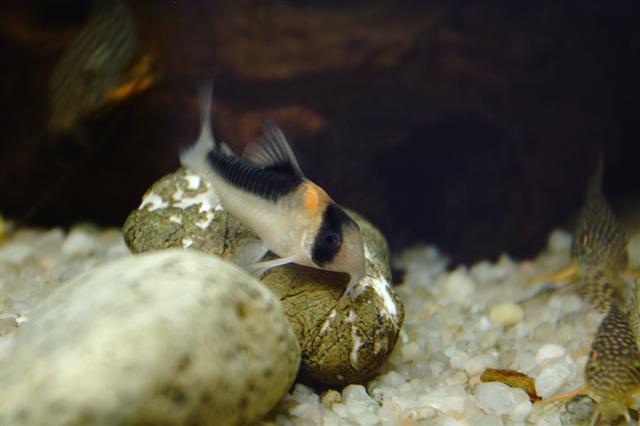
If you already keep Adolfo's Corydoras, you still have not kept Duplicareus Corydoras (Corydoras duplicareus) unless the dark pigment on the back is the continuous kind. This article is about the lookalike that earned a name meaning “double,” not about swapping labels on the same care sheet.
Why the name is a warning, not a joke
Corydoras duplicareus was described because it tracks C. adolfoi so closely that even experienced importers hesitate. Both fish come from Brazil’s Rio Negro basin. Both wear a gold-to-orange blaze on the nape. Both are short-snouted, ivory-flanked, and about 5–6 cm as adults. The difference that holds up in a net is the dorsum: duplicareus carries a darker, more unbroken band along the ridge of the back, so the “night stripe” reads as one mark rather than a mask plus a separate dorsal blotch. That is the fish you should see in the bag. If the back is mostly pale behind the dorsal fin, you are probably holding Adolfoi, and you should not write a duplicareus article in your head while you feed it.
Colour intensity still depends on water and diet. A washed-out duplicareus in hard tap can look like a dull Adolfoi. A well-kept Adolfoi in blackwater can look punchier than a stressed duplicareus. Pattern geometry beats “which one looks nicer today.”
Negro sandbars that are not São Gabriel postcards
Duplicareus is a Negro-basin endemic associated with stained, mineral-poor creeks and the sand that accumulates in their bends. Collectors and field notes place it in the same broader blackwater world as Adolfoi, which is why mixed imports happen. In those creeks the fish does not live as a lone “janitor.” It travels in a foraging party over pale sand, among leaves and submerged wood, darting to the surface for atmospheric air and dropping back before a heron or a larger fish notices the flash.
The practical point for aquarists is that duplicareus is a blackwater sand specialist. It is not a Paraguay-basin long-snout, not a coastal Brazilian cool-water fish, and not a midwater pygmy. If your layout is built for Sterbai in a discus tank, some of the chemistry overlaps; the ID still does not.
Reading the fish in the shop
Look down on the group. You want intact barbels, a smooth ivory flank, a blaze that is gold rather than grey, and that continuous dark dorsal work. Hollow bellies and clamped pectorals mean a shipping problem, not a “shy cory.” Eyes should be clear. Skinny fish with perfect pattern still die after purchase because the Negro trip is hard and they have not eaten.
Captive-bred duplicareus show up less often than farmed Adolfoi or Sterbai. Wild fish can be superb once they eat, but they need a quiet settling tank, not an immediate drop into a busy community with hungry tetras.
A footprint for the twin, not a cube for “one bottom feeder”
Give them length. A 90 cm aquarium with open sand in the front two-thirds lets the troop fan out. Fine, rounded sand is the working surface; they shove their snouts into it. Wood and a few broad leaves create shade without turning the floor into a maze of gravel islands. Gentle filtration, covered intakes, and a lid matter because a startled duplicareus jumps as stupidly as any other cory.
Planting can be sparse. Soft-water crypts, moss on wood, and floating plants that dim the lamps are enough. Bright white LED over white sand makes them sit under the wood all day, which then gets misread as “nocturnal species.” They are not. They are light-shy when the aquascape offers no dusk.

Water that stays poor in minerals
Temperature 22–26°C, pH roughly 5.0–7.0, low hardness. The lower end of that pH range is closer to the creeks; the upper end is a compromise with mixed communities. Do not chase pH 4.0 unless you know how to keep CO2 and respiration stable. Do chase zero ammonia. Vacuum the sand so the bed does not go sour. Large, infrequent water changes that swing temperature and TDS are worse than smaller, matched changes. If you mix RO, add a blackwater or general remineraliser; pure RO is not a habitat.
How a duplicareus troop actually behaves
Keep them as a single-species group of at least six, preferably more if the tank is wide. They forage in contact with one another. Isolated fish wedge into corners and lose weight. You can house them with Adolfoi in a large Negro biotope, but then you must still keep enough of each if you care about seeing species-typical shoals, and you must accept that fry ID will be a headache. Mixing “because they look the same” is how the names stay confused in the next generation of shop lists.
They are peaceful. They will not police a ram. They will not survive a large predatory catfish. They will lose food to energetic barbs. Match them with Cardinals, small pencilfish, and other Negro fauna, or with quiet tetras that share the chemistry.
Rations that reach the twin
Sinking cory granules, frozen bloodworm, grindal worm, and the odd algae wafer as a supplement — not as the meal plan. Feed in several spots. Stay for the two minutes after lights-out if the tetras are pigs. A duplicareus that only gets leftover flake becomes a grey, thin duplicate of itself, which is an ugly pun and a real husbandry failure.
Spawning a fish people cannot name
Condition with extra frozen food. Drop temperature a couple of degrees with a big water change. The T-position spawn deposits eggs on glass and décor. Remove adults if you want a yield. Soft, clean water and methylene blue or alder cones are old tricks against fungus; the real trick is not leaving eggs in a dirty community. Fry are tiny and need fine foods. Do not expect commercial farms to have done this work for you the way they have for bronze corys.
Barbels, ich, and the “identical care” trap
The care overlap with Adolfoi is real: sand, group, sinking food, soft water. That overlap is not a reason to copy an Adolfoi article and change the title. The ID, the dorsal pigment, the import channel, and the likelihood of wild fish are specific to duplicareus. Treat barbel erosion as a substrate emergency. Treat white spots as a quarantine problem. Treat a fish that never leaves the wood as a lighting and stocking problem.
Should you even buy the double?
Yes, if you want the continuous-saddle Negro cory and you can supply blackwater-ish chemistry and a proper troop. No, if you wanted Adolfoi and the shop shrugged. No, if you keep one catfish “for the bottom.” Corydoras duplicareus is a named species because the double is not the original. Keep the names honest and the sand clean, and the twin is as watchable as the blaze fish people fight over.
Explore other topics
Dive into more aquarium guides across the site.