

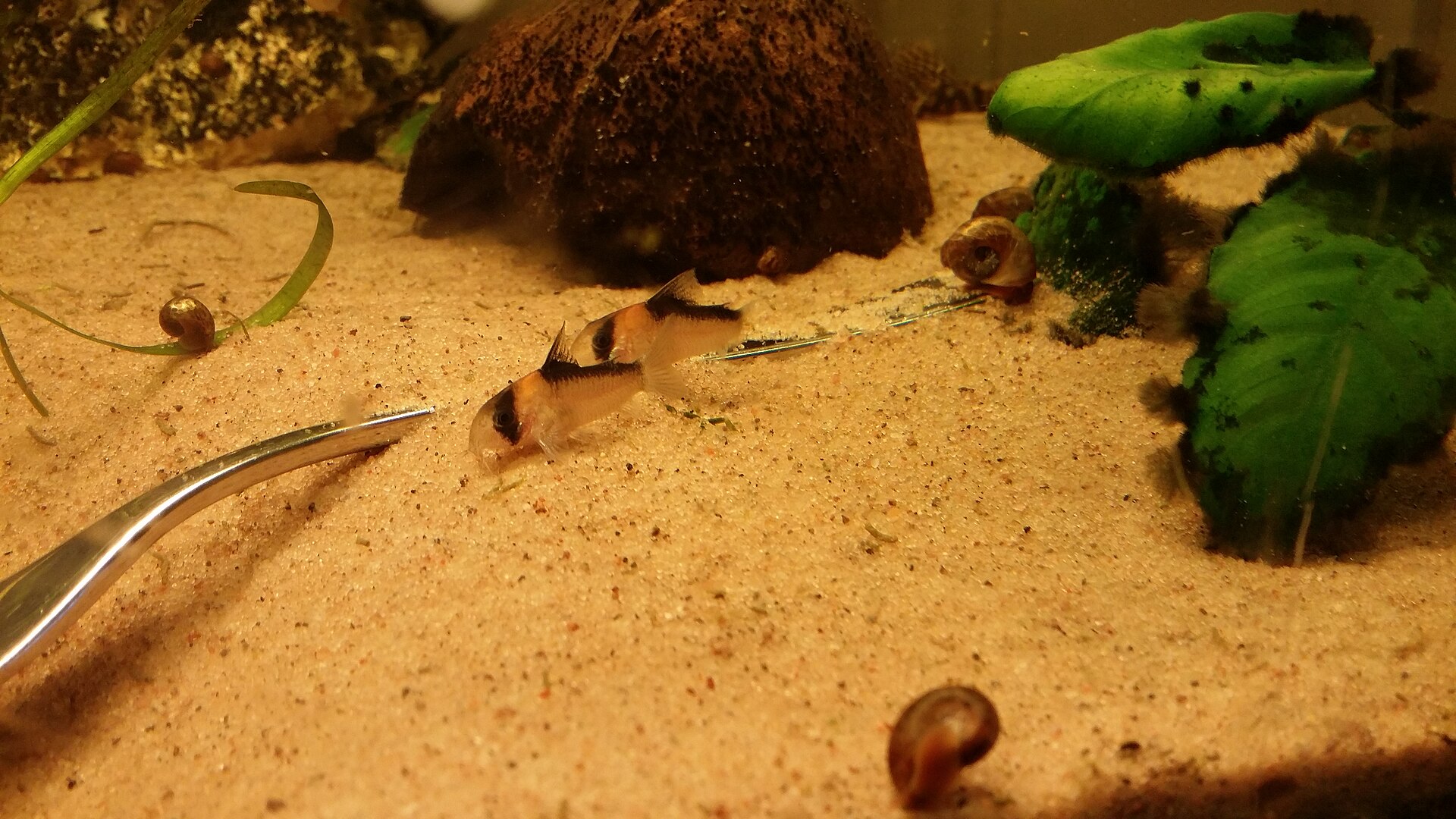
Shops sell a lot of “orange-blaze corys.” Most of them are not Adolfo's Corydoras (Corydoras adolfoi). The real fish is a short-snouted, pale-bodied callichthyid from blackwater sand in Brazil’s upper Rio Negro, with a tight black mask, a gold-to-orange crown on the nape, and a dark saddle under the dorsal fin that does not run as a solid night-stripe all the way to the tail. If you came here because a bag was labelled Adolfoi, read the identification section before you buy a second group.
A blackwater catfish with an orange crown
C. adolfoi was described from the Negro system near São Gabriel da Cachoeira. Collectors take it from shallow, tea-stained creeks where the bed is pale sand, the banks drop leaf litter, and the water is poor in minerals. That is not the same habitat as a whitewater Amazon channel, a Paraguay floodplain, or a coastal Atlantic-forest stream. The orange nape is not a dye or a “colour morph.” It is a species character, brightest on well-fed adults in soft, acidic water and duller on stressed, hard-water fish. The flanks stay cream to ivory. There is no leopard net, no rust wash over the whole body, and no midwater tetra-like silhouette.
Adults reach roughly 5–6 cm. Females look fuller from above when they are carrying eggs. Males stay slimmer and often look slightly more intense in the blaze. Both sexes have the same armour of overlapping bony plates and the same pair of sensitive barbels that they push into the sand. Those barbels are the reason gravel is a bad idea for this species: the fish does not “adapt” to sharp grains, it wears the whiskers down until it cannot forage.
How to tell C. adolfoi from C. duplicareus
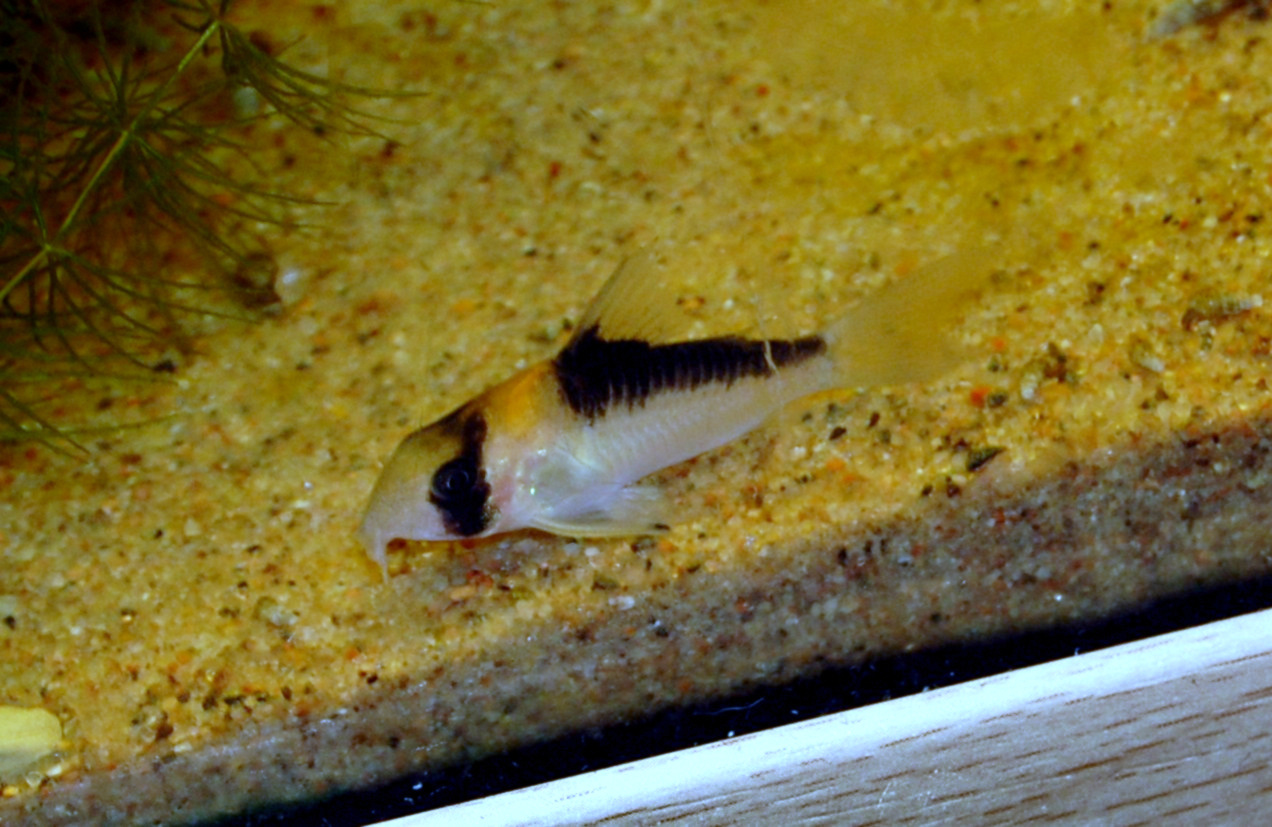
The usual mix-up is with Corydoras duplicareus, a Negro fish that really does look like a photocopy until you stare at the back. On Adolfoi the dark pigment is a mask through the eye plus a separate dorsal blotch; the rest of the dorsum stays relatively pale. On duplicareus the dark mark is more continuous along the ridge of the back, which is why the name means “the double.” Both can show an orange or gold blaze. If a seller cannot tell you which pattern you are looking at, treat the fish as a mixed lookalike group and do not pay an Adolfoi premium.
Other orange-headed corys exist. None of them share Adolfoi’s exact combination of ivory body, isolated dorsal saddle, and Negro blackwater origin. C. weitzmani is a fox-masked Peruvian fish with more colour in the fins. C. rabauti is rusty all over. Do not use “orange head” as a species name.
The upper Rio Negro, not a generic Amazon
The Negro is a blackwater river: dissolved organic matter, very low conductivity, pH that can sit well below 6 in forest creeks, and sand bars that look almost white under stained water. Adolfoi works that sand in small troops, darting up for a gulp of air the way other callichthyids do, then dropping back to sift. Current in those creeks is gentle except after rain. There are roots, branches, and a rain of leaves, but not a wall of Amazon swords in crystal water. Recreating “South America” with hard tap, bright white gravel, and a powerhead aimed at the glass is how this species fades and hides.
Wild fish also live with Cardinal Tetras, pencilfish, and other Negro specialists. That community is useful as a model: small, peaceful, and matched to soft water. It is not a licence to add anything labelled tetra.
Chemistry that actually matches São Gabriel
Aim for 22–26°C. Many keepers sit around 24°C. pH of 5.0–6.8 is the useful window; Adolfoi will survive higher pH for a while, but colour and breeding both suffer if you park it in alkaline tap. Hardness should stay low. If your tap is liquid rock, mix RO or rainwater and remineralise lightly rather than hoping the fish will “toughen up.” Ammonia and nitrite must stay at zero. Nitrate is not a blackwater nutrient; keep it modest with water changes, not with a bare-bottom hospital aesthetic in the display.
Tannins from botanicals are optional cosmetics unless you are chasing a biotope look, but they do no harm if you still test the water. What does harm is a dirty sand bed. Mulm packed around the barbels is a mechanical and bacterial problem, not a mysterious “cory disease.”
Building a sand field under botanicals

Give the group a tank with a long footprint. Height is wasted on a fish that lives on the floor. A 90 cm tank with a few centimetres of fine, rounded sand is more honest than a tall 80 litre cube. Scatter wood so the shoal can pause in shade. Add leaf litter if you like the Negro look; replace leaves as they break down instead of letting them become anaerobic sludge. Plants that tolerate soft water — Cryptocoryne, buoyant floating cover, Java fern on wood — break the light. Cover the filter intake. Adolfoi will dash when startled, and a lid stops a one-way trip onto the floor.
Do not “decorate” with crushed lava or angular gravel “just at the back.” The fish will forage wherever food falls. If the only soft patch is a dinner-plate of sand in the front, you have not solved the barbel problem.
Watching a Negro shoal work the bottom
Adolfoi is a social sifter. A pair looks nervous. Three or four still spend too much time jammed under wood. Six is a workable starting troop; eight to twelve in a bigger footprint looks like the real animal. They move as a loose unit, noses down, then sprint together when something overhead scares them. Daytime activity is normal if the light is not harsh and if they are not the only moving objects on a bright stage.
Solitary “cleaner corys” are a myth this species pays for. One Adolfoi does not polish your glass, does not replace a siphon, and does not behave like Adolfoi.
Feeding when tetras steal everything
This is an omnivore with a small mouth. Sinking granules made for corys, crushed flakes that actually reach the sand, frozen bloodworm, daphnia, and brine shrimp all work. Drop food in several places so the dominant fish cannot monopolise a wafer. If rummy-noses or other midwater fish vacuum the column, feed after the lights ease off and watch the sand, not the surface. Adolfoi will not graze algae into a living. A fat, rounded belly after feeding is the goal; a pinched underside a week later means the community ate the ration first.
Company that belongs in the same water
Cardinals, rummynose tetras, small pencilfish, and quiet Apistogramma that accept Negro chemistry are the obvious neighbours. Other short-snouted corys can share the sand if you still keep a proper Adolfoi group rather than one of each pattern. Skip large cichlids, angels that bully the floor, and anything that treats a 5 cm catfish as food. Loaches that want sand too will compete; that can work in a huge tank and fail in a standard community.
Getting eggs on the glass
Breeding follows the usual cory T-position. Condition the troop on meaty frozen foods, then a larger, cooler water change that mimics a rain pulse. Females park adhesive eggs on the pane, on wood, or on plant leaves. Adults will eat eggs. If you want fry, move the eggs or the parents. Hatch in a few days; first foods are infusoria or very fine fry powders, then baby brine. Soft, clean water matters more than a secret hormone. Hard, dirty water gives fungus, not a “difficult species.”
What damaged whiskers are telling you
Red, truncated barbels are almost always substrate and waste, sometimes with a secondary infection. Fix the sand, the siphon routine, and the stocking before you shop for a bottle. Clamped fins, gasping in the flow, or a fish sitting apart from the troop are water or bullying problems. White specks may be ich, which is ugly on a plated catfish and worse if you crash the temperature. Quarantine new fish in a simple tank with sand and a sponge filter so you can see them eat before they meet your Cardinals.
A last word on buying Adolfoi
Look at the saddle, the blaze, and the belly. Reject pinched fish, shredded fins, and bags of mixed “Nigerian corys” that happen to have a gold nape. Ask whether the group is captive-bred; farmed Adolfoi exist and settle easier than beaten wild fish. Then give them Negro-like water, a real troop, and food on the sand. That is the whole trick. Corydoras adolfoi is not a generic bronze cory in fancy paint. It is a São Gabriel sand-sifter, and it looks like one when you stop treating it as interchangeable.
Explore other topics
Dive into more aquarium guides across the site.