

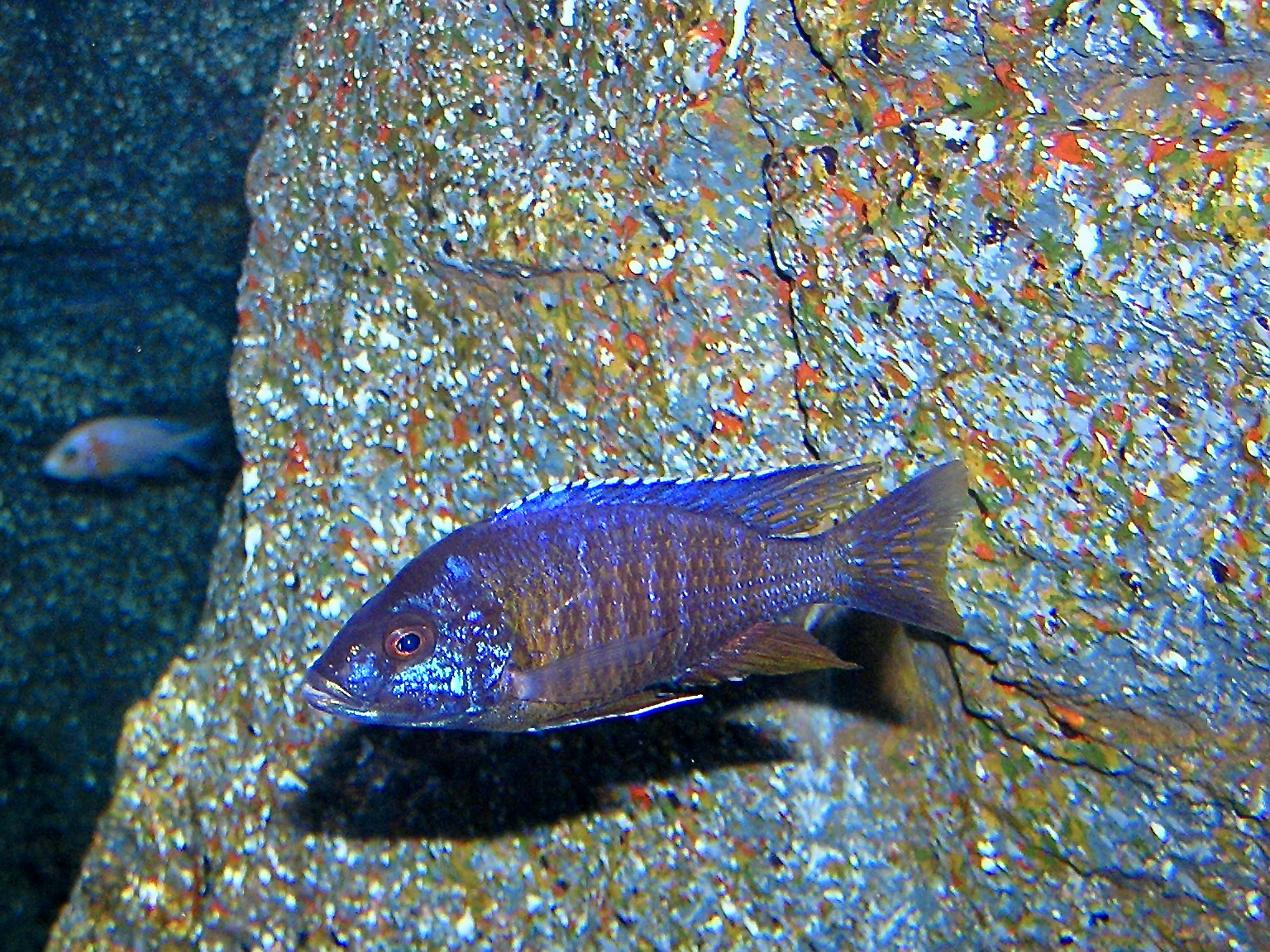
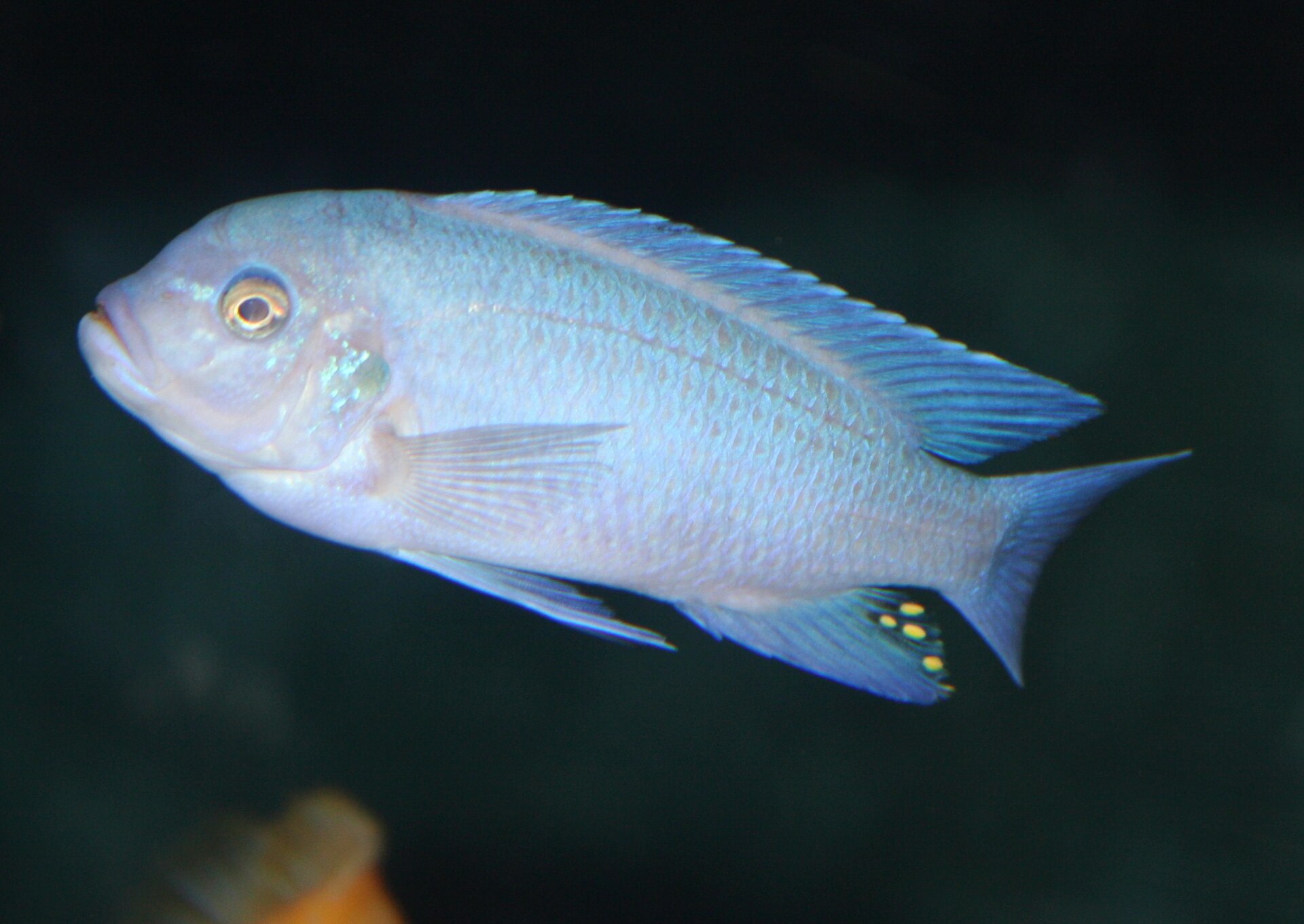
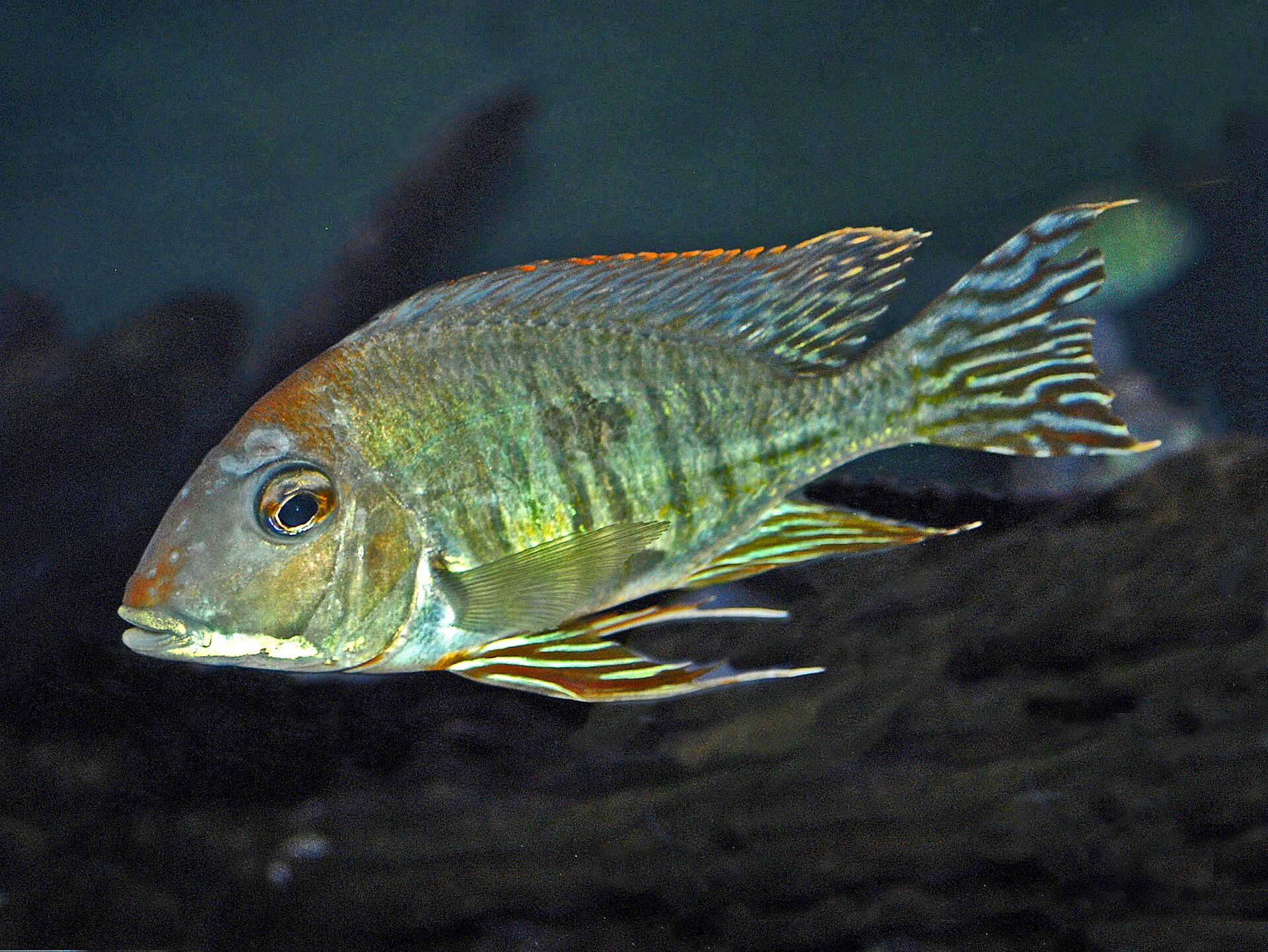
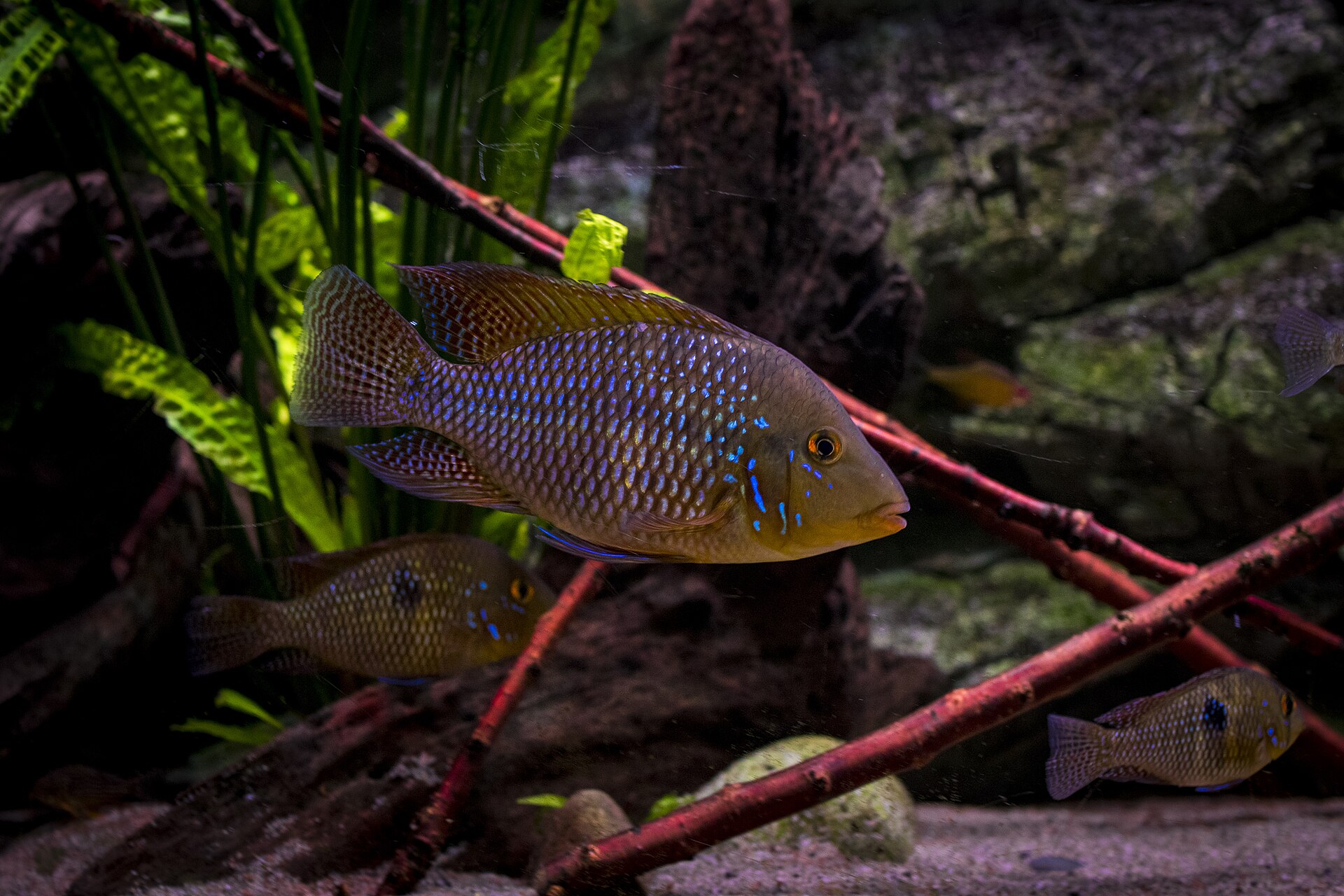
The blue is not a dye. A mature male Sciaenochromis fryeri — electric blue hap, electric blue kande, the fish shops shorten to “EB hap” — is a Lake Malawi predator that wears a uniform of saturated cobalt as a territorial flag. Females and juveniles are silver with faint bars and a few egg-spots on the anal fin. The mismatch fools beginners into thinking they bought two species. They bought a haplochromine with a harem economy and a mouth that will swallow fish a mbuna would only chase.
It lives along rocky and intermediate shores of Lake Malawi, hunting small fishes in the water column and along the rock-sand border. It is not an algae-grazing mbuna. It is not a peaceful peacock. It sits in the hap camp: larger, hungrier, more open-water, still a maternal mouthbrooder, still in love with hard, alkaline water. Older literature mixed it with Sciaenochromis ahli. The fish in the shops with the neon males is fryeri for practical purposes. Care does not hinge on the argument. Care hinges on not putting a piscivore in a tank of 4 cm companions and calling it a community.
Cobalt, silver, and a 20 cm appetite
Males reach 15 to 20 cm, sometimes a little more. The body is elongate for a “cichlid” in the public mind, built to chase. The blue can look fake under LEDs; it is not. Females stay smaller and camouflaged. You want one male and several females, not two males in a 200 litre box unless you enjoy a battered usurper. Egg-spots on the anal fin are part of the mouthbrooding theatre: females peck at them during spawning and take sperm with the eggs.
Malawi water, with swimming room a mbuna pile does not give
Two hundred litres can hold a small harem if you are disciplined; 300 litres and up is more reasonable once the male is full size. Provide rock structure for females to break line of sight, and open water for the male to patrol. Sand on the bottom. No sharp piles that will collapse. Temperature 24 to 28°C. pH 7.6 to 8.6. Hardness high. If your tap is soft and acidic, you remineralise for Rift Lake fishes or you do not keep this hap. Salt is not a substitute for carbonate hardness. Malawi salt mixes exist; use them as directed, not as a dump of table salt.
Filtration should be strong. Haps eat meaty foods and produce a cloud if you are sloppy. They like oxygen and a current they can sit in. They do not like a dark, tannin Amazon scape. Bright, clear, mineral water is the aesthetic and the chemistry.
He will eat the dither fish. That is the job.
Diet in the lake includes small fishes. In the tank, quality hap pellets, frozen krill, mysis, prawn, and similar items keep the blue. Spirulina-only mbuna food is the wrong staple; this is not Tropheus. Too much bloodworm as the only item is also wrong. Rotate. Feed what they finish. A fat male looks impressive until organs fail.

Do not keep them with tiny schoolers, with shrimp, or with fry of other cichlids you hoped to raise in the same box. They will hunt. Suitable tank-mates are other similarly sized Malawi haps and peacocks in a large tank, with caution about male-male colour wars, and robust catfish that occupy the bottom. Aggressive mbuna can shred the hap’s fins and stress females. Ultra-peaceful, tiny peacocks can be bullied or eaten depending on size. This is an intermediate-to-advanced Malawi stocking problem, not a “add one blue fish” problem.
A harem, a mouth, and three weeks of babysitting
Maternal mouthbrooder. The male displays, quivers, shows the egg-spots. The female takes eggs and broods for about three weeks. She eats little. A holding female should be able to hide from constant male harassment; that is why you have rocks and extra females. You can strip the female (remove fry from the mouth) at 18 to 21 days if you know how, or you can let her release in a nursery. Stripping without skill injures fish. Letting her release in the display feeds the male. Pick a method and a tank.
Do not house one female with one male in a small tank. She will be driven without rest. Three or more females is the social minimum.
When the blue goes dull
A male that loses colour is losing status, fighting a parameter swing, or getting sick. Malawi bloat is less classic here than in herbivorous mbuna, but dirty water and a terrible diet still kill. Ich is ugly on blue. Quarantine new Malawi fishes; they ship from crowded holding systems. Look for popped eyes, bloating, and a male that hides in a cave all day — haps that hide like mbuna are not comfortable haps.
Hybrids exist because people dump “blue” Malawi cichlids together. If you care about S. fryeri as a species, do not mix it with other Sciaenochromis or with random haps that will spawn on the same sand. The shop will still call the grandchildren electric blue. The lake will not recognise them.
The blue is a warning colour you invited in
Keep this hap if you already understand Lake Malawi chemistry, you can offer a harem and a long tank, and you do not need small, pretty dither fish in the same water. The male is one of the most intense blues in freshwater. The price is a piscivorous, polygynous cichlid that will not apologise for a 5 cm tank-mate. Sciaenochromis fryeri is honest that way. The electric part of the name is the colour. The hap part is the rest of the animal. Both have to fit your tank, or neither should.
A male in full colour, circling a sand patch, females at the rock line, water like liquid glass at pH 8.2 — that is the picture. It is not a community postcard. It is a slice of Malawi that happens to fit in a large glass box if you let it be a predator. Let it, or leave the cobalt on the other side of the shop pane.
Explore other topics
Dive into more aquarium guides across the site.