

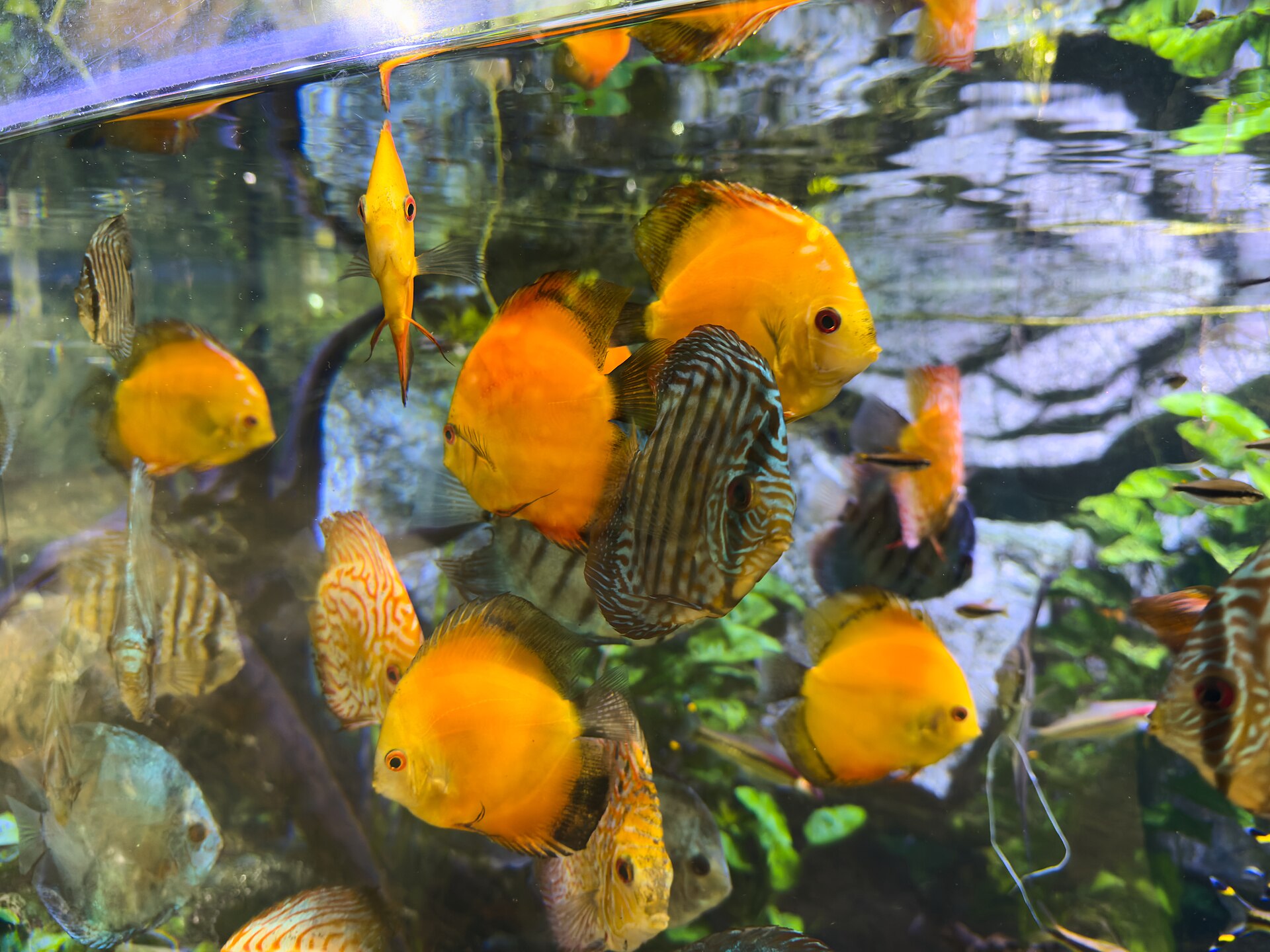
Heat is not a preference for discus. It is the climate the fish is built for. Symphysodon aequifasciatus, the green or blue discus of the Amazon’s quieter, forest-flooded waters, comes from a world of 28 to 31°C, tannin, and parents that feed their fry on body mucus. If you cannot hold that warmth steadily, with water cleaner than most community tanks ever see, this is the wrong cichlid. There is no workaround involving a pretty picture and a heater on 24°C. At 24°C a discus is a compromised animal, even if it lives.
Wild fish are still collected; farmed strains (pigeons, snakeskins, red turquoises, and an industry of names) are what most shops sell. Farmed discus are often more tolerant of hardness than their grandparents, which has been used as an excuse to keep them in ordinary tap at ordinary temperatures. The tolerance is real. The excuse is lazy. They still want warmth, frequent water changes, and a diet that is not leftover flake.
A disc that is a cichlid, not a decoration
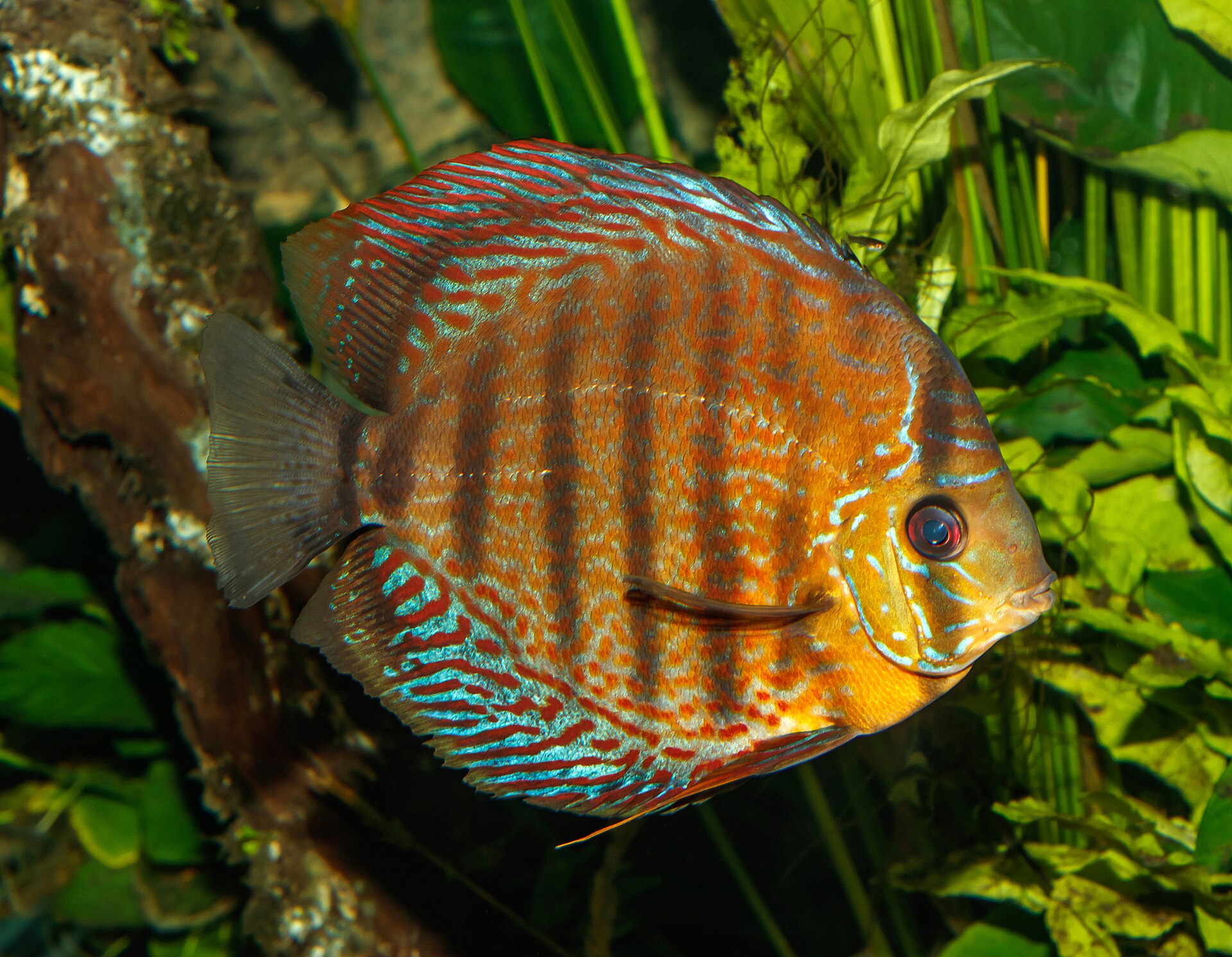
Adults reach 15 to 20 cm in diameter, sometimes more in heavy farmed fish. The body is compressed into a plate, the mouth small, the eye red in many lines. Vertical bars show in wild-type and in stressed fish; they wash out in some fancy morphs. Sexing is nearly impossible until they pair. Females may have a blunter genital papilla. In practice you buy a group of six or more juveniles, grow them in a tall tank, and wait for a pair to occupy a vertical slate. Removing extras is how you get a breeding pair without a coin toss.
The tank is a warm, tall, boring miracle
Two hundred litres for a group of young discus is a floor; 300 litres and up is more stable. Height matters because the fish is tall. Bare-bottom tanks exist in breeding rooms because they are easy to siphon. Planted, wooded tanks exist in living rooms because they are beautiful. Both can work if the water is warm and the maintenance is serious. Sand, botanicals, and wood suit the species aesthetically. A bare tank with a sponge filter suits the species bacteriologically if you are breeding. Pick a lane and clean it.
Temperature 28 to 31°C. A heater failure is an emergency. A second heater, or at least an alarm, is sanity. pH 6.0 to 7.0 for wild-type and for breeding; many farmed fish accept up to about 7.5 if hardness is stable. Soft water is traditional. Sudden pH swings are deadly. Reverse osmosis with remineralisation gives control; untreated hard tap gives you a fight. Nitrate should stay low, well under 20 mg/L if you can, because discus sit in the water like lungs with fins. Change water often. Large, matched-temperature changes are the actual “secret” in every old discus book.
Flow should be gentle. They are not river racers. Oxygen still has to be high because warm water holds less of it; do not confuse gentle flow with a stagnant soup. Surface agitation without a whirlpool.
Food that matches a mucus-feeding parent
The old beef-heart mixes grew discus and also grew filthy tanks. Modern keepers use high-quality discus granules, frozen beef-heart as a limited item if at all, frozen mysis, bloodworm from trusted sources, and extra vitamins. Feed small amounts several times a day, especially for juveniles. A discus that fasts for a week is a discus heading into hexamita. They are shy eaters if fast tank-mates are present. A species tank, or a tank with equally slow, warm-water companions, is how they stay plump.
Garlic, pepsin, and a hundred additives have cults. None of them replace warm, clean water and enough food. If the fish eat and the water is excellent, colour comes. If they hide and the bars stay up, the tank is wrong.

Who may share 30°C
Classic companions are few: small, peaceful, warm-water fishes that will not nip the discus and will not steal every meal. Many keepers use a species-only tank and are happier. Large angels overlap in shape and sometimes in aggression; a mixed angel-discus tank can work in huge volumes and fail in average ones. Avoid anything that needs cool water, anything nippy, anything that requires hard, alkaline chemistry, and anything that treats a slow disc as a target. Avoid most Central American cichlids entirely. Avoid mbuna as a thought experiment you will not run.
A group of discus has a pecking order. The lowest fish can be starved in a too-small tank. Six in 200 litres is tighter than six in 400. Watch the thinnest fish.
Mucus, slates, and the part that still looks like science fiction
A bonded pair cleans a vertical surface, lays eggs, and fans them. When the fry hatch and become free-swimming, they graze a secretion on the parents’ flanks. That is not optional folklore. It is how discus fry start. You can raise fry on extra foods in a hatchery, but the natural system is the pair and the mucus. Both parents take turns. If one parent eats the eggs, try again, improve water, reduce disturbance. Breeding is easier in a dedicated room than in a living-room display, because you will be changing water constantly and you will not want a coffee table in the way.
Do not expect a shop pair. Expect a group, time, and a spare tank.
Hexamita, holes, and the reputation
Discus are not dying because they are cursed. They die because they are kept too cold, too dirty, too hard-changing, and too hungry, then medicated in a panic. White stringy faeces, a dark fish hiding in the corner, and a refusal to eat are a cluster that often involves intestinal flagellates plus bad water. Fix temperature and changes first, then treat with a plan, not with three bottles at once. Hole-in-the-head is the long version of mineral, nutrition, and dirt problems. Quarantine new discus for weeks. They can carry issues that explode when they hit a warm display full of your existing group.
Gill flukes are common in farmed fish. Flashing and clamped fins in warm water: microscope if you have one, a fluke protocol if you do not. Ask a discus-keeping community rather than a general shop if you can.
If you can hold the heat
Then Symphysodon aequifasciatus is still the freshwater fish that looks like it should be saltwater, hovering in a tea-coloured column with its young on its side. If you cannot hold the heat, the changes, and the feeding rhythm, there are a hundred cichlids that will give you colour at 25°C. This one is a specialist. Treat it as a specialist and it is keepable. Treat it as a fancy community accent and it will do what discus have done for decades in the wrong tanks: fade, stripe, hide, and die while the test kit says nitrite is fine.
The mucus feeding is the reminder. You are keeping a fish whose parenting is chemistry. Your parenting of the tank has to be chemistry too. Warm, clean, often changed, and fed. That is the whole discus hobby, wearing a round body.
Explore other topics
Dive into more aquarium guides across the site.