

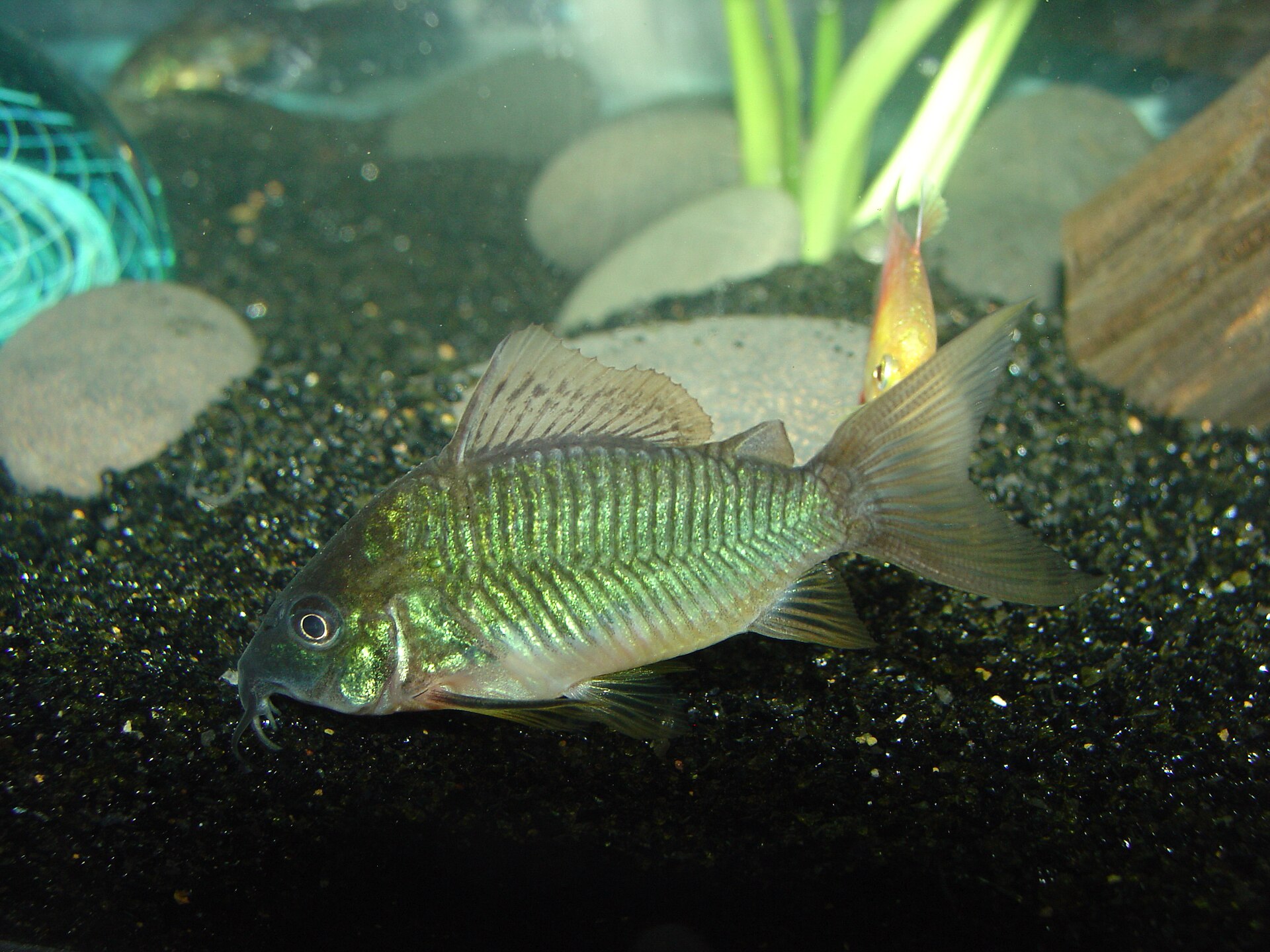
Call it emerald cory if you want a search term. In the tank, Emerald Brochis (Brochis splendens, also listed as Corydoras splendens depending on the paper you last opened) is a high-backed, metallic-green catfish that outgrows pandas, out-eats them, and carries extra dorsal-fin rays that old-school aquarists used to separate Brochis from typical Corydoras. It is still a sand-sifting callichthyid. It is not a 5 cm spotted dwarf, and it is not a loricariid.
Green armour, extra rays, real bulk
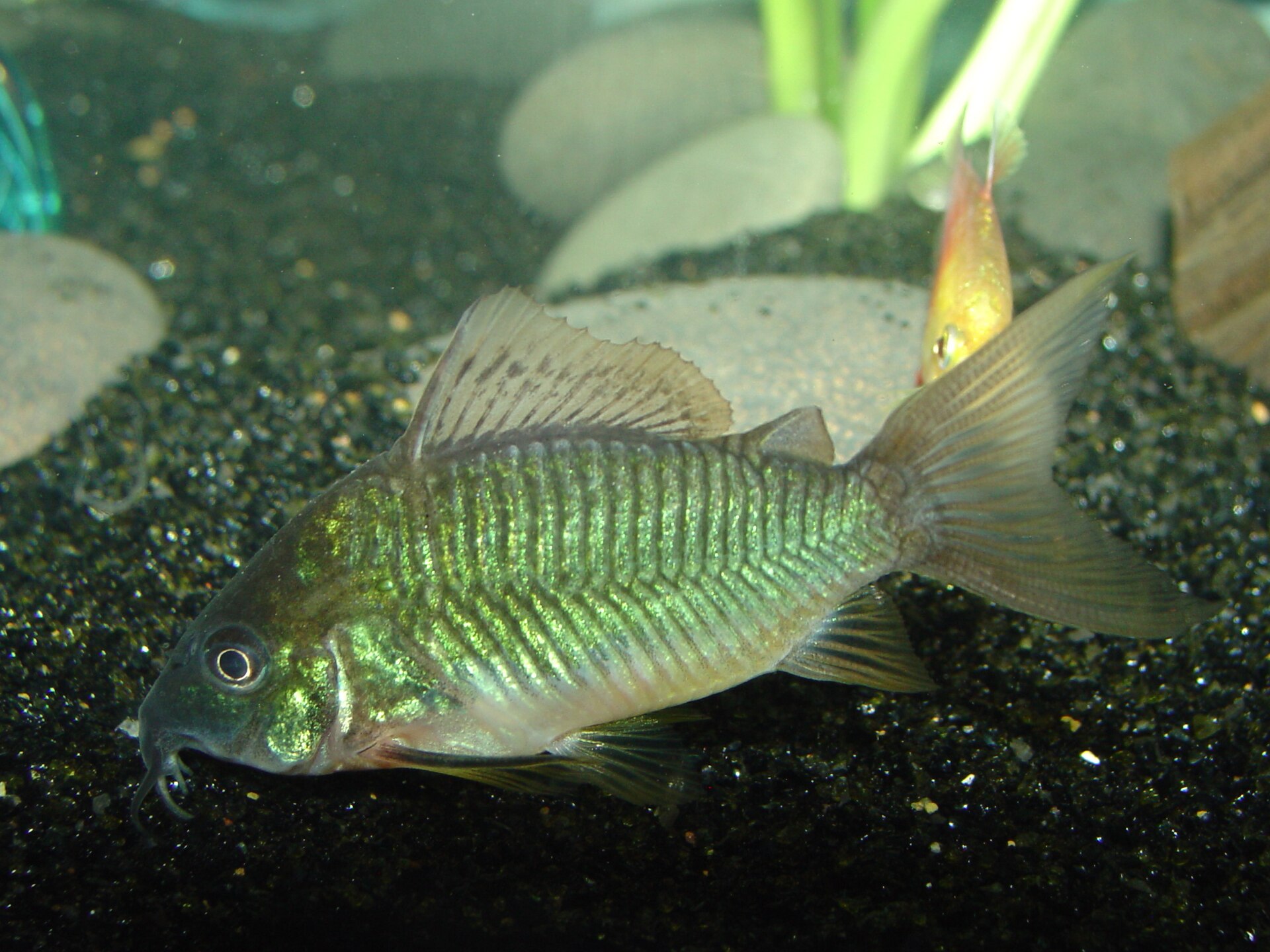
Adults commonly reach 7–8 cm, with big females looking even more substantial. The body is deeper than a bronze cory’s, with a steep forehead and a live emerald to olive iridescence over the flanks. Under cheap LEDs they can look muddy brown; under decent light they flash green. The belly is paler. Fins are mostly unmarked. The snout is moderately short to intermediate — they shovel sand with authority. Count dorsal rays if you like anatomy: Brochis-types have more than the usual six to eight of a classic Corydoras. You do not need a count to notice that this fish is simply bigger in the hand.
It is not C. aeneus with a green filter. It is not C. pantanalensis (gold net, wetland). It is not a “green laser” farm tetra. Juveniles in shops look like chubby olive corys; the emerald and the shoulder come with growth. Buy for 8 cm, not for the 3 cm in the photo.
A wide Amazon, not a creek specialist
B. splendens is widespread in Amazonian lowlands across Peru, Brazil, Ecuador, Bolivia and neighbouring water. That wide map is why it is more adaptable than a Negro endemic and why wild origins vary. Habitat is still sand, wood, tropical temperatures, and group foraging. It is a floodplain and tributary generalist, not a hillstream, not a Congo river, not a Panama mountain stream.
In nature they travel in serious numbers. A pair in a 60 litre community is a parody of that.
Tank size is the first Brochis rule
This is where people fail. They buy “corys,” get splendens, and park six fish in a tank sized for pygmies. Give them a 100–120 cm aquarium if you want a proper group plus tetras. Fine sand in quantity — they plough. Stronger waste production than a panda group: filter accordingly, but do not aim a canister jet at the floor. Wood for shade. Plants if you can protect them from rooting; they will rearrange sand around sword plants. Lid on; large corys jump. Prefilter sponges, because they kick substrate.
Height is less important than length and a calm floor. A tall column is tetra space. Brochis live in the bottom third.
Water for a green tank-plough
Temperature 22–27°C. pH 6.0–7.8. Soft to moderately hard. They tolerate community tap better than Adolfoi and still punish neglect. Warm plus dirty is barbel death. Because they eat more, they pollute more; water changes are not optional decoration. Oxygen and surface movement help, especially if you keep them on the warm side.
A herd, not a pair of emeralds

Six is a cramped minimum for this species; eight to twelve in a long tank is when the green herd makes sense. They bustle, shove each other politely, and forage like pigs in a good way. Isolated splendens hide and lose the metallic sheen. Mixing with small Corydoras works in huge tanks if you feed enough; in small tanks the Brochis vacuum the food and the pandas starve. Decide who the tank is for.
Appetite
They are omnivorous and greedy. Sinking pellets, frozen bloodworm, chopped earthworm, vegetables as a side (blanched courgette), quality flake that reaches them. Feed more than a pygmy ration and still avoid leftovers rotting. Two small feedings beat one feast. They will eat fry of other fish. They will not eat algae into a clean tank. A skinny Brochis is a red flag; a grossly overfed one in a dirty tank is the other red flag.
Who can live upstairs
Larger tetras, peaceful barbs of suitable size, gouramis, angels in big tanks, other size-matched catfish that are not predatory. Avoid tiny pygmy corys unless the footprint and feeding plan are excellent. Avoid anything that hunts 8 cm fish. Avoid mbuna. Discus plus Brochis can work if the Brochis get sinking food after lights dim.
Breeding a bigger callichthyid
Same T-position, bigger eggs, hungrier adults. Condition hard, then a rain pulse. Eggs on glass and décor. Remove parents or eggs. Fry grow faster than pygmies and need more food and more water discipline. Captive breeding happens but is less industrial than aeneus. Do not assume a green juvenile is splendens without checking the back and the eventual size.
Barbels on a plough
They work the sand harder, so gravel destroys them faster. Infections take hold on damaged tissue. Ich happens. Because they are popular, they are often added to uncycled tanks as “cleaners.” They are not cleaners. They are green pigs that need a cycle. Quarantine still applies.
Emerald is a size class
Keep Brochis splendens because you want a metallic-green, high-backed Amazon callichthyid that lives as a hungry herd on sand. Keep pandas if you wanted small and cute. Keep sterbai if you wanted orange spines and polka dots. The extra dorsal rays are the old genus clue. The bulk is the husbandry. The green is the reward when the light and the diet are right. That is not a Corydoras adolfoi article painted emerald.
Green that depends on light and a full gut
A hungry Brochis is olive mud. A well-fed one under a decent lamp is emerald. That is not a morph; that is physics and fat. If your fish never flash, check diet first, then light, then whether you actually have splendens or a dull aeneus. The high back and the extra bulk should already have told you. They will root plants. They will kick sand into the filter. They will eat a wafer and look at you for another. That appetite is why the tank must be larger than a panda tank, and why the water changes must be real. A green herd is a bioload. Treat it as livestock, not as jewellery that happens to eat.
Explore other topics
Dive into more aquarium guides across the site.