

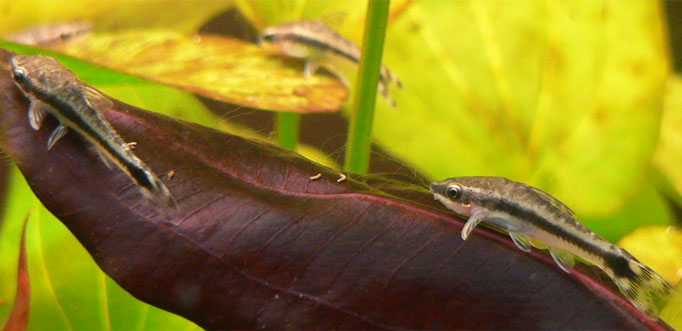
The corpse in the filter intake is usually an oto that starved, not one that “couldn’t handle the water.” Otocinclus vittatus is a small loricariid from South American drainages that lives on biofilm. It is sold as an algae eater for brand-new tanks. That sentence has killed more O. vittatus than any disease. They need an established aquarium, a group, and surfaces that actually grow the film they scrape. A sterile scape and a cucumber on Wednesday is not a habitat.
There are several similar otocinclus in the trade. Otocinclus vittatus is a striped species; identification to species is often sloppy at retail. The care below is for a small, peaceful, schooling oto of this type. If you have a giant “oto” that is actually a juvenile pleco, you have a different problem and a different adult size.
Where the film is the food
Otocinclus vittatus is reported from Amazon and Paraguay basin waters — slow, vegetated, often clear or slightly stained, with plants, wood, and leaf surfaces covered in aufwuchs. They do not hunt flakes in the water column. They rasp. In the wild that rasp is constant. In a week-old aquarium there is nothing to rasp. They eat their reserves, sit on the glass, and die.
Copy the habitat: mature plants, wood, maybe a light botanicals, gentle flow, a group of six or more. Sixty litres can work if the tank is old and planted; the litre count matters less than the biofilm acreage and the company of their own kind.
A pencil with armour and a stripe
Adults are around 4 cm. A dark lateral stripe, a pale belly, a small suckermouth. They are delicate in the hand and surprisingly tough in the right tank. Sexing is subtle: males slimmer, females fuller, genital papilla differences if you are breeding. For most keepers, buy a group and do not obsess. They school loosely on surfaces rather than in midwater like tetras, but a single oto is a stressed oto. Buy six. Ten is better in a larger tank.
Healthy fish have full bellies — a slight convexity, not a concave knife-edge. Shop stock is often already starving. Look from below if you can. Hollow fish may still recover in a mature tank with extra food, but they are a gamble.
The tank must already be alive
Do not add otos to a cycle. Do not add them to a tank you bleached last month. Wood, plant leaves, and even the glass should have a hint of film. Bright light plus plants plus a little nitrate from a working system grows that film. You can supplement with blanched zucchini, cucumber, and wafers made for otos and ancistrus, but supplement means extra, not instead.
Sand or fine gravel. Plants they can sit on — they love the underside of sword leaves and the faces of Anubias. Flow gentle to moderate; they will sit in a current on a leaf, but a powerhead that strips every surface clean also strips their pantry. Sponge filters are ideal because they grow film and do not suck the fish in as easily as an uncovered intake. Cover intakes anyway. A lid helps; they are not maniac jumpers but they will find a gap.
Soft, clean, and not new
Temperature 22–26°C, pH 6.0–7.5, soft to moderately soft water. They are more sensitive to water quality than a bristlenose. Ammonia and nitrite at zero is non-negotiable. They gasp and die in a dirty tank faster than the neon tetras you bought them to “clean up after.” They do not clean up after. They eat algae and biofilm. Your leftover food is still your problem.

CO2 injection in a high-tech planted tank can be lethal if it crashes pH or if they sit in a CO2-rich dead zone. Many otos live in planted tanks, but the gas must be managed. If you are new to CO2, add otos after you are stable, not during the week you are learning to count bubbles.
Weekly water changes with matched, dechlorinated water. They dislike sudden hardness and temperature swings. Drip acclimate from the shop; their water is often different from yours, and they are already tired.
Wafers are backup, not the biome
Every day they should be able to graze. Offer a small veggie wafer or a slice of blanched vegetable in the evening if the glass is too clean. Remove uneaten vegetable before it fouls. Some keepers keep a “biofilm box” — an extra light on a spare tank of water and rock — and rotate rocks in. That sounds obsessive until you watch a group thrive. Frozen food is not their staple; they may pick at leftover brine shrimp but they are not carnivore catfish.
A fat oto has been grazing. A thin oto is an emergency: add vegetables, reduce competition from hungry plecos and snails that beat them to wafers, and check whether the tank is simply too clean.
Peaceful, and still not a janitor
They are among the gentlest catfish you can keep. They belong with small tetras, rasboras, shrimp, and other quiet South American fish in soft water. They do not belong with cichlids that rasp the same surfaces or with large greedy plecos. They do not belong in a goldfish tank. A group is the stocking. “Two otos for algae” is how you get two dead otos.
Shrimp and otos can share a mature planted tank. Snails will compete for wafers; feed enough that the otos get some, or the snails win.
Breeding when the tank is a jungle
They have been bred in heavily planted, mature aquaria. Eggs are scattered or placed on plants; there is no parental care to speak of. Fry need biofilm — which is why it happens in old tanks and not in breeding vats of bare glass unless you are set up for infusoria and very fine foods. If you see tiny otos, congratulations. Do not siphon them. Most keepers never see fry and still succeed at keeping the adults, which is the actual goal.
Acclimate, then wait before you judge algae
Drip acclimate. Quarantine if you can in a mature, planted hospital tank — a bare tub is a death box for this species. Watch for the classic oto crash: they look fine for three days, then all die. That is starvation plus shipping stress plus new-tank syndrome stacked. Prevention is an established display and a group that arrived with bellies.
Ich and fungal issues happen; medication in a tank full of plants and shrimp is messy. Clean water and food prevent more than copper cures. Otocinclus vittatus is not a starter algae solution. It is a small grazing catfish for a tank that already looks a little dirty at the edges. When you can say that and mean it, the stripe on the glass is a living fish, not a future clog in the impeller.
Explore other topics
Dive into more aquarium guides across the site.