

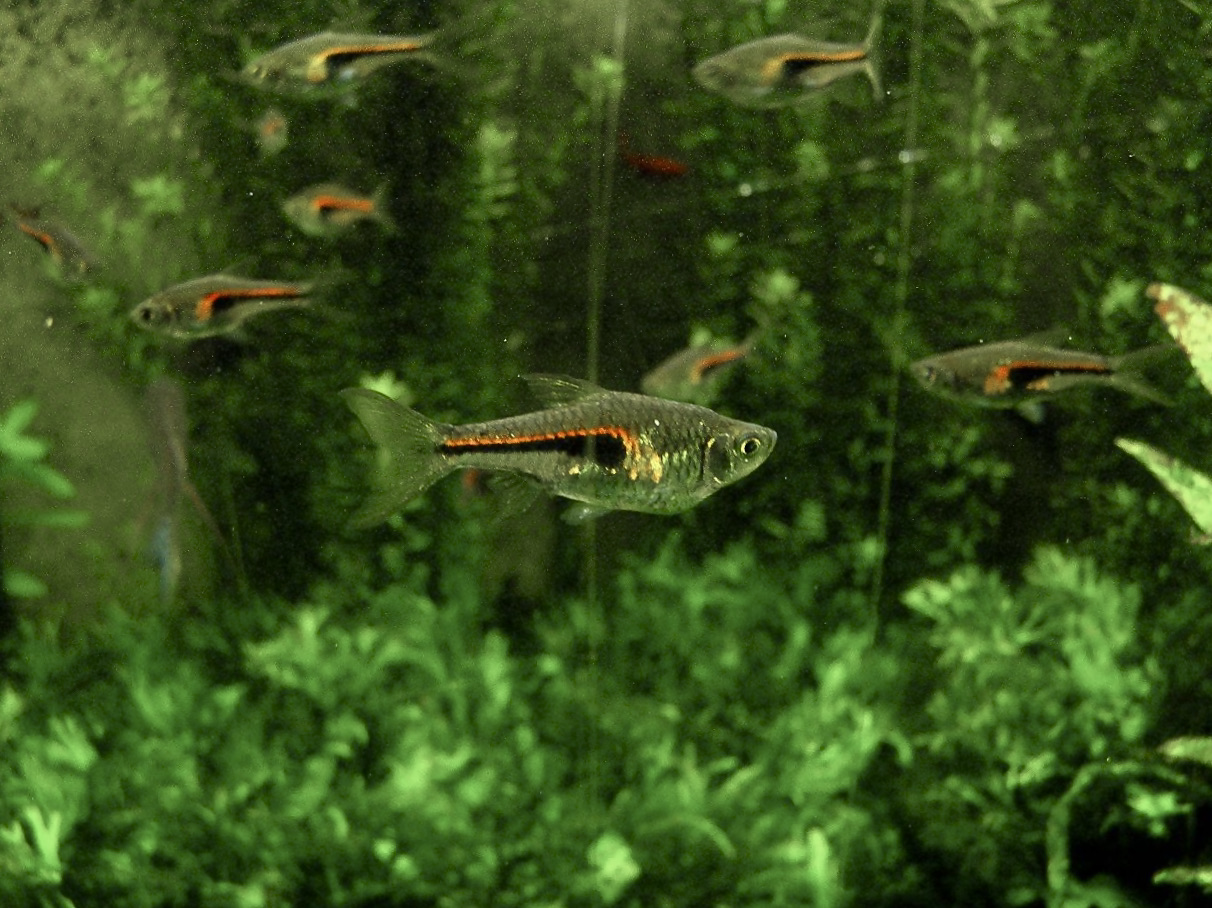
The glowlight rasbora is the fish people buy when they wanted a harlequin but fell for a slimmer, more golden wedge. Trigonostigma hengeli stays about 3–4 cm, schools in the middle of planted water, and shows an orange to copper “glow” along the rear body that is easy to wash out with hard tap and a noisy filter. It is a true Trigonostigma, not a Boraras, which means the tank is a forest stream with room to mill, not a 30 litre peat teacup.
If your mental model is chili rasbora, you will under-size the group’s swimming lane and over-stain the water. If your mental model is a 12 cm river rasbora, you will blow this species around with flow it does not use in Sumatra. Sit between those two mistakes.
Sumatran forest water, lightly stained
T. hengeli comes from Sumatra and nearby drainages, from shaded forest streams rather than the deepest peat cups. The water is still soft and often tea-tinted, but there is more open volume among roots and marginal plants than in a Boraras swamp. Current is moderate at most. The fish use the midwater, turning as a school when something moves on the bank.
That is the aquascape to steal: broken light, plants, a bit of driftwood, fine substrate, and a clear swimming path. Blackwater botanicals help, but you do not need to run pH 4.5 unless you are chasing a look. Many captive-bred glowlights colour well from pH 5.5–6.8 in mature planted tanks.
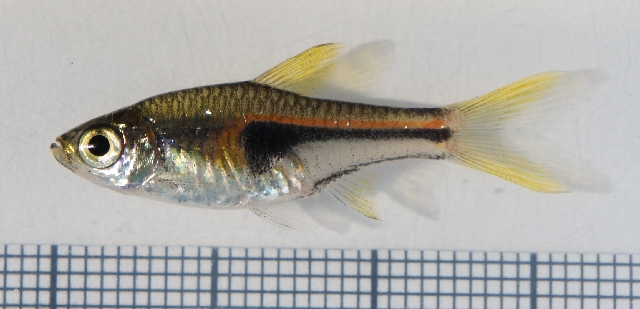
The wedge, not a neon stripe
Harlequin rasboras (Trigonostigma heteromorpha) carry a bold black triangular patch. Glowlights carry a warmer, more luminous rear body with a less heavy black mark — a living ember rather than a ink stamp. In a group of eight or more, the effect is a moving highlight, not a single show fish. Males are typically slimmer; females look fuller when in spawn condition. You will not get discus-red out of this species. You get gold, orange, and a clean, small cyprinid silhouette.
Shop lighting lies. A stressed glowlight in a bare holding tank looks like a dull straw-coloured minnow. The same fish in a planted tank with tannins and a crowd looks like a different species. Buy a school, not two “sample” fish to see if you like them.
Sixty litres with a lane, not a nano cube
A working school wants 60 litres or more. Length beats height. Plant the ends and the back. Leave the centre open enough for a school to turn. A 30 litre blackwater cube that is perfect for Boraras maculatus is cramped for a Trigonostigma that actually wants to swim. Gentle filtration, a lid (they can jump when spooked), and floating plants to knock the light down are the hardware list.
Wood is useful as shade and as a place for biofilm, not as a cave system. Do not stack rift-lake rock. Do not add shells. This is a Southeast Asian planted tank. Sand or fine gravel is fine; sharp coarse gravel is not, because they will pick at the bottom for leftover food.
Soft, warm, stable — not liquid rock
Temperature 23–28°C. pH 5.0–7.0, with the prettier fish at the softer end. Hardness should not be high. Ammonia and nitrite stay at zero in a cycled filter; if they do not, you do not add 3 cm fish. Glowlights are more forgiving than wild peat Boraras, which is why they show up in community lists, but they still fade and pick up ich when parameters swing.

Water changes should be regular and matched. A planted tank will eat nitrate, but it will not save you from a clogged filter. If you use RO, remineralise to a gentle soft-water recipe, not a Tanganyika salt mix. If you need the chemistry primer, use the chemistry basics article and then cycle properly with the cycling guide.
Flakes they can actually swallow
Diet is omnivore: quality micro pellets or crushed flakes, plus frozen or live daphnia, baby brine, and cyclops. They will rise in the water column for food. They are not surface specialists like hatchetfish, and they are not sand-sifters. Feed amounts the school finishes. In a community, feed in two spots so the glowlights get a share before danios vacuum the surface.
Colour improves on a mix of prepared food and small frozen invertebrates, not on a diet of leftover algae wafers. They do not need vegetable matter the way a Uaru does. They need frequent, small meals.
A peaceful school that still needs a school
Keep eight or more. Four fish will hide and look ill. Compatible tankmates are other peaceful, similarly sized Southeast Asian fish: harlequins if the tank is large enough for both schools, small rasboras that are not 2 cm prey, peaceful loaches that will not outcompete them, and shrimp in a gentle setup. Poor ideas: large barbs, boisterous danios in a small tank, any cichlid that claims the midwater, and rift-lake stocking in hard water.
They can live with Corydoras in a soft, sandy planted tank if you feed both levels. That is a planted community, not a Tanganyika biotope and not a nano Boraras swamp. Do not treat “small and peaceful” as a license to mix every continent.
Eggs on the underside of a leaf
Like other Trigonostigma, glowlights often deposit eggs on the underside of broad leaves (Cryptocoryne, similar plants) rather than scattering blindly in the current. Pairing is easiest in a conditioned group. Males slim down and chase; females round out. A separate spawning tank with soft water, a sponge filter, and suitable leaves raises the odds. Parents will eat eggs if left in. Fry start tiny and need infusoria or commercial fry food before newly hatched brine shrimp.
You will not get a Julie-style cave spawn or a shell-dweller colony. You will not get a mouthbrooder. If eggs vanish, it is usually the parents or shrimp, not a mysterious water sprite.
Why they look sick in a ‘clean’ tank
Faded colour, clamped fins, and hovering in the back corner usually mean the school is too small, the light is too hard, or the water is too mineral. Ich follows chill and stress. Treat the cause. Quarantine new fish in a planted tub if you can; watch them eat for a week. Medications that raise salt or smash biological filtration are risky in a small planted tank — use them as a last resort, not a welcome ritual.
Long-term keepers leave the wood in, trim plants instead of ripping the scape, and keep the school large as individuals age out. A glowlight rasbora is a five-year fish in good water, not a three-month impulse.
If the wedge you wanted was bolder and blacker, the harlequin rasbora is the larger, classic cousin. If you actually wanted a 2 cm peat speck, go back to chili rasboras. Trigonostigma hengeli sits in the middle: planted, social, and only as glowing as the water you give it.
Explore other topics
Dive into more aquarium guides across the site.