

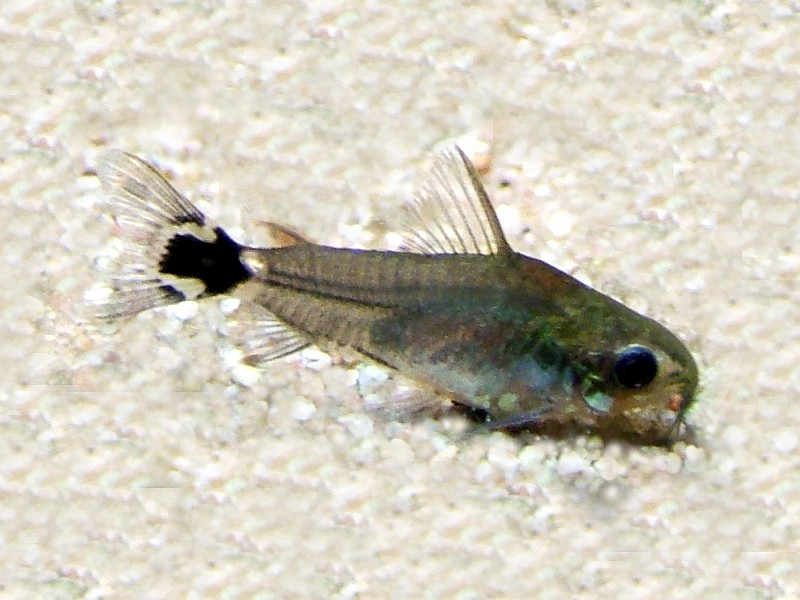
Most Corydoras hug the sand. Hastatus Pygmy Cory (Corydoras hastatus) spends a shocking amount of time in midwater, looking like a tiny, armoured tetra with a spear-spot on the tail. If you set this fish up as a typical bronze-cory janitor crew, it fails in a way pandas never do: it starves in the open while you wait for it to “start sifting.”
The cory that schools like a characin
C. hastatus is a dwarf from the Paraguay–Paraná basin (Brazil, Paraguay, Bolivia), not from Negro blackwater and not from the western Amazon leopard country. Adults are about 2.5–3.5 cm. The body is translucent silver with a dark horizontal stripe and a conspicuous black caudal blotch — the “hasta,” the spear, that gives the species its name. A pale halo often rings that tail spot. The dorsal profile is slimmer than a chunky aeneus. In a planted tank the group hangs in open water, facing into a gentle current, then drops to the sand to pick at food. That dual use of the column is the behaviour you are buying.
It is not Corydoras pygmaeus (Amazon pygmy, more even stripe, different range) and not C. habrosus (salt-and-pepper dwarf with a different pattern). Mixed “pygmy cory” bags are a tax on people who only measure centimetres.
Shallow floodplain water
Hastatus comes from weedy, often seasonal shallows in the Paraguay system: sand, mud, plants, and warm water that can be clearer than Amazon tea. pH is frequently near neutral. Hardness is low to moderate. The fish lives in big aggregations because a 3 cm catfish in open water is lunch. Recreate plants and numbers, not a bare sand desert with one piece of wood.
Aquaria for a midwater dwarf
A 60 litre tank can work if it is planted and the group is large, but length still helps. Fine sand remains important — they do pick at the bed, and their barbels are real — yet the hardscape should leave swimming lanes in the lower-middle water. Hairgrass, small crypts, floating plants, and gentle flow mimic a vegetated ditch better than a pleco cave pile. Bright light without plant cover pushes them into corners. A lid is non-negotiable; tiny fish jump through tiny gaps.
Filtration should not blast them. Sponge filters are ideal for breeding tanks. In a community, baffle the output. Heater guards matter because a 3 cm fish can cook on an unguarded tube.
Counts that look like a shoal, not a sample
Eight is a bare minimum. Twelve to twenty is when hastatus starts to look like the wild animal. They school tightly when nervous and loosen up when confident. Two “pygmies” in a 200 litre show tank are decorations that die of loneliness and competition. Do not mix one hastatus with one pygmaeus and call it a dwarf group; they may shoal loosely, but you still owe each species a crowd, and you will not be able to name the fry.
Chemistry for Paraguay dwarfs
Temperature 22–26°C. pH 6.0–7.5. Soft to moderately hard. They are less addicted to tannins than Adolfoi. They are more sensitive to being sucked into intakes and to being out-competed than larger corys. Cycle fully. Keep waste low; tiny gills sit in the same soup as everyone else. Water changes should not swing temperature wildly — pygmies feel a 4°C dump more than a 6 cm schwartzi does.

Micro-food, or they vanish while you watch
The mouth is small. The competition is every tetra you own. Use crushed pellets, fry powders that sink, baby brine shrimp, microworms, cyclops, and finely chopped frozen foods. Feed several times in small pinches if you can. Evening feeding helps. A full-size cory wafer is a joke they cannot finish before it fouls. Hastatus will pick the sand, but it will not survive on detritus myths.
Tank mates that do not inhale them
Ember tetras, small rasboras, other dwarfs, shrimp in mature tanks (adult shrimp may be okay; babies are food), and peaceful pencilfish. No angels, no gouramis that hunt fry-sized fish, no large corys that will out-eat them in a small footprint, no “community barbs.” Adult hastatus is the size of a big meal for a betta with an attitude. Species-only planted tanks show the fish best.
Breeding a spear-spot pygmy
They spawn like corys, just in miniature: T-position, eggs on plants and glass, no parental care. Dense plants increase survival in a display. Dedicated breeding tanks with sponges and infusoria raise more fry. Females are rounder. A heavily planted Paraguay-style tank with a large group will surprise you with babies if the adults are well fed and you are not vacuuming every egg. Do not assume fry can eat the same granules as the parents.
Why pygmy tanks fail
Standard “cory care” copied from bronze fish: too few animals, too large tank-mates, food that never suspends or sinks at the right size, gravel, and a powerhead. Barbels still rot on sharp sand. Ich still kills. The extra failure mode is midwater starvation. If your hastatus only hide, add plants and numbers before you add medicine.
The point of hastatus
Keep Corydoras hastatus because you want a dwarf catfish that occupies the same visual space as a small tetra, with a spear-spot you can ID from across the room. Keep sand because they still have barbels. Keep a crowd because they still have enemies. Do not keep them as a substitute for pandas, Adolfoi, or otos. The Paraguay basin made a cory that swims. Honour that, or buy a different species.
Open water is not optional décor
Leave a lane. Hairgrass at the back, sand in front, a little flow so the spear-spots can hover like characins. If you fill the tank with caves “because catfish,” hastatus will hide and starve in a layout built for synos. They still need sand for the moments they drop to pick food, and they still shred barbels on gravel, but the species you bought is the one that schools in the lower-middle water with a black caudal blotch you can ID from the sofa. Count twelve fish. If you cannot afford twelve, buy a larger cory that looks like a group at six. A pair of hastatus is a sample vial, not a shoal.
Explore other topics
Dive into more aquarium guides across the site.