

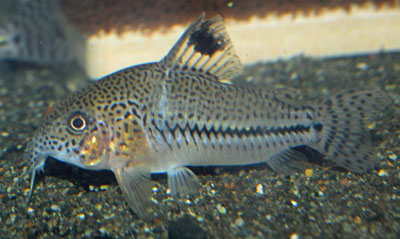
The trade name “leopard cory” gets pasted onto Corydoras julii, C. trilineatus, and whatever spotted catfish arrived in the same box. Leopard Corydoras (Corydoras leopardus) is the larger, longer-snouted animal with irregular leopard-like blotches, not the tiny three-line fish from the same general Amazon. If the fish in the photo has a short baby-face snout and neat rows of pin-dots, keep scrolling; that is probably not leopardus.
Print, snout, and the size shops forget
C. leopardus comes from western Amazon drainages spanning parts of Peru, Brazil, and Ecuador. Adults commonly reach 6–7 cm, sometimes a little more, which is enough extra bulk that a “cory tank” sized for pandas feels tight. The snout is longer than on julii. The spotting is coarser and more leopard than pepper: blotches and irregular patches rather than a textbook three-stripe. A dark mark often sits in the dorsal fin. The body is the typical armoured cory shape, just scaled up.
That extra length is not only vanity. A bigger cory eats more, needs a wider sand field, and loses fights with the same mid-sized cichlids that ignore a 4 cm panda. Buy the adult size, not the cute juvenile in the dealer tank.
Three names, three fish
C. julii is a Brazilian species with fine spotting and a relatively short snout; much of what is sold as julii is actually C. trilineatus, the three-lined cory from Peru and neighbouring waters. C. leopardus is the leopard: longer head, larger adult, messier big spots. Hybridisation in farm ponds muddies bags further. If you are writing a species list for a biotope, get a specialist ID. If you are stocking a community, still try not to mix all three and call them a “leopard group,” because they will not school as one species and the fry will be a mess.
Western Amazon sand, not a pebble beach
In nature leopardus works sandy and silty shallows, often with wood and seasonal flooding. Water is warm and typically soft to moderately soft. It is still a sifting catfish: the barbels and the long snout go into the bed. Gravel that would merely annoy a bronze cory will wreck a leopardus snout because this fish leans into the substrate with more face.
They gulp air at the surface like other callichthyids. That is normal. Constant hanging at the surface is not; that is oxygen, gill, or water-quality trouble.
Give the leopard a paddock
Think in length. A 100–120 cm aquarium is a sensible home for a group of six to ten leopardus plus peaceful midwater fish. Fine sand, open foreground, wood in the back, maybe some leaf litter if you like the look. Plants are optional; Amazon swords and crypts work if the light and tabs are there. Strong flow is unnecessary. A lid is necessary. Large corys still jump.
Because they are bigger, they kick more sand into filters. Prefilter sponges save you from weekly impeller archaeology.
Water for a western Amazon leopard
Temperature 22–27°C. pH 6.0–7.5. Soft to moderate hardness. They are less fussy than Negro blackwater specialists and more demanding of space than schwartzi. Cycle the tank. Keep ammonia at zero. Do not park them at 30°C because a discus article said corys “love heat.” Leopardus will live with discus if the water is clean and the discus do not out-compete them, but heat plus waste is how barbels cook.

A troop of leopards, not a single spot
They are social. A lone leopardus is a stressed, hiding, oversized “cleaner.” Six of the same species is the start. They forage as a pack, which is when the leopard print actually reads as a pattern instead of a random spotted fish under a log. Mixed spotted corys in ones and twos look busy to the owner and lonely to the fish.
Feeding a heavier catfish
More body means more calories. Sinking cory foods, frozen bloodworm, chopped earthworm for adults, brine shrimp, and the occasional vegetable matter. Feed enough that the sand party gets a share after the tetras have had their circus. A wafer in the corner is not a diet. Watch bellies from above: concave is hungry, massively swollen and listing may be female-with-eggs or a constipation/bloat problem — those two are not the same treatment.
Who can live over a leopard
Peaceful tetras, smaller gouramis, rams, and other corys in proper groups. Avoid large predatory catfish, aggressive cichlids, and fin-nipping barbs. Angels sometimes work in big tanks and sometimes pick on the floor. Loaches that also want sand can be neighbours or rivals depending on species and space. Do not keep leopardus with anything that swallows 7 cm fish.
Breeding the long-nosed leopard
Same T-position ritual as smaller corys, but eggs and adults are larger. Condition well. Cooler, larger water changes can trigger spawning. Remove eggs if you want fry. Because leopardus is less commonly farmed than aeneus, hobbyist spawns matter. Do not cross it with trilineatus to “get more spots.” You get unidentifiable spotted fish and a less honest hobby.
Snout damage is the species-specific injury
On short-snouted corys, barbels fail first. On leopardus, watch the snout and the barbels together. Pitting, redness, and reluctance to dig mean the bed is wrong. Ich still happens. So does columnaris in dirty, warm water. Quarantine new leopards; they are often wild or pond-raised and arrive thin. Feed them until the belly rounds before you congratulate yourself on the pattern.
Buy the name, keep the animal
Corydoras leopardus is worth the tank space if you like a bigger spotted cory and you will not confuse it with julii on a price tag. It needs a wider sand field, a real group, and food that matches its size. The leopard print is the look. The long snout is the ID. The Amazon floor is the habitat. Everything else is a smaller cory’s article.
When you net a leopardus, the extra snout length is obvious in the hand. That is the moment to stop calling it julii. Buy the group that matches that snout, then give them a paddock of sand wide enough for 7 cm catfish to turn around without a meeting.
Explore other topics
Dive into more aquarium guides across the site.